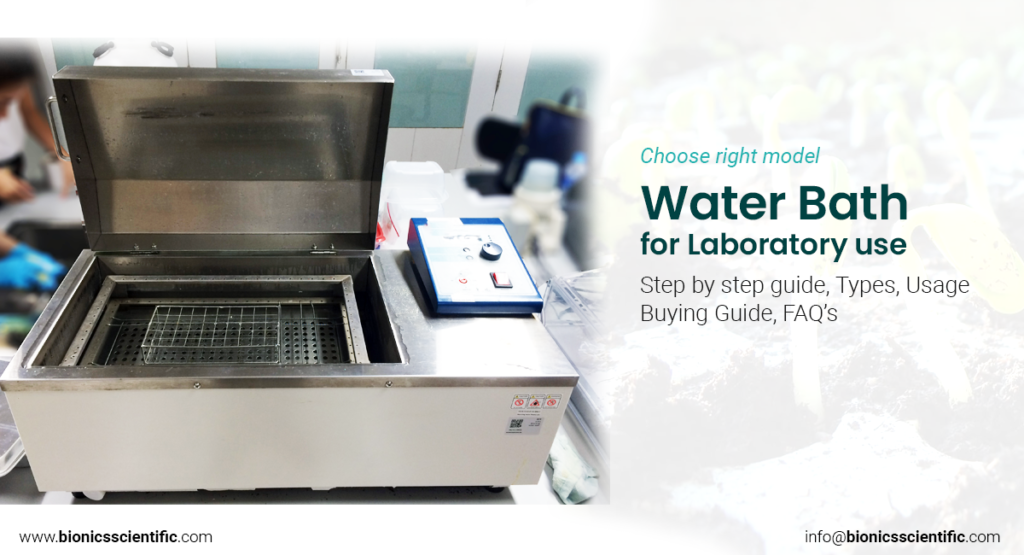
With delicate samples like enzymes or reagents, even minor temperature swings can impact results or spoil the experiment.The quality of your results relies on stability and precision. This is where a high quality laboratory water bath becomes one of the most essential pieces of equipment in your lab which provides superior temperature uniformity compared to standard dry ovens.
If a person is in the research phase of buying a new water bath then a clear and reliable guide can help in comparing features and specifications before making decision. This comprehensive guide walks you through the key features, types and important safety factors to help in choosing the ideal water bath for your specific needs.
Searching for a reliable laboratory water bath that is both ISO 9001 and CE certified?
Bionics Scientific Laboratory Water Baths deliver reliable, uniform, and consistent heating for all your critical lab procedures. Choose our certified range for guaranteed performance and temperature stability. Contact our experts at info@bionicsscientific.com or call +91 9111161955 | 9376651333.

What Is a Laboratory Water Bath and Why Do You Need One?
A water bath is a lab tool that uses water or sometimes oil to keep a steady and controlled temperature for incubating samples over time. They are essential in clinical, pharmaceutical and academic labs.
Core Applications:
- Sample Incubation: Keeping cell cultures or bacterial growth at the ideal temperature which is usually around 37°C.
- Thawing Frozen Samples: Gently and consistently bringing cryo preserved samples back to life.
- Warming Reagents: Ensuring reaction components are at the correct starting temperature.
- Microbiological Applications: Used extensively for bacteriological research and examinations.
Deep Dive: How Your Water Bath Works and its Mechanism
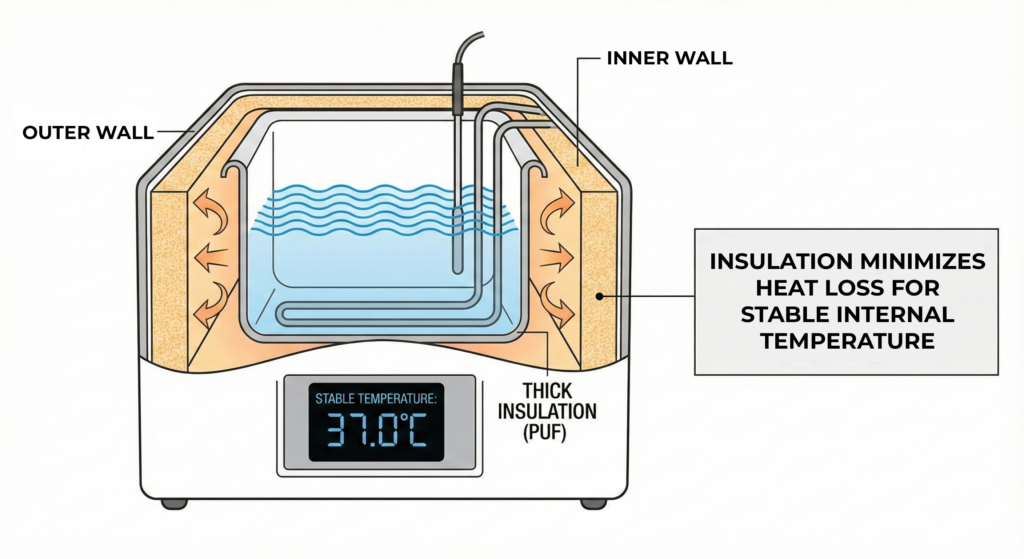
The mechanism is straightforward: a heating element which warms the water and a sensor monitors the temperature. However, the precision of a digital water bath comes down to the quality of its controller.
The Role of the PID Controller
Many high quality laboratory water bath systems, including those from Bionics Scientific, use an advanced PID (Proportional Integral Derivative) controller.
- What it is : A smart feedback system that measures the difference between the set temperature and the actual temperature and constantly adjusts the heating element to keep it as accurate as possible.
- Why it matters : Unlike basic thermostats that only switch the heater on or off which leads to temperature swings, a PID controller anticipates and corrects temperature changes. This provides exceptional temperature stability for example, plus or minus 0.01°C in some Bionics Scientific circulating models and temperature uniformity. This technical superiority is crucial for research where precision is non negotiable.
Choosing Your Model: Types of Water Baths
The type of water bath you need depends entirely on your specific laboratory application.
| Type of Water Bath | Ideal For | Key Feature/Benefit | Bionics Scientific Examples |
|---|---|---|---|
| General Purpose / Unstirred | Standard lab work, routine incubation, general heating applications. | Relies on natural convection; simple and cost effective. | Unstirred Heated Water Bath |
| Circulating Water Bath | High uniformity requirements (e.g., enzyme reactions, serology, viscosity tests). | Uses a pump or magnetic stirrer to actively circulate water that ensures maximum temperature uniformity and stability for example, plus or minus 0.01°C | Refrigerated cum Heated Circulators |
| Shaking Water Bath | Cell culture, aeration, hybridization, tissue culture and solubility studies. | Includes a shaking platform to agitate samples while maintaining temperature. | Reciprocating Water Bath Shaker |
| Serological Water Bath | Clinical labs, warming blood samples, reagents and culture media. | Designed specifically for bacteriological work with high precision. | Serological Water Bath (Specific design) |
Note: Bionics Scientific offers various models including Ultrasonic Water Baths (for cleaning and degassing) and specialized models like the Rectangular Water Bath for general boiling applications.
Practical Buying Guide: 4 Key Features to Look For
To make the best choice then focus on these critical specifications which separate a standard unit from a truly reliable Best Laboratory Water Bath.
1. Temperature Range and Accuracy
- Range: Most standard hot water baths work at temperatures starting from ambient room temperature plus 5°C and all the way up to 100°C which is boiling point. Refrigerated models are available for applications that need lower temperatures which go below ambient such as down to -5°C or even colder.
- Accuracy and Stability: Look closely at the specifications for details on stability which means how consistent the temperature stays. You want to see values like plus or minus 0.1°C or even better. This high level of precision is usually achieved by using a circulating system combined with an advanced PID controller.
2. Chamber Material : Why Stainless Steel SS 304 is Non Negotiable
The inner chamber or tank must be durable and resistant to corrosion.
- Recommendation: Always go for a unit with an inner chamber made of Stainless Steel SS 304 grade or higher.
- Benefit : SS 304 is highly chemical resistant and easy to clean plus preventing rust and degradation caused by water or common lab reagents.
3. Capacity and Design
- Capacity : Choose a unit based on workflow that typically ranges from small 2L or 5L benchtop units to larger 20L or 30L floor models.
- Lid : A gabled lid is recommended as it directs condensation away from samples, preventing contamination and minimizing evaporation.
- Drain Valve : A drain plug or valve simplifies maintenance and water replacement.
4. Critical Safety Features
Safety protects both lab personnel and your valuable samples.
- Over Temperature Protection: Automatically cuts off the heater if the water temperature exceeds a safe limit.
- Dry Run Protection or Low Water Level Alarm: This is vital. If the water level drops too low due to evaporation or a leak then the heater will automatically shut off to prevent damage to the heating element or dry running and potential fire hazards.
Common Mistakes to Avoid : Water Bath Maintenance
Even the Best Laboratory Water Bath needs proper care to perform with accuracy over its long lifespan. Avoid these common mistakes:
- Using Tap Water: Never use tap water. The minerals in tap water cause rapid scale/mineral buildup on the heating element and the stainless steel chamber which leads to corrosion and poor performance. Always use distilled water.
- Ignoring Water Level: The heating element must remain fully submerged. Always check the water level before use, especially in general purpose models without a low level alarm.
- Overloading the Bath: Excessive use of racks or too many large containers can restrict water circulation that leads to poor temperature uniformity and unstable results.
Proof and Trust Signals
Pick a supplier with a strong track record of quality and expertise to get a reliable and long lasting product.Bionics Scientific equipment is engineered for durable construction, used in reputable research centers and is supplied with essential safety and performance features like PID controllers and low level cut offs. As an ISO certified equipment manufacturer, Bionics Scientific adheres to strict calibration standards, providing a reliable foundation for your critical research.
People Also Ask
Q1: What makes a water bath different from an incubator?
A: A traditional incubator uses air or sometimes CO₂ to maintain a steady temperature for growing cells or cultures whereas a water bath uses water to transfer heat, giving much better temperature uniformity and stability for samples that can be placed directly in the water.
Q2: What type of water should be used in a laboratory water bath?
A: Always use distilled water in a water bath. Tap or deionized water contains minerals that can cause scaling, corrosion and damage the heating element over time.
Q3: How to clean and maintain a water bath?
A: It is a good idea to drain and refill the water bath every week. Clean the stainless steel chamber with a mild, non corrosive detergent and use regular descaling solutions to keep mineral buildup at bay.
Q4: What is the role of the PID controller in a digital water bath?
A: The PID controller which stands for Proportional Integral Derivative uses an algorithm to constantly adjust the power to the heating element. This continuous, intelligent correction minimizes temperature fluctuations plus gives you much higher temperature stability and accuracy compared to a basic thermostat.
Q5: What is a circulating water bath used for?
A: A circulating water bath is used for applications requiring extremely high temperature uniformity such as enzyme reactions, serological work and high precision temperature calibration. The circulation pump makes sure the heat is distributed evenly throughout the entire water volume.
Q6: What does dry run protection mean?
A: This feature shuts off the heater if the water runs low, preventing damage and ensuring safety in the lab.
Q7: Is it possible to use a water bath at temperatures below room temperature?
A: Yes but you need a specialized refrigerated water bath or refrigerated circulator. These units include a cooling element refrigeration as well as a heater to precisely control temperatures below room temperature.
Q8: Why to choose a Stainless Steel SS 304 inner chamber?
A: Made from SS 304 the water bath chamber resists corrosion from water and everyday lab chemicals which makes sure it stays durable and reliable for years to come.
Q9: What is a serological water bath?
A: A serological water bath is a specialized type of hot water bath designed for serology, bacteriological examinations and warming biological media. It often features a hinged lid and precision temperature control.
Q10: How important is capacity when choosing a water bath?
A: The capacity of the water bath which is measured in liters basically tells how much you can fit inside at one time. Picking the right size for work, whether it is 5L, 10L or 20L, makes sure you are not overloading it and helps the bath keep a steady plus even temperature.
Conclusion
The difference between successful and inconsistent research often comes down to the quality of your equipment. When selecting a laboratory water bath, you must focus on three main points: Accuracy via PID control and stability, Material Quality (Stainless Steel 304) and Safety over temperature and dry run protection.
Do not compromise on your research results with low quality temperature control.Bionics Scientific creates high quality, customizable laboratory water baths that are built with precision and made to support the demanding needs of modern scientific work.
Explore the premium range of Laboratory Water Baths at Bionics Scientific.
Searching for a reliable laboratory water bath that is both ISO 9001 and CE certified?
Bionics Scientific Laboratory Water Baths deliver reliable, uniform, and consistent heating for all your critical lab procedures. Choose our certified range for guaranteed performance and temperature stability. Contact our experts at info@bionicsscientific.com or call +91 9111161955 | 9376651333.