
A Fume Hood Step inside any chemical lab, pharmacy, or research center, and you will find an apparatus that works discreetly but provides safety protection for everyone working inside the lab—a fume hood.
Every laboratory experiment uses chemicals that produce gases, fumes, or aerosols. Even though they might not always be visible to the naked eye, being exposed to these substances for a prolonged period of time may cause health hazards. That is why every lab worldwide makes use of a fume hood to provide a safe environment for work.
But purchasing a proper system requires consideration. Managers, procurement staff, and facility developers must make sure they know enough about performance capabilities of the selected system, chamber sizes, material suitability, installation requirements, and possible maintenance expenses before making their purchase decisions. Such questions as “Do we choose a ducted or ductless system?”, “What do we spend?”, and “Is this system appropriate for us?” arise frequently in the buying process.
If you decide to buy or renew your fume hood system, this article will definitely help.
What Is a Fume Hood?
The fume hood is a special ventilation device that is meant to contain and remove fumes, vapor, gas, and other particles generated in the laboratory process.
One can imagine this device as a barrier between a scientist and some hazardous agents. A chemical fume hood captures fumes and sends them into an exhaust system rather than letting them spread around the whole laboratory.
It doesn’t matter what a scientist works with—acids, solvents, or other substances—the presence of such a fume hood will ensure his/her safety.
That is why the lab fume hood is important equipment for research laboratories, pharmaceuticals, educational centers, and chemical factories.
How Does a Fume Hood Work?
Although modern systems may appear complex, the operating principle is relatively simple.
Air is continuously pulled into the front opening of the hood. The air movement thus creates a shield that prevents harmful fumes from escaping the laboratory.
During the course of the experiment, any fumes produced are captured by this air movement and taken to the exhaust system.
- Depending on the design, the contaminated air can be either
- Disposed of in the outside environment via ducts
- Filtered and then recycled into the room
A good chemistry lab fume hood is dependent on effective airflow, correct hood design, maintenance, and user conduct.
The Importance of ASHRAE 110 Testing
ASHRAE 110 test is among the most universally recognized tests in assessing the performance of laboratory hoods. The test focuses on containment effectiveness as it measures the degree to which the hood prevents the escape of contamination into the breathing zone.
In the testing process, the test releases the tracer gas in the hood while the level of leakage near the sash is measured. The lower the leakages, the higher the containment effectiveness.
ASHRAE 110 test results have become very relevant in purchases of hoods in laboratories dealing with hazardous materials.
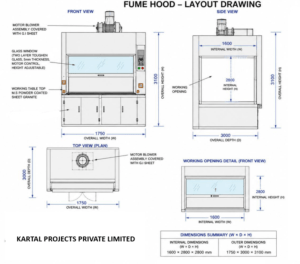
Interpreting the Fume Hood Diagram
When purchasing equipment, most consumers look at size and cost but neglect the aspect of design. The essential design of a fume hood will show how multiple parts function to provide safety for the operator.
Understanding Airflows and Pressure Areas
A fume hood works based on the principles of negative pressure. The air comes through the opening of the sash and flows toward the rear baffles for exhaust through the ductwork.
The flow of air can be described as follows:
- Operator Area (front area)
- Work Area (work area)
- Baffle Area (rear airflow area)
- Exhaust Area (air exhaust area)
This flow is very critical in controlling any hazardous air from getting out to the lab surroundings.
| Part | Function |
| Sash
Airfoil |
Barrier between the operator and the process
Ensures smooth airflow |
| Work Surface | Area where experiments take place |
| Baffles | Airflow distributors |
| Exhaust Duct | Filters out contaminated air |
| Fan System | Ensures negative pressure |
| Lighting | Improves visibility |
| Control Panel | Controls the process |
| Fume Hood Chamber | Primary containment unit |
The fume hood in the laboratory setting is particularly significant since it affects efficiency, compatibility, and longevity.
Classification of Fume Hoods
Fume hoods come in various types depending on the type of chemicals being dealt with, arrangement of the laboratory, and other factors that include containment. It is important to know the options available for a proper match of equipment.
Ducted Fume Hood
This type of fume hood extracts the polluted air from the laboratory using an exhaust system located externally. Polluted air is then channeled via ducting and released into the atmosphere outside the building.
As there is physical removal of contaminating substances from the laboratory air, this system is mostly favored by drug manufacturers, research organizations, and industries that process hazardous substances.
Ductless Fume Hood
In this fume hood, pollutants are first trapped using filtering technology, after which the purified air is circulated back to the laboratory.
The choice of this equipment is normally when external ducting is impossible or where minimal amounts of chemicals are processed. Filters need careful selection to ensure their effectiveness.
fume hood performance.
Specialized Fume Hoods
There are certain applications in the laboratory that demand specialized fume hoods because of their particular process and the type of hazard they pose.
Perchloric Acid Fume Hood
The wash-down system incorporated in perchloric acid hoods aids in preventing any explosive deposits of perchlorates from building up in the hood ducts.
Radioisotope Fume Hood
This type of fume hood is designed for laboratory operations handling radioisotopes and provides better containment and decontamination options.
Acid Digestion Fume Hood
This is a typical fume hood found in analytical or environmental laboratories that involve use of acid digestion techniques in sample preparation.
Walk-in Fume Hood
Walk-in fume hoods are containment units that are bigger in size than regular fume hoods to accommodate large equipment or industrial process operations that cannot fit in regular fume hoods.
Ducted vs Ductless Fume Hood Comparison
Chemical Compatibility Concerns for Ductless Enclosures
All chemicals are incompatible with ductless enclosures.
While choosing an enclosure, labs must ensure:
- Compatibility of filters with solvents
- Acid fumes control ability
- Activated carbon filters’ absorption capability
- Filter breakthrough time
- Chemical loading
Incorrect filters’ choice could result in poor containment and frequent maintenance.
| Feature | Ducted Fume Hood | Ductless Fume Hood |
| Initial Cost | Higher | Lower |
| Installation | More Complex | Easier |
| Chemical Capacity | High | Moderate |
| Energy Consumption | Higher | Lower |
| Maintenance | Exhaust System | Filter Replacement |
| Safety Level | Excellent | Application Dependent |
| Best Use | Research & Industry | Education & QC Labs |
Technical Specifications Buyers Need to Consider When Comparing
Although price considerations cannot be ignored, buyers working in laboratory procurement generally consider technical specifications that are more easily measured before deciding.
| Technical Specification | Ranging from |
| Face Velocity | 80–120 FPM |
| Airflow Volume | 800–2000 CMH |
| Material Used | SS304, Polypropylene, and Epoxy-Coated Steel |
| Sound Level | Under 65 dB |
| Lighting | System of LED Lighting |
| Voltage Required | 220–240V |
| Width of Chamber | 3 ft, 4 ft, 5 ft, and 6 ft |
A Real Buyer Scenario
A research laboratory recently approached Bionics Scientific while searching for a cost-effective containment solution. Initially, the team planned to install a ductless model because it required less infrastructure.
Nevertheless, after considering the chemicals used when performing routine tasks, it was apparent that the ducted system would be the most ideal option in the long run. Although there was increased expenditure on the part of the laboratory, better results were guaranteed.
This example demonstrates why application requirements should always take priority over upfront cost comparisons.
Applications of Laboratory Fume Hoods
A laboratory fume hood is used across a wide range of industries where hazardous substances are handled.
Educational Laboratories
Schools, colleges, and universities use fume hoods during chemistry practicals to create a safer learning environment for students and faculty.
Pharmaceutical Industry
The production process in the pharmaceutical industry makes use of volatile chemicals that need containment.
Research Facilities
Experimental work in laboratories entails the use of experimental chemicals and reactions producing harmful gases.
Environmental Testing Laboratories
Testing methods for air, water, and soil require reagents that require ventilation.
Chemical Manufacturing
Manufacturing plants require containment in the process of producing goods.
Comparison of Fume Hood and Biosafety Cabinet
Some people find it difficult to differentiate between a lab hood and a biosafety cabinet, as both serve the function of containment. But their purposes differ greatly.
| Characteristic | Fume Hood | Biosafety Cabinet |
| Purpose: Hazardous | Chemical Protection | Biological Safety |
| User Protection | Safeguards the User | Yes |
| Product Protection | Not Required | Required |
| Use with Chemical Vapors | Suitable for Use | Not Suitable for Use |
| Handling of Biological Samples | Not Suitable for use | Suitable for use |
If hazardous chemicals are your main concern, then the lab hood will be your best bet. If you are dealing with biological materials, then a biosafety cabinet may suit you.
Common Mistakes Buyers Make When Purchasing a Fume Hood
Many laboratories focus only on purchase price while comparing different models. However, experienced facility planners understand that airflow performance, chemical compatibility, maintenance requirements, and service support often have a greater impact on long-term value.
Some of the errors that are committed when installing fume hoods include:
- Choosing an unsuitable fume hood
- Not considering any expansion plans
- Choosing inappropriate chamber sizes
- Not considering airflow requirements
- Basing your decision on costs alone
- Not considering maintenance services
It is always important to plan your investment properly for you to make significant improvements through your purchase.
Price Factors Affecting Fume Hood Cost
One of the questions that buyers want to know is about the price of fume hoods.
This question will depend on many factors such as dimensions, construction materials used, airflow, etc.
For instance, the price of a polypropylene fume hood, which is made for handling highly corrosive chemical substances, can be higher than that of steel construction.
- Material of Construction
- Chamber Size
- Airflow Capacity
- Monitoring Systems
- Ducting Requirements
- Compliance Standards
| Type | Approximate Price Range |
| Educational Models | ₹80,000 – ₹1.5 Lakh |
| Standard Laboratory Fume Hood | ₹1.5 – ₹4 Lakh |
| Advanced Chemical Fume Hood | ₹4 – ₹10 Lakh+ |
| Customized Industrial Models | As Per Specification |
The most accurate way to determine pricing is through a detailed assessment of laboratory requirements.
Installation and Maintenance Considerations
Installation specifications will largely be determined by the selected system.
In terms of the installation of ducted systems, laboratories need to consider:
- Ducting and exhaust system
- Sizing of fan
- Integration of system with building ventilation system
- Electric connections
When it comes to ductless systems, filter inspections and changes will be part of the maintenance schedule.
Maintenance will include:
- Airflow check
- Calibration test
- Fan check
- Filter change (as required)
Annual performance testing
Case Study: Increasing Safety at a Pharmacy Laboratory
A research center dealing with drugs faced issues concerning solvent vapors while performing its routine formulation processes.
Following evaluation of various alternatives, the laboratory chose a customized laboratory hood by Bionics Scientific for its lab.
Post-installation, the center found that:
- Average face velocity maintained at 100 FPM
- Solvent vapor exposure reduced
- Maintenance downtime decreased
- Internal safety targets achieved
This case study proves that proper selection of equipment depends more on laboratory needs than initial cost.
Conclusion
Choice of Laboratory Hood Selection of laboratory hood involves several aspects of consideration including containment capability, airflow needs, material used for construction, and maintenance, among others. Knowledge about these aspects facilitates proper choice of lab equipment.
Frequently Asked Questions (FAQs)
1. For what purpose is a fume hood required?
The fume hood serves to protect workers in laboratories from dangerous vapors, fumes, and air pollutants.
2. What is the mechanism of action of the fume hood in the laboratory?
This task is done by controlled air flow.
3. How does a ducted and non-ducted fume hood differ from each other?
Ducted systems expel the air into the atmosphere, whereas the latter filters and recycles air.
4. Which substances can be applied to use in a chemical fume hood?
Acids, solvents, reagents, and other substances can be used safely in the laboratory hood.
5. What should the face velocity of a fume hood be?
In most labs, face velocity is set at 80-120 FPM.
6 Which period should be set for testing the fume hood?
Laboratories perform testing of hoods annually.
7. Which parameters determine fume hood cost?
These include size, material, airflow capacity, filtration technology, and customization options.
8. Why is a fume hood chamber significant?
It impacts the performance of airflow, containment efficiency, and interaction with chemicals.
9. In which industries are laboratory fume hoods used?
They include the pharmaceutical industry, education industry, research organizations, environmental testing labs, and chemical manufacturing units.
10. How should one select a fume hood for his laboratory?
Consider your chemicals, airflow needs, chamber size, and future expansion plans prior to purchasing.