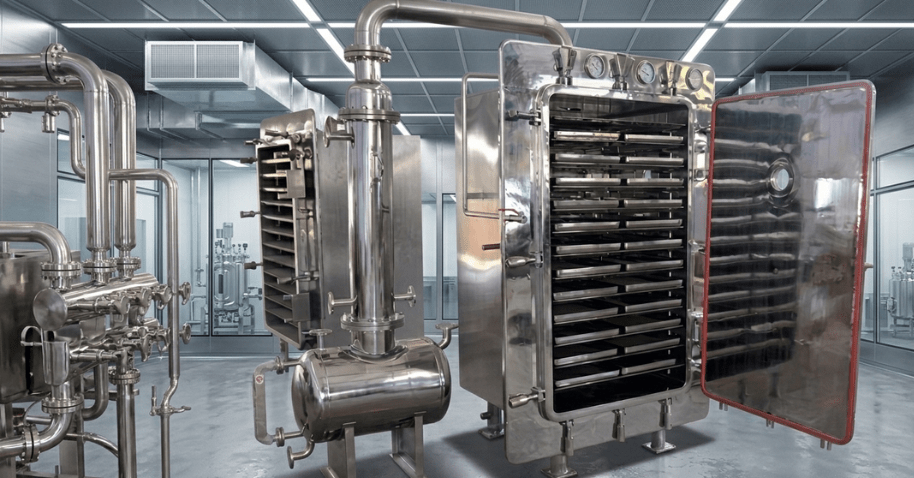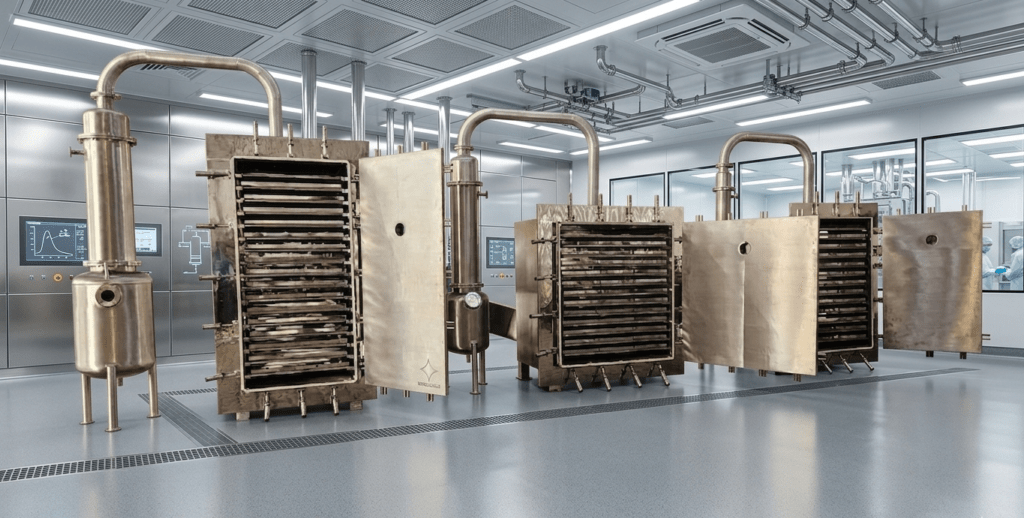
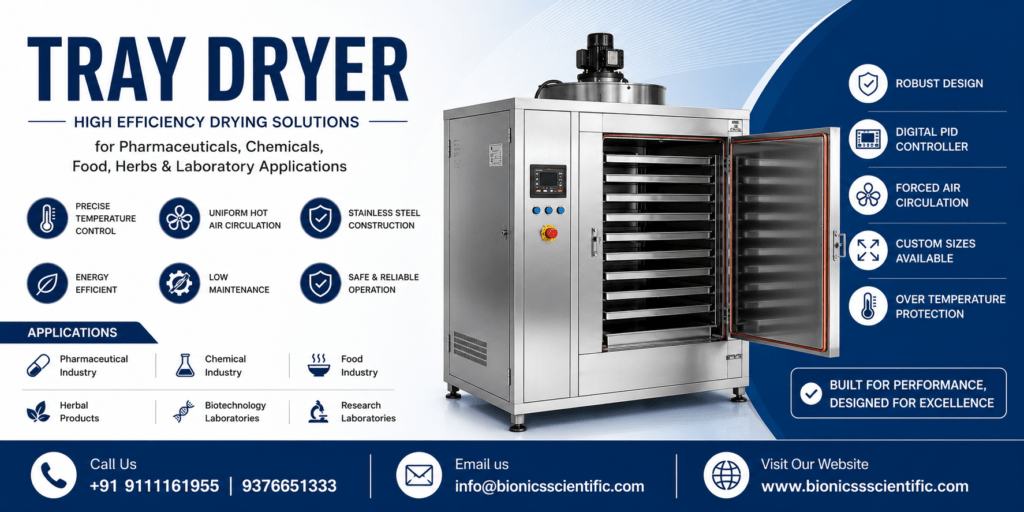
Tray Dryer is a hot air dryer which dehydrates drugs, chemicals, foods, herbal medicines and other laboratory samples. This is achieved by the process of circulating hot air around the samples contained in trays inside an insulated chamber where there is evaporative removal of moisture.
There are many kinds of tray dryers of different sizes for laboratory and industrial uses. Whereas the normal tray dryer can be used in conventional hot air drying, the vacuum tray dryer can be considered for some heat sensitive substances.
In this guide, you will learn about the theory, working, kinds, uses, advantages, specification, cost and selection of tray dryer.
Bionics Scientific is one of the reputed manufacturers of tray dryers in India. The company provides a high-efficiency drying system that ensures efficient temperature control and durable and energy-saving operation.
What is a Tray Dryer?
A tray dryer is an equipment that is operated through a hot air drying process and in which products are dried on stainless steel trays enclosed in an insulated chamber. Hot air is circulated in the chamber with the help of a blower and allows moisture to get evaporated.
| Feature | Details |
| Main purpose | Controlled moisture removal |
| Drying method | Forced hot-air circulation |
| Material placement | Stainless steel trays |
| Air movement | Motor-driven blower |
| Heating system | Electric heaters |
| Temperature control | Digital/PID controller |
| Common applications | Pharmaceutical, chemical, food, herbal and laboratory drying |
| Construction | Stainless steel |
| Special configuration | Vacuum tray dryer for suitable applications |
Principle of the drying system
The drying system works on the forced convection principle. The air is evenly circulated in the chamber by the blower and heated by electric heaters. Heat from the hot air is transferred to the substance, thus making moisture evaporate. Moist air is exhausted out of the chamber to facilitate effective and even drying.
How Does the Tray Dryer Machine Function?
The tray dryer machine works on a simple and effective mechanism:
- Loading of the material into stainless steel trays.
- Digital control is used to set the desired temperature.
- Heating the air with electric heaters.
- Even distribution of hot air across all trays by the blower.
Evaporation of moisture through the exhaust system until desired dryness is obtained.
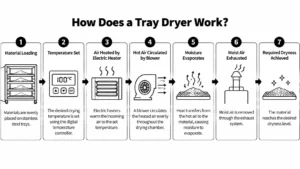
Diagram of Tray Dryer
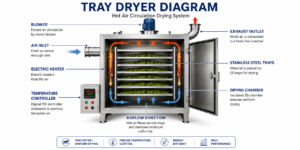
The diagram of the standard tray dryer consists of the following components: drying chamber, stainless steel trays, electric heater, blower, air inlet, exhaust outlet, temperature control, insulation, and airflow pattern. The knowledge about such components is necessary for optimization of the drying process.
Types of Tray Dryers
Standard Tray Dryer
This type of tray dryer can be used to dry powder, granules, chemicals, lab samples, spices, and foodstuffs.
Vacuum Tray Dryer
A vacuum tray dryer is designed to work at lower pressures. This allows drying heat-sensitive materials at lower temperatures. It is widely used in the pharmaceutical industry for drying herbal extracts, APIs, and specialty chemicals.
Industrial hot air dryer
It is used in the food industry, chemical and pharmaceutical production, and agriculture.
Applications of Tray Dryers
Pharmaceutical Industry
Used for drying suitable pharmaceutical powders, granules, herbal materials, and intermediates.
Chemical Industry
Used for controlled drying of various chemicals and processed materials.
Food & Spice Industry
Used for drying spices, food ingredients, and other suitable products.
Herbal Products
Used for drying herbs and plant-based materials under controlled conditions.
Biotechnology & Research
Used for laboratory sample preparation and other controlled drying applications.
Advantages of Tray Dryers
- Uniform hot-air circulation supports consistent drying.
- Controlled temperature allows suitable drying conditions to be maintained.
- Batch processing makes the equipment useful for laboratory and production applications.
- Stainless steel construction provides a durable and cleanable chamber.
- Flexible tray capacity allows different batch sizes.
- Lower routine maintenance can simplify regular operation.
- Customizable configurations can accommodate specific process requirements.
Technical Specifications
| Specification | Details |
| Product Name | hot air dryer |
| Capacity | 6, 12, 24, 48, 96 Trays (Custom Sizes Available) |
| Tray Material | SS304 / SS316 Stainless Steel |
| Chamber Material | Stainless Steel Construction |
| Temperature Range | Ambient 5°C to 250°C (Custom Available) |
| Temperature Controller | Digital PID Controller |
| Temperature Sensor | PT-100 Sensor |
| Heating System | Electric Air Heaters |
| Air Circulation | Forced Air Circulation with Motor Blower |
| Insulation | High-Density Mineral Wool |
| Power Supply | 220V / 415V, 50 Hz |
| Safety Features | Over Temperature Protection |
| Applications | Pharmaceutical, Chemical, Food Processing, Research Laboratories |
Note: Technical specifications can be customized according to customer requirements.
How to Select a Suitable Tray Drier
When buying a hot air dryer, you should take into account:
- Tray capacity
- Range of operating temperatures
- Chamber construction material (SS304/SS316)
- Air circulation ability
- Digital temperature controller
- Electricity consumption
- Safety measures
- Manufacturer assistance and guarantee
- When comparing hot air dryer manufacturers, consider construction quality, temperature-control accuracy, airflow performance, safety features, customization options, warranty, and after-sales support.
The cost of a tray drier varies with the tray capacity, type of construction material used, operating temperature range, heating system, level of automation, and customization. Rather than choosing equipment on the basis of cost, focus more on quality and efficiency to get better value for money.
Why is Bionics Scientific the Scientific Choice?
Bionics Scientific manufactures tray dryers and hot air dryers for laboratory and industry applications. Some of the options that may be incorporated into these include stainless steel, digital temperature control, forced air circulation, and safety systems.
This is because the features can be selected depending on the requirements of the application regarding capacity, temperature, material, and method of drying.
Bionics Scientific, due to its long experience in producing laboratory and scientific equipment, adheres to strict quality control practices in its manufacturing processes. All the laboratory dryer are tested in terms of temperature, airflow, safety, and functionality prior to shipment.
Certifications & Quality Compliance
| Standard | Cert. No. | Scope | Valid Until |
| ISO 9001:2015 (QMS) | 184876 | Lab, scientific & cleanroom equipment mfg. | 30-03-2029 |
| CE (MDD 93/42/EEC) | 184877 | Products as per annexure | 30-03-2029 |
| GMP | 184878 | Includes fume hood and a biosafety cabinet. | 30-03-2029 |
| NSF/ANSI 61 | 183884 | Bio-safety cabinet, lab & scientific equipment | 08-03-2027 |
Conclusion
Tray dryer offers precise hot air drying for a variety of pharmaceutical, chemical, food, herbal, and laboratory uses. Knowledge about the operating principle of tray dryer, its drying capacity, temperature requirements, air flow, and material suitability will assist in selecting the proper equipment for your process.
From a basic tray dryer, a vacuum tray dryer to an advanced hot air drying system, equipment selection based on the application needs can be helpful for you.
Tray Dryer Price in India
The price of a tray dryer depends on factors such as tray capacity, number of trays, material of construction, operating temperature, heating system, airflow design, automation level, safety features, and customization.
Laboratory-scale and industrial tray dryers can differ considerably in price because their capacity and configuration requirements are different. For an accurate quotation, consider the required capacity, temperature range, material, and drying application rather than comparing machines on price alone.
Request Quotation
Are you looking for a professional drying equipment for your lab or industrial needs? Bionics Scientific provides quality tray dryers with temperature-control features. Contact us now for your quotation.
Frequently Asked Questions (FAQs)
What is a tray dryer?
A tray dryer is a hot air drying system that dries off moisture from pharmaceuticals, chemicals, food products, herbs, and laboratory samples through circulation of heated air.
What is the tray dryer principle?
The tray dryer principle utilizes the principle of forced convection, whereby the heated air transfers heat to the material for evaporation of the moisture in order to dry it evenly.
What is the difference between a standard tray dryer and a vacuum tray dryer?
A standard tray dryer uses heated air at normal pressure, while a vacuum tray dryer operates under reduced pressure. Vacuum drying can be considered when suitable materials need to be dried at lower temperatures.
What is a vacuum hot air dryer?
A vacuum hot air dryer works under reduced pressure, making it ideal for drying heat-sensitive products at low temperatures without affecting product quality.
What are the applications of a drying machine?
drying machine have a wide range of applications, such as in the manufacture of pharmaceuticals, chemicals, foods, biotech, herbs, and laboratory research.
What is the temperature range of a laboratory tray dryer?
The temperature range varies by model and application. The specifications listed for this equipment range indicate operation from approximately 5°C to 250°C, with customized configurations available.
What are the parameters affecting the price of a tray dryer?
The parameters that affect the price of a tray dryer include capacity of the tray, material of the tray, heating mechanism, type of control, operating temperature, etc.
What are the reasons to buy a tray dryer from Bionics Scientific?
Buy tray dryers from Bionics Scientific because we manufacture drying equipment with sturdy construction, high accuracy in temperature regulation, energy saving, and good after-sales services.
How can one select the proper drying machine?
Select the correct drying machine based on its capacity, operating temperature, airflow, chamber material, energy saving, and application requirements.
What are the benefits of a tray dryer?
A tray dryer gives you uniform drying, quick processing, low maintenance, temperature accuracy, energy saving, and product consistency.
Does Bionics Scientific manufacture customized tray dryers?
Yes, Bionics Scientific manufactures customized tray dryers with different capacities and temperatures along with stainless steel chambers.