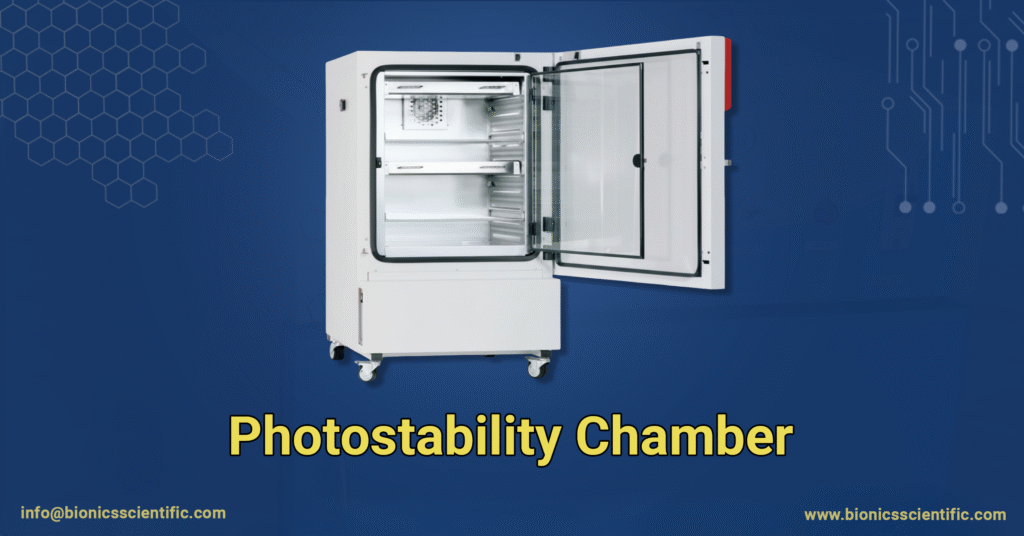
Photostability Test Chamber is an enclosed laboratory chamber designed to test the performance of various pharmaceutical, chemical, cosmetic products, or any light-sensitive material against UV and visible light. It enables the manufacturer to observe the alteration such as degradation, discoloration, or loss of potency due to exposure.
Quick Answer
Photostability test plays an important role in drug development as controlled exposure of light enables the generation of necessary data required for product stability analysis and regulatory review.
In this guide, you will be able to understand about photostability chamber, working of photostability chamber, ICH Q1B guidelines, uses of photostability chamber, benefits of photostability chamber, types of stability chamber, and selection of photostability chamber.
- Quick Answer
- What is a Photostability Chamber?
- Importance of Photostability Testing
- ICH Q1B Photostability Guidelines: Complete Overview and Requirements
- Stability Chambers in Pharmaceutical Applications
- How a Photostability Test Chamber Works
- Choosing the Right Stability Chamber Suppliers
- Applications of Photostability Chambers
- Photostability Test Chamber Video
- Advantages of Photostability Chambers
- Why Choose Bionics Scientific for Photostability Chambers?
- Frequently Asked Questions : FAQs
- Conclusion
Thats where photostability test chambers come into the picture because these specialized chambers are designed to affect light conditions both UV and visible to test how much life does a product have during storage or transport.These photostability test chambers are used widely in pharmaceutical stability testing, photostability chambers help companies meet strict standards like ICH Q1B that makes sure their products stay safe, effective and compliant from production to end use.
|
Feature |
Details |
|
Main purpose |
Evaluate product response to light exposure |
|
Light sources |
UV and visible-light sources |
|
Common applications |
Pharmaceutical, cosmetic, chemical and research testing |
|
Environmental control |
Temperature and, where applicable, humidity |
|
Key consideration |
Controlled and uniform light exposure |
|
Regulatory relevance |
Used in photostability studies following applicable guidelines |
|
Main benefit |
Helps identify light-induced changes in products |
This guide covers everything that a person needs to know about photostability chambers what they are, how they work, why they matter in pharmaceutical stability testing and how they help ensure regulatory compliance and product safety.
What is a Photostability Chamber?
A photostability chamber is a machine used to test how light exposure affects drugs and chemicals. It is critical to maintain product safety and to meet compliance with global quality standards. Photostability chamber is a special kind of device designed to test medicines, cosmetics and paints react when exposed to light. This basically done for knowing it reaction when they come into sunlight and ultraviolet radiation. It combines temperature and humidity control with specialized light sources like UV and fluorescent lamps to recreate real world conditions.
Basically, it for testing purpose for manufacturer of these products, before going into production they first test their products by creating the environment, it help them to know whether their products are losing color or loose effectiveness, or degrade when left out in the light for a while. just like how a book’s pages can turn yellow or a cream might lose potency on a sunny windowsill. We at Bionics Scientific understand the importance of this process so we manufacture photo stability chambers according to ICH Guidelines.
Is your pharmaceutical testing truly meeting ICH Q1B guidelines?
Get a free quote for your ideal Photostability Chamber today. Connect us today at +91 9111161955 | 9376651333 | info@bionicsscientific.com
Importance of Photostability Testing
Photostability testing plays a major role in product development and quality assurance:
- Ensures Product Safety: Helps make sure medicines and chemicals stay safe and effective for long term use.
- Compliance with Global Regulations: Keeps in line with ICH guidelines as well as FDA, EMA and GMP standards.
- Shelf Life Accuracy: Supports manufacturers in setting the right expiration dates so products last as long as they should.
- Market approvals: Regulatory authorities demand stability data before product launches.
Without these tests the products might degrade which leads to health risks and financial losses.

ICH Q1B Photostability Guidelines: Complete Overview and Requirements
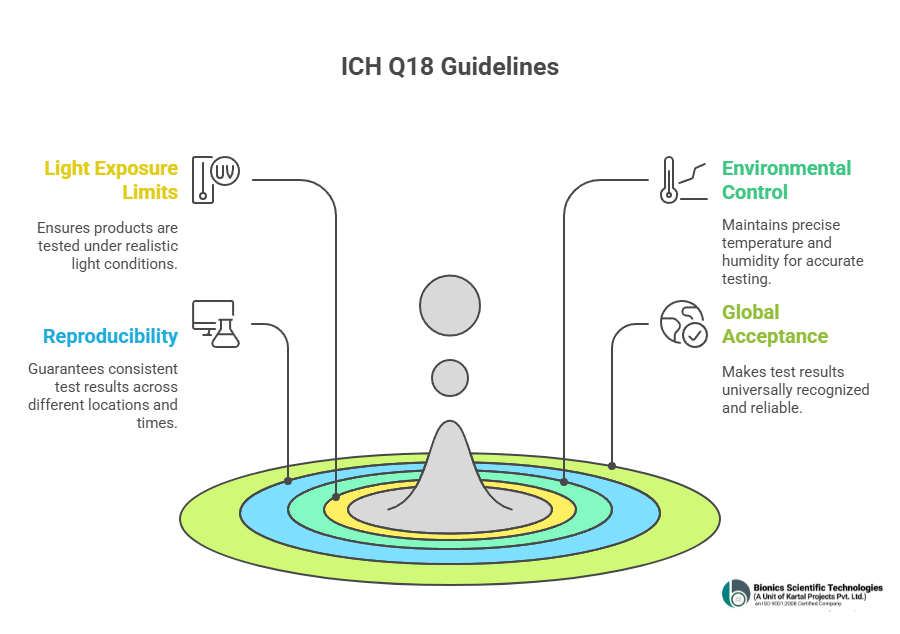
ICH Q1B provides guidance for evaluating the effects of light exposure on pharmaceutical products. Photostability studies use controlled light exposure to determine whether a product undergoes changes such as degradation, discoloration, or loss of potency.
Key considerations include:
- Controlled visible-light exposure
- Appropriate UV exposure
- Temperature control during testing
- Uniform exposure conditions
- Monitoring and documentation of test conditions
- Evaluation of changes in the tested product
By following these widely accepted guidelines the pharmaceutical companies can feel good knowing they are testing their products the right way, keeping things compliant and most importantly making sure the medicines people rely on stay safe and effective.
Stability Chambers in Pharmaceutical Applications
Besides photostability chambers there are several types of stability chambers in pharmaceutical testing are widely used:
- Humidity and temperature stability chambers : Test products under controlled moisture and heat conditions.
- Binder stability chambers : Reliable chambers often used in pharmaceuticals for precision testing.
- Benchtop stability chambers : Compact units designed for R and D labs with limited space.
- Stability cabinets : Large storage systems for bulk testing and long term stability studies.
Each chamber type supports product testing under different environmental conditions also ensuring durability and compliance.
Talk to our experts for a custom built stability test chamber
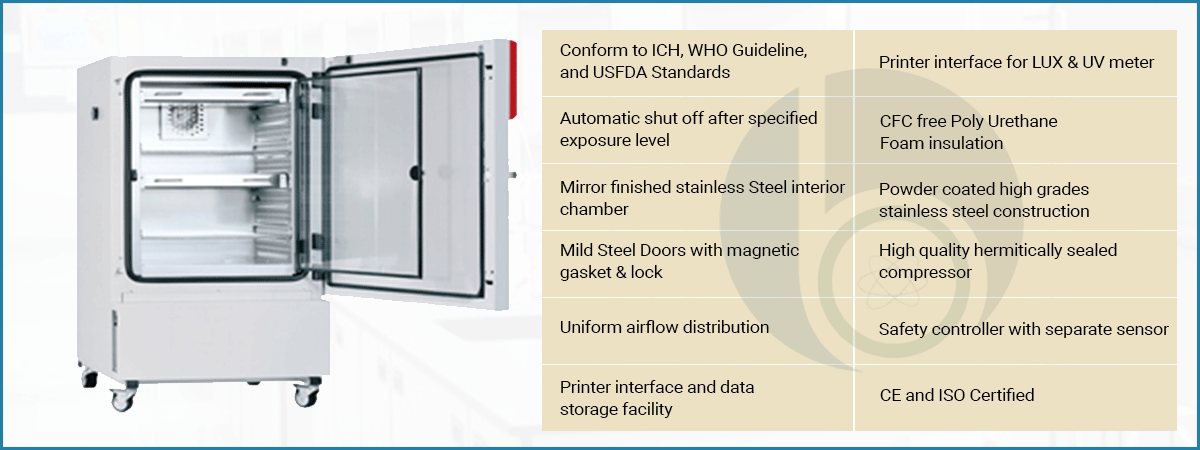
We design, build and install stability test chambers for pharmaceutical use (Drug and Medicine Tests). These Photostability chambers are specifically designed to perform near UV and visual light testing with fluorescent lamps per ICH Q1B Guidelines, Option 2. Designed matching with international standards ICH, WHO Guideline, and USFDA Standards Contact us for specs & pricing: +91 9111161955 | 9376651333 | info@bionicsscientific.com
How a Photostability Test Chamber Works
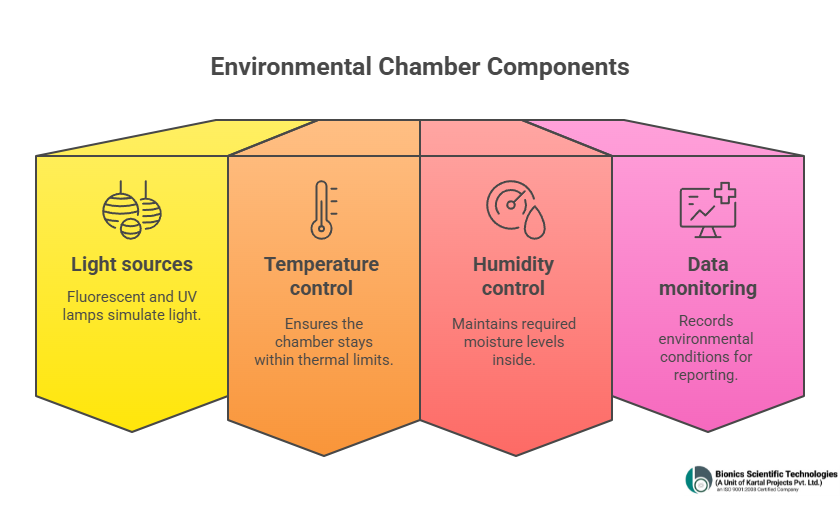
A photostability test chamber is engineered with advanced systems to replicate environmental exposure:
- Light sources : Fluorescent and UV lamps simulate both artificial and natural light.
- Temperature control : Ensures the chamber stays within precise thermal limits.
- Humidity control : Maintains required moisture levels.
- Data monitoring : Records environmental conditions for accurate reporting.
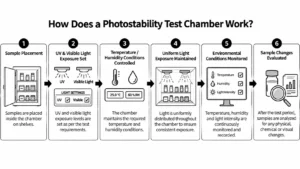
The precise control of stability chamber temperature and humidity ensures that test results are reliable and compliant with international guidelines.
Upgrade your stability testing with advanced Bionics chambers.
Get a world-class Photostability Test Chamber from Bionics Scientific, a leading Indian manufacturer. Contact Us for Specs & Pricing: +91 9111161955 | 9376651333 | info@bionicsscientific.com
Choosing the Right Stability Chamber Suppliers
Finding the right stability chamber suppliers is critical. Following points should be consider before purchase:
- Does the chamber comply with ICH guidelines for stability chambers?
- Is the equipment reliable and durable?
- Does the supplier provide after sales service and calibration?
- Can the chamber be customized according to size, capacity and features?
- Does the supplier have relevant experience in catering pharmaceutical and industrial clients?
Choosing reliable suppliers helps in making sure product testing is accurate and operations run smoothly. It is a simple step that supports long term success and peace of mind.
Applications of Photostability Chambers
Pharmaceutical Industry
Used to evaluate whether tablets, capsules, solutions, and other pharmaceutical products undergo changes after controlled light exposure.
Cosmetics
Used to assess changes in creams, skincare formulations, fragrances, and other light-sensitive products.
Chemical Industry
Used to investigate light-induced changes in chemicals and specialty formulations.
Food & Packaging Research
Can be used for suitable studies involving light sensitivity of food products, ingredients, and packaging materials.
Research & Development
Supports controlled photostability studies during formulation development and product evaluation.
This makes photostability chambers a must have for any industry where product quality and compliance are critical.
Photostability Test Chamber Video
Advantages of Photostability Chambers
- Controlled light exposure helps evaluate product response under defined conditions.
- Consistent environmental conditions support repeatable testing.
- Temperature monitoring and control help reduce unwanted environmental variation.
- Reduced manual intervention can improve testing workflow.
- Documented test conditions support reporting and quality-control processes.
- Useful across multiple industries, including pharmaceutical, cosmetic, chemical, and research applications.
This shift ensures compliance, saves time and supports innovation in pharmaceuticals and cosmetics.
Facing inconsistent results in your drug stability tests?
Get a world class Photostability Test Chamber from Bionics Scientific, a leading Indian laboratory products manufacturer. Contact Us for Specs & Pricing: +91 9111161955 | 9376651333 | info@bionicsscientific.com
Why Choose Bionics Scientific for Photostability Chambers?
Then explain:
- Manufacturing capability
- Customization
- Technical support
- Installation
- Calibration/validation support
- After-sales service
Certifications & Quality Compliance
|
Standard |
Cert. No. |
Scope |
Valid Until |
|
ISO 9001:2015 (QMS) |
184876 |
Lab, scientific & cleanroom equipment mfg. |
30-03-2029 |
|
CE (MDD 93/42/EEC) |
184877 |
Products as per annexure |
30-03-2029 |
|
GMP |
184878 |
Includes fume hood and a biosafety cabinet. |
30-03-2029 |
|
NSF/ANSI 61 |
183884 |
Bio-safety cabinet, lab & scientific equipment |
08-03-2027 |
Frequently Asked Questions : FAQs
What is a photostability chamber and why is it important in pharmaceuticals?
How does ICH Q1B apply to photostability testing?
ICH Q1B provides guidance for evaluating the effects of light exposure on pharmaceutical products. The study uses specified visible and UV exposure conditions, along with appropriate monitoring and controls, to evaluate whether the product undergoes unacceptable changes.
How does a stability chamber control temperature and humidity?
What is the difference between photostability and ICH photostability testing?
Can stability chambers be used in industries other than the pharmaceutical industry?
What types of stability chambers are available?
How do I choose reliable stability chamber suppliers?
What is the role of a photostability test chamber in regulatory compliance?
Are benchtop stability chambers effective for research labs?
Yes. Benchtop stability chambers can be useful for R&D laboratories with limited space or smaller sample volumes. Their suitability depends on the required temperature, humidity, capacity, and testing conditions.
Why are stability cabinets preferred for bulk testing?
What is the purpose of a photo stability chambers ?
What does 1.2 million lux hours mean in photostability testing?
Lux hours describe the cumulative visible-light exposure received by a sample during a photostability study. 1.2 million lux hours is a commonly referenced exposure level under ICH Q1B for confirmatory photostability testing, subject to the applicable study conditions and guideline requirements.
Conclusion
A photostability chamber is more than just a testing device but it is a safeguard for quality, compliance and safety. By following ICH Q1B guidelines and using reliable stability chamber suppliers the industries can ensure their products remain effective and safe worldwide.