Quick Answer
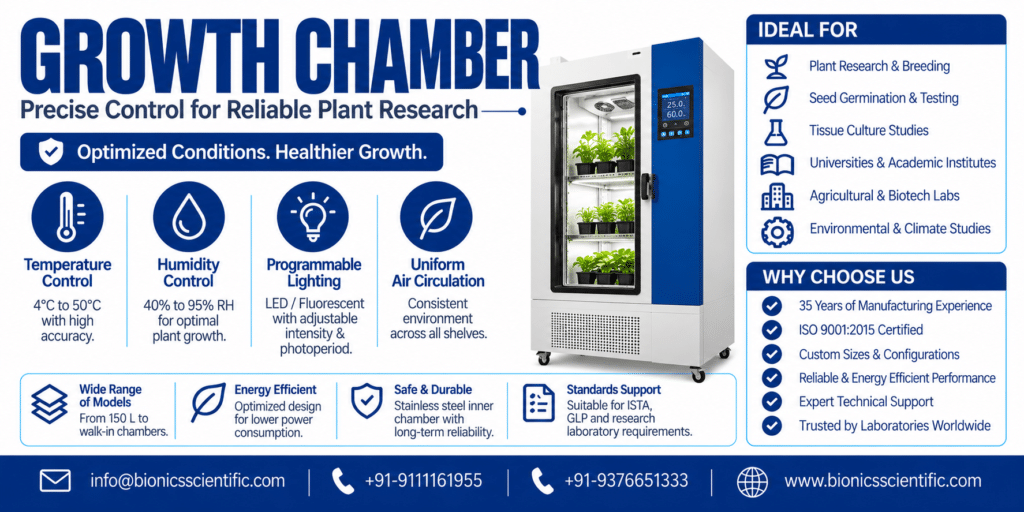
A growth chamber is an insulated cabinet that holds temperature, humidity, light, and often CO₂ steady, so plants, seeds, algae, or microbes grow under repeatable conditions. A plant growth chamber is the same unit tuned for crops, with programmable photoperiods and LED or fluorescent lighting, and a typical model runs from 4°C to 50°C, 40% to 95% RH, and up to 30,000 lux. A grit chamber and a screen chamber in a sewage treatment plant are different.
they are large civil structures that remove sand and debris from wastewater, though many wastewater labs use a growth chamber to test treated water on plants. Bionics Scientific has manufactured growth chambers for 35 years, and this guide covers specifications, a crop-wise temperature chart, and a 15-point buyer checklist.
What Is a Growth Chamber?
A growth chamber is a sealed, insulated cabinet with a refrigeration and heating system, a humidifier, and a lighting bank, all driven by one controller. You set a recipe, for example, 14 hours of light at 26°C and 10 hours of dark at 18°C, and the chamber repeats it every day without drift.
Researchers need this because a greenhouse follows the weather, and a growth chamber does not. When a seed-germination result changes, you know the cause was your treatment, not a cloudy week.
Common uses include seed germination, tissue culture hardening, insect rearing, plant pathology, stability studies, and algae or microbial culture.
Growth Chamber vs. Plant Growth Chamber
People use the two terms interchangeably, but buyers should look at what the chamber is built for.
A general growth chamber may serve insects, fungi, or materials. A plant growth chamber adds features crops need: tall internal height, adjustable shelves, a light spectrum matched to photosynthesis, and a day/night temperature split. If your work is mostly wheat, rice, tomato, or Arabidopsis, ask for a plant-specific model.
Grit Chamber and Screen Chamber in a Sewage Treatment Plant: Not the Same Thing
Many buyers searching these phrases land on lab equipment pages by mistake, so here is the difference.
- Screen chamber: the first stage at a sewage plant. Bar screens catch rags, plastics, and large debris before they damage pumps.
- Grit chamber: the next stage. Flow slows so sand, gravel, and heavy particles settle out and do not wear down downstream equipment.
Both are concrete or steel structures designed by civil and environmental engineers. Bionics Scientific does not build them. What we do supply is the laboratory side of wastewater work. Treatment plant labs in Saudi Arabia, South Africa, Malaysia, and elsewhere use growth chambers to test treated effluent on test plants, run algae-based polishing trials, and check phytotoxicity before water is reused for irrigation.
15 Things Buyers Check Before Ordering a Growth Chamber
- Temperature range and accuracy. Look for a stated uniformity figure, not only a range.
- Humidity control. Many units cannot hold high RH at high temperatures, so ask for the combined operating envelope.
- Light source. LED gives lower heat and a tunable spectrum.
- Light intensity at shelf level. Ask for readings at plant height, not at the lamp.
- Photoperiod programming. You need multi-step day/night cycles.
- Usable volume. Plant height decides the model more than floor area.
- Refrigeration. Check the compressor brand and whether it copes with a hot ambient room.
- Power supply. Confirm 220-240 V or 110 V by country and single or three-phase.
- Controller and data logging. USB or network export helps audits.
- Alarms. Over-temperature cut-off protects months of work.
- Build material. The stainless steel interior resists humidity and cleaning chemicals.
- Water supply. Know if the humidifier needs a connection or a refill tank.
- Validation support. IQ/OQ documents are relevant for regulated labs.
- Service reach. Ask who installs and repairs in your city.
- Warranty and spare parts. Check lead time for sensors and lamps.
Growth Chamber Specification Table
Indicative figures for a standard walk-in-free cabinet model. Final values depend on the model and customization, so confirm with our team.
| Parameter | Specification |
| Temperature range (light on) | 10 °C to 50 °C |
| Temperature range (light off) | 4 °C to 45 °C |
| Temperature uniformity | ± 0.5 °C to ± 1 °C |
| Humidity range | 40% to 95% RH (within 15 °C to 40 °C) |
| Light intensity | Up to 30,000 lux, adjustable in steps |
| Light source | Full-spectrum LED or cool-white fluorescent |
| Photoperiod | Programmable, multi-segment |
| Capacity | 250 L to 1,500 L (custom sizes on request) |
| Interior | SS 304 stainless steel |
| Controller | Microprocessor with touchscreen and data export |
| Safety | Over-temperature cut-off, door alarm, sensor-fault alarm |
| Power | 220-240 V, 50/60 Hz (110 V on request) |
Temperature Chart: Where Common Crops Grow Best
| Application | Day (°C) | Night (°C) | Suggested RH |
| Wheat seedlings | 20-22 | 14-16 | 60-70% |
| Rice germination | 28-30 | 24-26 | 75-85% |
| Tomato | 24-26 | 16-18 | 65-75% |
| Arabidopsis | 22 | 18 | 60-70% |
| Lettuce | 18-20 | 12-14 | 65-75% |
| Seed storage trial | 4-10 | 4-10 | 40-50% |
| Algae culture | 24-28 | 22-25 | n/a |
Quick visual of the daytime ranges:
Where Bionics Scientific Ships Growth Chambers
We supply research institutes, universities, agricultural labs, and water-quality labs across the United States, United Kingdom, the UAE, Saudi Arabia, South Africa, Canada, Australia, Singapore, Malaysia, Philippines, Indonesia, Kenya, Nigeria, Bangladesh, Nepal, Qatar, Oman, Kuwait, Bahrain, Vietnam, Thailand, Tanzania, Ghana, Sri Lanka, and New Zealand, and across India.
Each region has its own trouble. Gulf Labs needs compressors rated for 45°C ambient rooms. Tropical sites such as Indonesia, Vietnam, and the Philippines need strong dehumidification. Power fluctuations in parts of Africa and South Asia call for voltage stabilizers, which we can pair with the chamber.
Why Bionics Scientific
Bionics Scientific has manufactured laboratory equipment for 35 years. That history shows in small decisions: sensors placed where air actually circulates, door gaskets that last, and manuals written for the technician who will use them. We build to your crop and your room, and our team answers technical questions before you place an order, not after.
Frequently Asked Questions
What is a growth chamber used for?
It provides controlled temperature, humidity, and light for plant, seed, insect, algae, and microbial studies, so results can be repeated.
How is a plant growth chamber different from a greenhouse?
A greenhouse follows outdoor weather. A plant growth chamber holds fixed conditions around the clock, which isolates the variable you are testing.
What temperature range should I choose?
Most plant work sits between 15°C and 35°C. Choose a wider range, 4 °C to 50 °C, if you also run cold stratification or heat-stress tests.
Can a growth chamber control humidity as well?
Yes. Most models hold 40% to 95% RH, though very high RH at high temperature needs a model designed for it.
Is LED or fluorescent lighting better?
LEDs run cooler, use less power, and allow spectrum tuning. Fluorescent costs less upfront and suits basic germination work.
Do you make grit or screen chambers for sewage plants?
No. We supply lab equipment, including growth chambers, for wastewater testing.
How much space do I need?
Allow at least 30 cm of clearance on all sides for airflow. Reach out and we can share dimensional drawings.
How often does a growth chamber need calibration?
Once a year is typical. Regulated labs may calibrate every six months.
Can you ship to my country?
We ship to the USA, UK, UAE, Saudi Arabia, South Africa, Canada, Australia, Singapore, Malaysia, and the other countries listed above, with export packing and documents.
How long does delivery take?
Standard models usually ship sooner than custom builds. Please send your requirements, and we will confirm the delivery date in writing.
Get a Quote for Your Growth Chamber
Tell us your crop, the temperature range, the chamber volume, and your country. Bionics Scientific will send a matched specification and a firm quotation within one working day.
Request your quote today and talk to an engineer who has built these chambers for 35 years.