Quick Answer
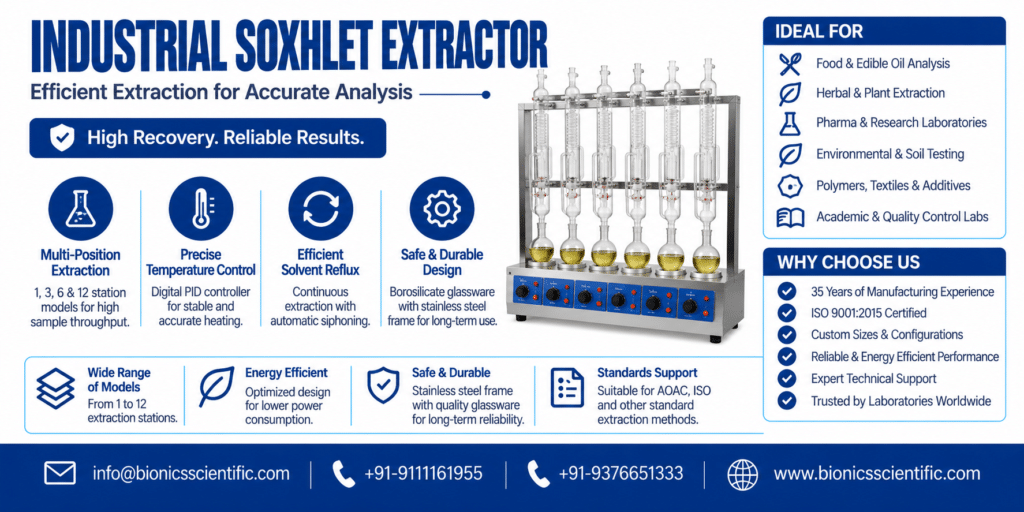
An industrial Soxhlet extractor is a large-capacity extraction system that recycles hot solvent through a solid sample until the target compound (fat, oil, resin, pesticide residue, or polymer additive) is fully removed. It uses the same siphon-and-reflux principle as a lab Soxhlet, but with bigger thimbles, stronger heaters, safer electrics, and a build suited to daily production use.
- Principle: continuous solvent reflux with automatic siphoning
- Typical use: fat and oil analysis, herbal extraction, soil and polymer testing
- Key buying checks: capacity, heating control, condenser efficiency, solvent safety, glass or SS construction
- Maker: Bionics Scientific, manufacturing for 35 years
What Is an Industrial Soxhlet Extractor?
A Soxhlet extractor pulls a soluble compound out of a solid. The sample sits in a porous thimble. The solvent boils below, condenses above, drips onto the sample, and when the chamber fills, a siphon returns the extract to the flask. Fresh solvent keeps touching the sample every cycle, so extraction is thorough with a modest amount of solvent.
The industrial version scales this up. Instead of a single 250 ml unit on a retort stand, plants and quality labs run multi-place heating mantles, large extraction chambers, and stainless steel frames that handle long shifts. At Bionics Scientific we have built extraction equipment for 35 years, and the most common request we hear is the same: “Give us the same recovery as the lab method, but at a volume we can run every day.”
Soxhlet Extractor Diagram (Parts and Flow)
Searching for a Soxhlet extractor diagram? Here is a simple text version showing where each part sits.
Parts that matter to a buyer:
- Boiling flask: holds solvent; collects the extract.
- Vapour arm: carries hot vapour up, bypassing the sample.
- Extraction chamber and thimble: where contact happens.
- Siphon tube: empties the chamber once full.
- Condenser: converts vapor to liquid; its efficiency decides solvent loss.
- Heating mantle with controller: keeps boiling steady without overheating the extract.
How It Works, Step by Step
- Load the dried, ground sample into the thimble.
- Fill the flask to about two-thirds with solvent.
- Heat until the solvent boils; vapor rises and condenses.
- Condensate soaks the thimble and dissolves the target compound.
- At the siphon level, the chamber empties into the flask.
- The cycle repeats, usually 4 to 8 times an hour, for 4 to 16 hours, depending on the sample.
- Recover the solvent by distillation and weigh the residue.
Uses of Soxhlet Extractor Across Industries
The uses of Soxhlet extractor systems go well beyond university benches. Based on the enquiries we handle from buyers in different regions, these are the work areas where industrial units earn their place:
- Food and edible oils: crude fat in flour, oilseeds, feed, dairy powders, and snack products.
- Pharma and herbal: extraction of alkaloids, essential oils, and plant actives before purification.
- Environmental labs: pesticide and hydrocarbon residues from soil, sediment, and sludge.
- Polymers and textiles: plasticizers, finishing oils, and additives from plastic and fiber.
- Cosmetics and fragrance: waxes, resins, and plant extracts.
- Academic and R&D: method development where a repeatable benchmark is needed.
Industrial vs. Laboratory Soxhlet: What Actually Changes
| Point | Laboratory Unit | Industrial Soxhlet Extractor |
| Sample volume | 10 to 30 g | 100 g to several hundred grams per batch |
| Number of places | 1 to 2 | 4, 6, 12 or more in one frame |
| Heating | Basic mantle | PID-controlled, individually switched |
| Body | Bench glassware | SS frame, protected wiring |
| Daily duty | Occasional | Continuous shifts |
| Solvent handling | Open stand | Closed cooling loop, fume hood ready |
Specification Table
The ranges below describe our standard configurations. Custom builds are possible, so please confirm final figures at quotation.
| Parameter | Specification |
| Extraction capacity | 250 ml to 5000 ml flask options |
| Number of stations | 1, 2, 4, 6, 8, 12 |
| Heating mantle | 0 to 450°C, digital PID controller |
| Temperature accuracy | ±1°C (typical) |
| Glassware | Borosilicate 3.3 |
| Frame and body | Stainless steel, powder-coated, or SS 304 |
| Condenser | Allihn or coil type, water-cooled |
| Thimble size | 25 x 80 mm up to 90 x 200 mm |
| Power supply | 220/230 V, 50/60 Hz single phase (415 V on request) |
| Safety | Over-temperature cut-off, spill-proof mantle |
| Plugs and voltage | Configured for destination country |
Temperature Chart: Solvent Boiling Points and Mantle Setting
Mantle temperature should sit slightly above the solvent boiling point, enough to give steady reflux, never a violent boil. Use this chart as a starting point.
| Solvent | Boiling Point (°C) | Suggested Mantle Setting (°C) | Typical Use |
| Diethyl ether | 35 | 45 to 55 | Fats, lipids |
| Dichloromethane | 40 | 50 to 60 | Polymer additives |
| Acetone | 56 | 65 to 75 | Resins, pigments |
| Methanol | 65 | 75 to 85 | Polar plant compounds |
| n-Hexane | 69 | 80 to 90 | Edible oils, fats |
| Ethanol | 78 | 90 to 100 | Herbal and food extracts |
| Toluene | 111 | 125 to 140 | Bitumen, heavy residues |
Visual view (boiling point):
What Buyers Actually Ask Before Ordering
From years of talking with purchase managers, QC heads, and researchers, these are the real concerns, in the order they usually appear:
- Will it match our standard method? Dimensions follow common AOAC and ISO-style extraction practice.
- How much solvent will we lose? A well-matched condenser and good ground joints keep this low.
- Is it safe with flammable solvents? Sealed mantle, cut-off, and fume-hood compatibility matter more than speed.
- Can we replace glassware locally? Standard joints mean spares are easy to source.
- What about voltage and plug type? We configure for your destination.
- Who handles installation and training? Remote video support and documentation come with supply.
- What does it cost over five years? Heater life and spare availability decide this, not only the purchase price.
Supply Across Our Export Markets
Bionics Scientific ships industrial Soxhlet extractors to customers in the United States (USA), the United Kingdom (UK), the United Arab Emirates (UAE), Saudi Arabia, South Africa, Canada, Australia, Singapore, Malaysia, the Philippines, Indonesia, Kenya, Bangladesh, Nepal, Qatar, Oman, Kuwait, Bahrain, Vietnam, Thailand, Tanzania, Ghana, Sri Lanka, and New Zealand.
For Gulf buyers (UAE, Saudi Arabia, Qatar, Oman, Kuwait, and Bahrain), the focus is often petrochemical and food testing. In Kenya, Tanzania, and Ghana, edible oil and agricultural labs lead demand. In Southeast Asia (Malaysia, Indonesia, Thailand, Vietnam, Philippines, Singapore), palm oil and food QC dominate. Each unit ships with export packing, a test certificate, and a manual in English.
Why Bionics Scientific
- 35 years of manufacturing experience in laboratory and testing equipment.
- In-house build and inspection mean that what you approve is what ships.
- Custom configurations for station count, capacity, and voltage.
- Practical after-sales help with calibration guidance and spare glassware.
Frequently Asked Questions
What is an industrial Soxhlet extractor used for?
It extracts fats, oils, resins, and residues from solid samples at a higher volume than a lab unit, mainly for food, pharma, environmental, and polymer testing.
How does a Soxhlet extractor work?
Solvent boils, condenses over a sample in a thimble, dissolves the target compound, and siphons back to the flask. The cycle repeats until extraction is complete.
Which solvent is best for fat extraction?
n-Hexane and diethyl ether are widely used. Choose per your standard method and local safety rules.
How long does one extraction take?
Most runs take 4 to 16 hours, depending on sample type, particle size, and solvent.
What sample size can it handle?
Standard thimbles take roughly 10 g to over 100 g; large chambers take more.
Can I see a Soxhlet extractor diagram before buying?
Yes. The diagram above shows the layout, and we share a dimensional drawing with every quotation.
Is it safe with flammable solvents?
Use it in a ventilated fume hood with a spill-proof mantle and over-temperature cut-off, and keep ignition sources away.
What is the difference between Soxhlet and other extraction methods?
Soxhlet gives repeated contact with fresh solvent and high recovery but takes longer than ultrasonic or microwave methods.
Do you supply to my country?
We export to the USA, UK, UAE, Saudi Arabia, South Africa, Canada, Australia, Singapore, Malaysia, the Philippines, Indonesia, Kenya, Bangladesh, Nepal, Qatar, Oman, Kuwait, Bahrain, Vietnam, Thailand, Tanzania, Ghana, Sri Lanka, and New Zealand.
How do I get a quotation?
Send your sample type, solvent, number of stations, and destination country. Our team replies with a configuration and price.
Request Your Quote Today
Tell us your sample, solvent, and daily volume, and Bionics Scientific will recommend the right industrial Soxhlet extractor. Call +91 9111161955 or 9376651333, email info@bionicsscientific.com, or message us now for a drawing, a quotation, and a delivery timeline to your country.
Bionics Scientific: 35 years of building lab equipment you can rely on.