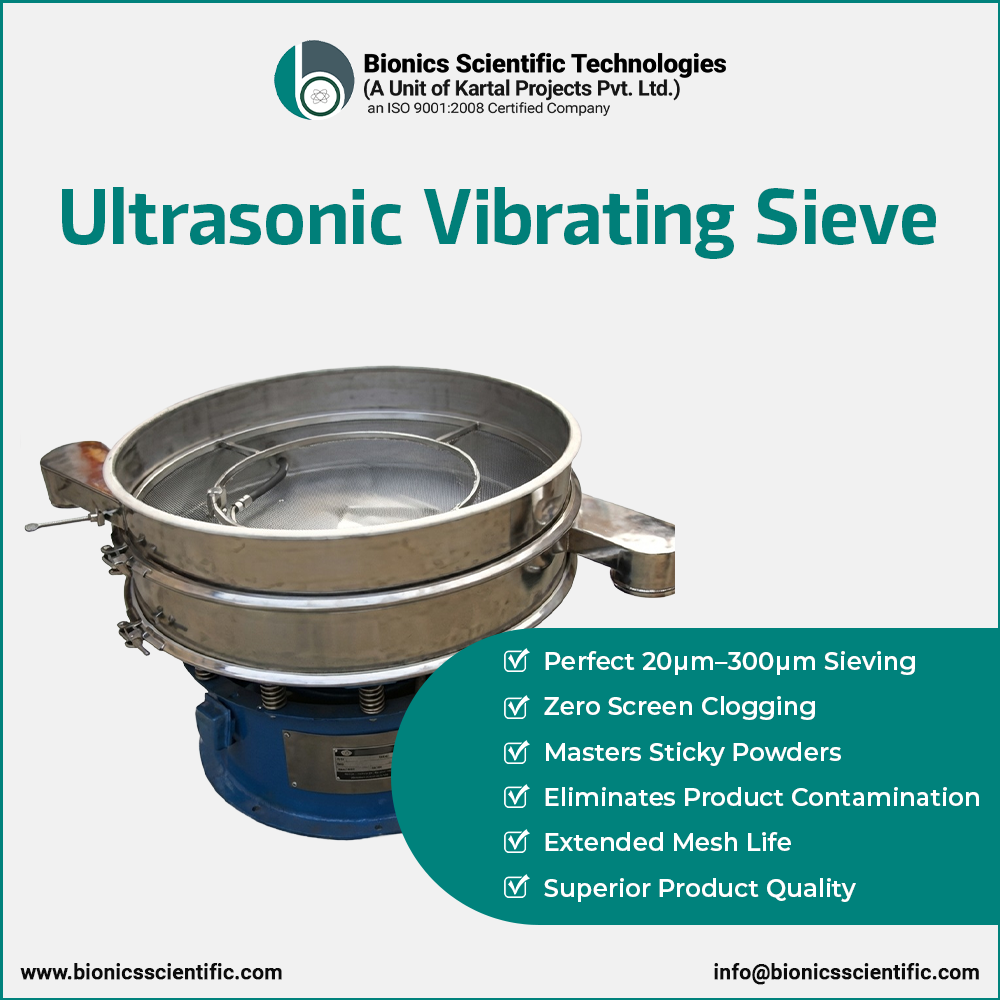
Ultrasonic Vibrating Sieve
An ultrasonic vibrating sieve is a screening system designed for fine powders and materials that can be difficult to process with conventional vibrating sieves. The system combines mechanical vibration with ultrasonic energy applied to the sieve mesh, helping improve the movement of fine particles through the screen and reducing mesh blinding during the sieving process.
Bionics Scientific manufactures ultrasonic vibrating sieves for laboratory and industrial powder-processing applications. Different models are available for pharmaceutical, chemical, food and other industries where fine or difficult-to-screen materials require controlled particle separation.
How the Ultrasonic Sieving System Works
The ultrasonic sieving system uses an ultrasonic generator, transducer and sieve frame to transfer high-frequency vibration to the screening mesh. The generator produces the electrical signal, which is converted by the transducer into mechanical vibration and transmitted to the sieve frame. This additional vibration helps fine particles pass through the mesh and can reduce screen blinding when processing difficult powders.

|

|

|
| Ultrasonic Generator | Ultrasonic Transducer | Ultrasonic Frame |
Ultrasonic Vibrating Sieve Features
| Suitable for fine, sticky and difficult-to-screen powders | Designed for fine particle screening applications |
| Ultrasonic vibration helps reduce mesh blinding | Supports continuous and uniform screening performance |
| Consistent screening operation | Simple operation and routine maintenance |
| Robust construction for laboratory and industrial use | Available in multiple sieve sizes and motor capacities |
Ultrasonic Vibrating Sieve Specifications
| Model | Motor Power | Vibrating Force | Dimensions (L × H), mm | Frequency |
|---|---|---|---|---|
| BST/UCS-400 | 0.1 kW | 2500 N | 400 × 660 | 36.5 kHz |
| BST/UCS-500 | 0.2 kW | 5000 N | 500 × 745 | 36.5 kHz |
| BST/UCS-600 | 0.2 kW | 5000 N | 600 × 875 | 36.5 kHz |
| BST/UCS-800 | 0.5 kW | 10 kN | 800 × 895 | 36.5 kHz |
| BST/UCS-1000 | 0.7 kW | 16 kN | 970 × 945 | 36.5 kHz |
| BST/UCS-1200 | 0.7 kW | 16 kN | 1170 × 995 | 36.5 kHz |
| BST/UCS-1500 | 1.5 kW | 25 kN | 1470 × 1095 | 36.5 kHz |
Applications of Ultrasonic Vibrating Sieve
Ultrasonic vibrating sieves are used for screening fine powders and materials that may be difficult to process with conventional sieving systems. The ultrasonic vibration applied to the mesh can help improve screening performance where fine particles tend to accumulate or cause mesh blinding.
- Pharmaceutical powder screening and processing
- Chemical and fine chemical powder separation
- Food and ingredient powder screening
- Fine mineral and pigment processing
- Laboratory and research powder analysis
- Screening of fine, lightweight or difficult-to-sieve materials
Ultrasonic Vibrating Sieve vs Conventional Vibrating Sieve
Both conventional and ultrasonic vibrating sieves are used for particle screening and separation. The main difference is that an ultrasonic vibrating sieve applies additional high-frequency vibration to the screening mesh, which can be useful when processing fine or difficult-to-screen powders.
| Parameter | Ultrasonic Vibrating Sieve | Conventional Vibrating Sieve |
|---|---|---|
| Screening Method | Mechanical vibration with ultrasonic energy applied to the mesh | Primarily mechanical vibration |
| Suitable Materials | Fine, lightweight and difficult-to-screen powders | General powder and particle screening applications |
| Mesh Blinding | Ultrasonic vibration can help reduce mesh blinding | Mesh blinding may occur with some fine or difficult materials |
| System Components | Includes ultrasonic generator, transducer and compatible sieve frame | Does not require an ultrasonic system |
| Selection | Useful when conventional screening is difficult for the material | Suitable for many routine screening requirements |
How to Choose an Ultrasonic Vibrating Sieve
Selecting the right ultrasonic vibrating sieve depends on the material being processed, required screening capacity and desired particle separation. The sieve diameter, mesh size, motor capacity and ultrasonic system should be selected according to the specific powder-processing application.
Important factors to consider include:
- Type and characteristics of the powder or material
- Required particle size and mesh size
- Required screening capacity or throughput
- Sieve diameter and available installation space
- Motor power and vibrating force
- Ultrasonic frequency and system configuration
- Material-contact construction requirements
- Cleaning and maintenance requirements
For application-specific requirements, the suitable model should be selected according to the material properties and required screening conditions.
Related Sieve Shakers
For other particle separation and laboratory sieving requirements, explore our sieve shaker range . Different sieve shaker configurations are available depending on the material, particle size and testing or screening application.
For general information on particle-size analysis and sieve testing standards, refer to ASTM International .
Frequently Asked Questions About Ultrasonic Vibrating Sieves
What is an ultrasonic vibrating sieve?
An ultrasonic vibrating sieve is a screening system that combines mechanical vibration with high-frequency ultrasonic vibration applied to the sieve mesh. It is commonly used for fine and difficult-to-screen powders where conventional screening may experience mesh blinding.
How does an ultrasonic vibrating sieve work?
The ultrasonic generator produces a high-frequency electrical signal that is converted into mechanical vibration by the transducer. This vibration is transferred to the sieve frame and mesh, helping fine particles move through the screen during the sieving process.
What is the difference between an ultrasonic sieve and a conventional vibrating sieve?
A conventional vibrating sieve primarily uses mechanical vibration for particle separation. An ultrasonic vibrating sieve adds high-frequency vibration to the screening mesh, which can help when processing fine, lightweight or difficult-to-screen powders.
Can an ultrasonic vibrating sieve reduce mesh blinding?
Ultrasonic vibration can help reduce the accumulation of fine particles on the sieve mesh and therefore reduce mesh blinding. Actual screening performance depends on the material properties, mesh size, operating conditions and equipment configuration.
Which materials can be processed with an ultrasonic vibrating sieve?
Ultrasonic vibrating sieves can be used for a variety of fine powder-processing applications, including pharmaceutical, chemical, food, pigment, mineral and laboratory materials. Suitability should be evaluated according to the characteristics of the material and required particle separation.
What components are used in an ultrasonic sieving system?
A typical ultrasonic sieving system includes an ultrasonic generator, transducer and compatible sieve frame or mesh assembly. These components work together to transfer ultrasonic vibration to the screening surface.
How do I choose the right ultrasonic vibrating sieve?
Consider the material characteristics, required particle size, mesh size, screening capacity, sieve diameter, motor power, vibrating force and ultrasonic system configuration. Material-contact construction and cleaning requirements should also be considered for the intended application.
What factors affect ultrasonic vibrating sieve price in India?
Ultrasonic vibrating sieve price in India can vary according to sieve diameter, motor capacity, ultrasonic system configuration, construction material, required screening capacity and customization. An exact quotation depends on the selected model and application requirements.
Looking for an Ultrasonic Vibrating Sieve?
Select an ultrasonic vibrating sieve according to your material, required particle size, screening capacity and application. Contact Bionics Scientific for model selection, customization and pricing.
Request a Quote