Plant growth regulators are substances that change how a plant grows, roots, flowers, or ripens, even in tiny doses. Ask ten plant scientists about them and you will hear the same worry ten times: the dose was right, so why did the result change? Usually the answer sits in the room, not the bottle. Temperature drift, uneven light, and a different batch of soil can undo a perfectly measured PGR trial. This guide covers the science in plain terms, then moves to the practical side: conditions, equipment, and buying checks. It is written by Bionics Scientific, a laboratory equipment manufacturer with 26 years of manufacturing experience.
Quick Answer
- Plant growth regulators (PGRs): natural or lab-made substances that change how a plant grows, roots, flowers, or ripens.
- Five main groups: auxins, gibberellins, cytokinins, abscisic acid, and ethylene.
- Example that promotes growth: auxin (IAA) lengthens cells; gibberellic acid (GA3) lengthens stems.
- Working dose: usually a few parts per million. More is not better.
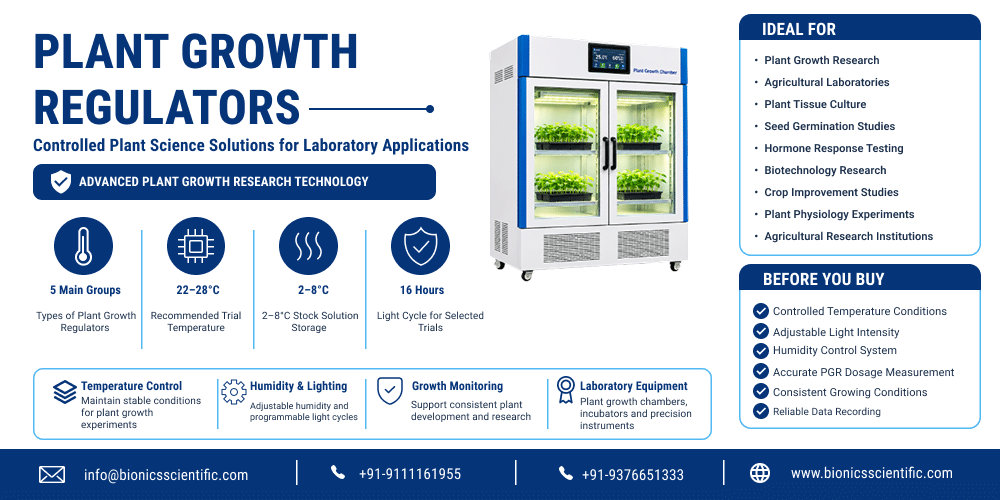
- Ideal room conditions: 22-28°C for most trials, with steady humidity and light.
- Core equipment: growth chamber, shaking incubator, hot plate stirrer, balance, and pH meter.
What Are Plant Growth Regulators?
Every plant produces its own chemical messengers. These are the plant growth hormones: tiny amounts made in one tissue acting in another. A PGR is the wider term. It covers those natural hormones and also the synthetic copies made in factories.
Why use the synthetic ones? They keep longer on the shelf, they cost less, and each batch behaves the same way. That consistency matters more to a lab than to a farmer. If you ask a student to give an example of a plant hormone that promotes growth, auxin is the safe answer. Indole-3-acetic acid stretches cells in young shoots, helps cuttings form roots, and suppresses side buds below the growing tip.
How PGRs Fit Into Plant Growth and Development
Plant growth and development runs through five phases. Each one leans on a different hormone balance, which is why one PGR rarely does everything.
- Germination: gibberellins wake the seed up and start the enzymes that break down stored food. Abscisic acid does the opposite and keeps seeds dormant until conditions improve.
- Seedling and leaf growth: auxins stretch cells while cytokinins make new ones.
- Flowering: gibberellins and the auxin to cytokinin ratio help decide when buds form.
- Fruit set and ripening: auxins support fruit set, and ethylene takes over for ripening.
- Ageing: ethylene and abscisic acid push leaves toward drop.
Students hunting for plant growth and development notes or an NCERT PDF will recognize this same sequence in class 11 and 12 biology. For a quick reference on hormone types, the plant hormone overview on Wikipedia is a fair place to start.
The Five Groups of Plant Growth Regulators
| Group | What it does | Where it is used |
| Auxins (IAA, IBA, NAA) | Cell elongation, rooting | Cuttings, callus induction |
| Gibberellins (GA3) | Stem growth, germination | Breaking dormancy, larger fruit |
| Cytokinins (kinetin, BAP) | Cell division, shoots | Tissue culture multiplication |
| Abscisic acid | Stress and dormancy signal | Drought tolerance studies |
| Ethylene (ethephon) | Ripening, leaf drop | Fruit ripening, flower induction |
If you want dose-response data from real crop trials, the Journal of Plant Growth Regulation is a regular stop for researchers.
Best Soil for Plant Growth in a PGR Trial
A PGR experiment only means something if the growing medium stays the same across every pot. The best soil for plant growth in a controlled study is a loose, well-drained loam at pH 6.0 to 7.0, with some organic matter and steady moisture.
Local conditions change what you start with. Soils in the UAE, Qatar, and Kuwait are sandy and low in organic carbon, so labs there usually mix in cocopeat or compost. In Bangladesh, Vietnam, and the Philippines, heavy clay holds water, so drainage needs fixing first. Once you pick a mix, use it for treatment and control alike. Otherwise you cannot say whether the hormone or the soil made the difference.
Why Temperature Control Decides the Result
Hormones work through enzymes, and enzymes respond to heat. A room that wanders by 3 to 4°C can move your numbers further than the PGR does. This hits hardest in the Gulf. In Saudi Arabia, Oman, and Bahrain, summer air passes 45°C, and an ordinary air-conditioned room cannot hold a germination setpoint on its own.
Temperature Chart for PGR Experiments
| Stage or activity | Temperature | Light and humidity |
| Seed germination (GA3 treated) | 20-25°C | Dark to low light, 70-80% RH |
| Rooting of cuttings (auxin dip) | 22-26°C | 16 h light, 80-90% RH |
| Tissue culture shoot multiplication | 24-26°C | 16 h light, 60-70% RH |
| Vegetative growth trials | 24-28°C | 12-14 h light, 60-70% RH |
| Flowering induction | 18-24°C | Photoperiod set by crop |
| Stock solution storage | 2-8 °C | Dark bottle |
Equipment for Plant Growth Regulator Research
Start at the bench. Many PGRs, especially IBA and NAA, barely dissolve in cold water. A magnetic stirrer with hot plate lets you warm and mix a stock solution evenly, so next month’s batch matches today’s. For cell suspension and callus work, a shaking incubator holds temperature and orbital speed together. Whole-plant trials need a plant growth chamber that controls light, humidity, and temperature inside one enclosure.
Specification Table: Plant Growth Chamber
| Parameter | Specification |
| Temperature range | 5 °C to 50 °C |
| Temperature uniformity | ±0.5°C |
| Humidity range | 40% to 95% RH |
| Lighting | Programmable LED with adjustable intensity and photoperiod |
| Controller | Microprocessor PID with digital display |
| Inner chamber | SS 304 with adjustable shelves |
| Outer body | Powder-coated MS |
| Capacity options | 250 L, 500 L, 1000 L, 1500 L |
| Power supply | 220-240 V, 50/60 Hz, single phase |
| Alarms | Over-temperature, door open, sensor fault |
| Options | CO2 control, data logging |
Mistakes That Ruin PGR Trials
Three problems come up again and again in plant labs. First, shelf position: the top shelf runs warmer than the bottom, and nobody records it. Second, stock solutions kept on a bench in daylight, which breaks down some hormones. Third, copying a dose from a paper written for a different species. Check each before blaming the chemical.
15 Points to Check Before You Buy
- Temperature uniformity on every shelf, not only the center.
- A humidity range that suits your local climate.
- Light intensity and spectrum control.
- Stainless steel interior that cleans easily.
- PID accuracy and recovery time after the door opens.
- Capacity that fits your trays or pots.
- Voltage that matches your country’s supply.
- Data logging for audits and publication.
- A calibration certificate supplied with the unit.
- Spare parts available in your region.
- Installation and operator training.
- Warranty terms in writing.
- Export packing for sea or air freight.
- Delivery time you can plan around.
- A real manufacturer behind the quote, not a middleman.
Supplying Labs Across the Middle East, Asia-Pacific, and Africa
Bionics Scientific equips universities, agricultural research centers, biotech firms, and quality labs. In the Middle East we ship to the UAE, Saudi Arabia, Qatar, Oman, Kuwait, and Bahrain, where desert heat makes stable cooling the first requirement. In Asia-Pacific we deliver to Australia, Singapore, Malaysia, the Philippines, Indonesia, Vietnam, Bangladesh, and Nepal. Kenya is a growing market for tissue culture and horticulture labs. Each unit is built, tested, and calibrated in-house before dispatch, backed by 26 years of manufacturing experience.
Frequently Asked Questions
What are plant growth regulators?
Substances, natural or synthetic, that control plant growth, rooting, flowering, and ripening.
Are plant growth hormones and PGRs the same?
Hormones are made by the plant. PGRs include both those and synthetic ones.
Which hormone makes you grow?
Auxin makes cells grow longer. Gibberellins elongate stems and help germination.
What are the stages of plant growth?
Germination, vegetative growth, flowering, fruiting, and aging.
What type of soil is best for plant growth?
Loam, good drainage, organic matter, pH 6.0-7.0.
What is a good temperature for PGR trials?
22-28°C, mostly depending on crop and stage.
Do PGRs damage plants?
Yes. Overdosing causes stunted twisted leaves and poor fruit set.
How should stock solutions be stored?
In dark bottles at 2-8°C, labelled with date and strength.
What equipment do PGR trials need?
A growth chamber, shaking incubator, hot plate stirrer, and a precise balance.
Do you ship to the Middle East?
Yes. We supply the UAE, Saudi Arabia, Qatar, Oman, Kuwait, and Bahrain.
Get a Quote for Your Plant Research Lab
Setting up a PGR study or a new plant science lab? Send us your chamber size, temperature range, and crop, and our engineers will suggest the right setup with delivery to your country. Contact Us for a quotation from Bionics Scientific.