Quick Answer
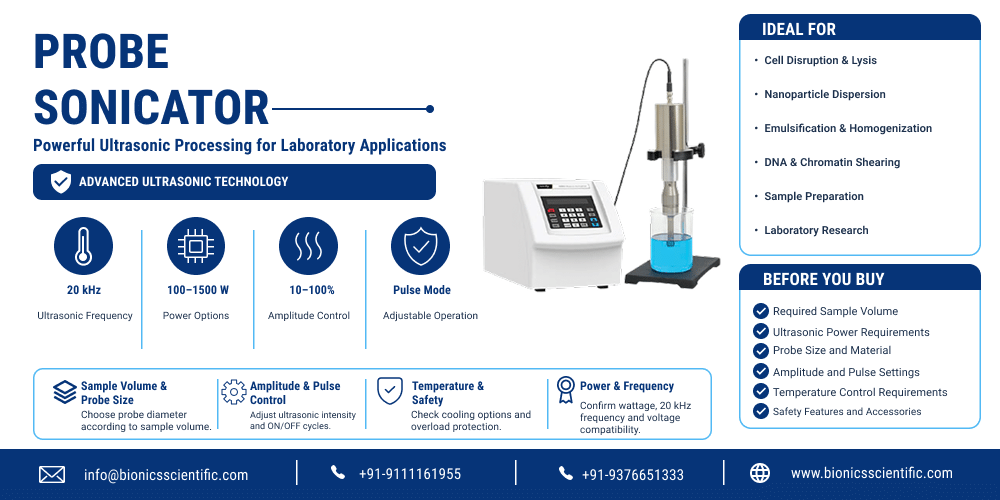
A probe sonicator is a laboratory device that pushes high-frequency sound waves (usually 20 kHz) straight into a liquid through a titanium probe. The sound creates millions of tiny bubbles that collapse violently, and that collapse breaks cells, disperses particles, and mixes emulsions.
- What is ultrasonicator: a machine that turns electrical energy into ultrasonic vibration.
- Ultrasonic probe sonicator: the direct-contact type, far stronger than a bath.
- Ultrasonic sonicator: the general name for both probe and bath models.
- Ultrasonic sterilization: useful for disrupting microbes and cleaning, but not a replacement for an autoclave.
- Best for: cell lysis, nanoparticle dispersion, emulsification, degassing, and DNA shearing.
What Is an Ultrasonicator?
If you are asking what an ultrasonicator is, think of it as a controlled source of vibration. A generator converts mains power into a 20 kHz electrical signal. A piezoelectric converter changes that signal into mechanical movement. A horn, or probe, then moves up and down a few microns, thousands of times per second, inside your sample.
Bionics Scientific has manufactured laboratory equipment for 26 years, and in that time the questions we hear most are simple ones: how much power do I need, and why did my sample get hot? This guide answers both.
How a Probe Sonicator Works
The process is called acoustic cavitation. The probe tip pushes and pulls on the liquid. During the pull phase, tiny vacuum bubbles form. During the push phase they implode, creating local pressure spikes and shear forces strong enough to tear cell walls apart. A deeper explanation of sonication is available on Wikipedia’s sonication page.
Three settings control the result:
- Amplitude: how far the tip travels, shown as a percentage.
- Pulse ratio: seconds on versus seconds off.
- Time: total processing duration.
Probe Sonicator vs Ultrasonic Bath
An ultrasonic bath sends waves through a water tank and then through the sample vessel wall, so much of the energy is lost. A probe delivers it directly. For stubborn jobs such as yeast, spores, or nanoparticle clusters, a bath rarely works. For routine cleaning of glassware, a bath is fine and cheaper.
Ultrasonic Sterilization: What It Can and Cannot Do
Ultrasonic sterilization is a phrase many buyers search, so let us be accurate. Cavitation can kill or rupture bacteria, reduce biofilm, and disrupt cell membranes. It is widely used for decontaminating instruments before sterilization and for lowering microbial load in liquids. However, ultrasound alone does not meet the validated sterility standard of a steam autoclave. If your protocol demands sterility assurance, use ultrasound as a pre-treatment and finish with a validated method.
Where Labs Use a Probe Sonicator
- Cell disruption for protein and enzyme extraction
- DNA and chromatin shearing for sequencing prep
- Nanoparticle and graphene dispersion
- Nanoemulsions in pharma, cosmetics, and food research
- Liposome size reduction
- Degassing solvents and HPLC mobile phases
- Homogenizing tissue samples
Specification Table
| Parameter | Typical Range (Bionics Scientific Models) |
| Frequency | 20 kHz ± 0.5 kHz |
| Power output | 100 W, 250 W, 500 W, 750 W, 1000 W, 1500 W |
| Sample volume | 0.1 mL to 1000 mL (probe dependent) |
| Probe material | Titanium alloy (Ti-6Al-4V) |
| Probe diameters | 3 mm, 6 mm, 13 mm, 19 mm, 25 mm |
| Amplitude control | 10% to 100%, adjustable |
| Pulse mode | 1 to 99 seconds on/off |
| Timer | Up to 99 minutes |
| Display | Digital LCD with real-time power reading |
| Protection | Overload, overheating, and probe-fault cut-off |
| Enclosure | Optional sound-proof chamber |
| Power supply | 220–240 V, 50/60 Hz (110 V on request) |
| Temperature probe | Optional, with auto-stop |
Temperature Chart: Why Heat Matters
Cavitation turns part of the energy into heat. Without cooling, a 50 mL sample at 60% amplitude can climb past 50 °C within minutes, which denatures proteins and degrades RNA. The values below are indicative figures for a 500 W unit, 13 mm probe, 50 mL water sample, starting at 4°C.
| Run Time | Continuous, No Ice | Continuous Ice Bath | Pulse 5s On/5s Off, Ice Bath |
| 1 min | 18 °C | 6 °C | 5 °C |
| 3 min | 38 °C | 9 °C | 6 °C |
| 5 min | 56 °C | 13 °C | 8 °C |
| 10 min | 78 °C | 21 °C | 11 °C |
Probe sonicator temperature rise chart showing continuous run without ice, continuous run in ice bath, and pulse mode in ice bath
Practical rule: use pulse mode, keep the vessel in an ice-salt bath, and let the sample rest between cycles.
15 Things Buyers Actually Think About
Buyers in our regions rarely ask only about price. These are the points that come up in real purchase discussions:
- Power rating: match watts to sample volume, not to a higher number.
- Probe size: small tips for microliter work, large tips for liters.
- Heat control: look for a built-in temperature sensor.
- Probe life: titanium tips erode, so ask about replacement cost.
- Noise: a soundproof enclosure protects operators.
- Pulse flexibility: needed for heat-sensitive biologicals.
- Repeatability: consistent amplitude batch after batch.
- Safety cut-offs: protection against dry running.
- Calibration: traceable documentation for audits.
- Warranty: length and what is covered.
- Spare parts: local stock, not a six-week wait.
- Voltage compatibility: 220 V versus 110 V.
- Installation and training: especially for new labs.
- Export paperwork: invoices, packing list, conformity papers.
- After-sales response time: a quick reply matters more than a long brochure.
Supply Across the Middle East, Asia-Pacific, and Africa
Our priority market is the Middle East. We supply universities, hospitals, petrochemical labs, and food-testing units in the United Arab Emirates (UAE), Saudi Arabia, Qatar, Oman, Kuwait, and Bahrain, where high ambient temperatures make cooling and heat-protection features especially important. In Asia-Pacific we ship to Australia, Singapore, Malaysia, the Philippines, Indonesia, Vietnam, Bangladesh, and Nepal, and in Africa to Kenya. Voltage, plug type, and documentation are adjusted for each destination.
Why Choose Bionics Scientific
- 35 years of laboratory equipment manufacturing experience
- In-house design, assembly, and testing, with no third-party rebranding
- Each unit is output-tested before dispatch
- Custom probes and enclosures available
- Technical support from engineers who built the machine
Alongside sonicators, we also build laboratory mixers for gentler blending work.
Frequently Asked Questions
What is a probe sonicator used for?
Cell lysis, nanoparticle dispersion, emulsification, and DNA shearing.
What is an ultrasonicator?
A machine that creates ultrasonic vibrations to disrupt or mix samples.
How is a probe sonicator different from a bath?
A probe touches the sample directly, so it delivers much more energy.
What frequency do probe sonicators use?
Most operate at 20 kHz.
Can ultrasonic sterilization replace an autoclave?
No. It reduces microbes but does not guarantee sterility.
How do I stop my sample overheating?
Use pulse mode and an ice bath.
Which probe size should I choose?
Small probes for small volumes, larger probes for bigger batches.
How long does a titanium probe last?
Typically several hundred hours, depending on amplitude and sample.
Do you ship to the Middle East?
Yes, to the UAE, Saudi Arabia, Qatar, Oman, Kuwait, and Bahrain.
Can you customize a probe sonicator?
Yes, power, probes, and enclosures can be tailored.
Get Your Probe Sonicator Quote Today
Stop guessing which sonicator fits your sample. Tell our engineers your volume, material, and target region, and we will recommend the exact model, probe, and cooling setup, with a clear quotation and delivery timeline. Contact Bionics Scientific now and get your lab running faster.