A coefficient of friction tester price in India usually falls between ₹45,000 and ₹2,50,000, depending on load cell capacity, display type, sled weight, software, and calibration. A basic manual unit sits at the low end. A digital, software-linked static and kinetic COF tester for film and sheet sits at the high end.
At Bionics Scientific, we have manufactured laboratory and testing equipment for 26 years. This guide explains how pricing works, so your purchase order matches your actual test need and not a catalogue headline.
Quick Answer
- Price range: ₹45,000 to ₹2,50,000 (indicative, configuration-based).
- What it measures: The resistance between two surfaces, as a static value (start of movement) and a kinetic value (during movement).
- Best for: Plastic films, paper, laminates, foils, woven sacks, and packaging.
- Main price drivers: Load cell accuracy, sled mass, travel speed control, data output, calibration certificate.
- Standard followed: ASTM D1894 and ISO 8295 principles.
- Who should buy digital: Labs that log results, audit batches, or export data.
- Who can buy basic: Small converters doing routine slip checks.
- Delivery: India-wide, plus export to 25 countries.
What a COF Tester Actually Does
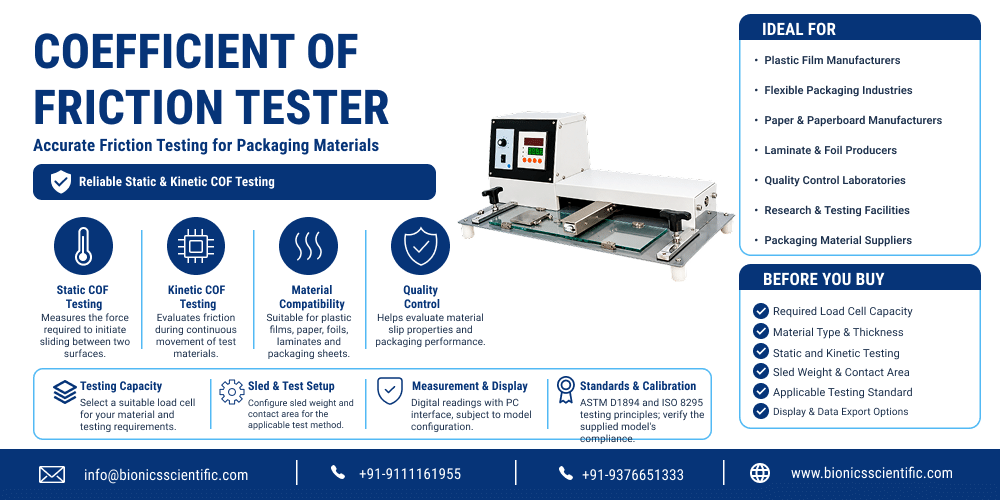
A COF tester drags a weighted sled across a test surface at a fixed speed and records the force needed. Two numbers come out of it. The static coefficient tells you how hard the material resists the first push. The kinetic coefficient tells you how it behaves once sliding has started.
For a film line, this decides whether bags feed smoothly on a form-fill-seal machine or jam. For a paper mill, it decides whether reams stack safely on a pallet. So the instrument is not a luxury. It is a quality gate.
Coefficient of Friction Tester Price in India: What Moves the Number
Buyers often ask us for a single price. A fair answer needs context, because two machines that look alike can differ by ₹100,000 inside.
- Load cell capacity and resolution. Thin films produce very small forces. A 5 N load cell with fine resolution costs more than a 50 N cell but gives usable results on slip-treated film.
- Display and data handling. An analogue or simple digital readout is cheaper. A digital COF tester with a PC interface, graph plotting, and result storage costs more.
- Sled and surface setup. The standard sled is 200 g for film. Different sled weights, film-to-film, and film-to-steel plates add accessories.
- Speed control. A stable 150 mm/min travel needs a good motor and drive. Cheap drives drift, and drift ruins repeatability.
- Build quality. Frame rigidity, flat base plates, and guide rails affect whether Monday’s result matches Friday’s.
- Calibration. A unit supplied with a traceable calibration certificate costs more, and it is the one that survives an audit.
- After-sales support. Spare parts, service visits, and training have a cost. They also protect you from downtime.
Indicative Price by Machine Type
| Machine Type | Typical Use | Indicative Price (INR) |
| Basic manual COF tester | Routine slip checks | ₹45,000 – ₹80,000 |
| Digital COF Tester (standalone) | Film and paper QC | ₹80,000 – ₹1,40,000 |
| Static and Dynamic COF Tester with Software | Lab reporting, audits | ₹1,40,000 – ₹2,50,000 |
| Custom or multi-surface setup | R&D, special packaging | On quotation |
Prices are indicative and change with configuration, taxes, and freight. Request a written quotation for exact figures.
Specification Table
| Parameter | Typical Specification |
| Test method | Static and Kinetic COF |
| Standards | ASTM D1894, ISO 8295 |
| Load cell | 5 N / 10 N / 50 N (selectable) |
| Accuracy | ±1% of reading |
| Sled weight | 200 g (standard), custom on request |
| Sled contact area | 63.5 mm × 63.5 mm |
| Test speed | 150 ± 30 mm/min |
| Travel distance | Up to 130 mm |
| Test plate | Stainless steel / glass, polished |
| Display | Digital LCD with PC interface |
| Power supply | 230 V AC, 50 Hz, single-phase |
| Specimen | Plastic film, sheets, paper, foil, laminates |
| Calibration | Traceable certificate supplied |
Test Condition Chart (Temperature and Humidity)
COF readings change with temperature and moisture, which is why a standard lab condition matters. Plastic films, especially those with slip additives, can read very differently on a hot afternoon than in a conditioned room.
| Condition | Temperature | Relative Humidity | Use |
| Standard conditioning | 23 ± 2°C | 50 ± 5% | Reference and reporting |
| Tropical check | 30 ± 2°C | 65 ± 5% | Warehouse and monsoon simulation |
| Cold storage check | 5 ± 2°C | Ambient | Frozen and chilled packaging |
| Hot-fill/summer check | 40 ± 2°C | 40 ± 5% | Export and transit stress |
Condition the sample for at least 40 hours before testing when the standard asks for it, and note the room conditions on every report.
Static vs Kinetic COF: Reading the Result
Slip additives such as erucamide migrate to the film surface over days. So a film tested on the day of extrusion may read high, then settle lower after a week. We recommend testing at production, at dispatch, and on receipt at the converter. This habit exposes a drifting recipe early.
A low kinetic value with a high static value often means stick-slip, and bags will stutter on the packing line. A buyer who understands this reads the same machine very differently from one who only wants a number.
Where This Tester Is Used
- Flexible packaging and film converters
- BOPP, LDPE, HDPE, and PET film makers
- Paper, board, and corrugated mills
- Pharmaceutical blister and foil packaging
- Textile and woven sack manufacturers
- Research and university labs
Our Coefficient of Friction Tester manufacturer in India team supports each of these. If you also test material strength, see our tensile strength testing machine and bursting strength tester for a complete packaging lab.
15 Points Every Buyer Should Check Before Ordering
- Which standard does your customer demand: ASTM D1894 or ISO 8295?
- Do you need static, kinetic, or both values?
- What is your thinnest material? Choose the load cell from it.
- Is the sled weight and area as per the standard?
- Does the speed stay constant under load?
- Is the test plate polished and flat?
- Can results be exported to a PC?
- Is a traceable calibration certificate included?
- Who calibrates it again, and at what cost?
- Are spare sleds and plates available?
- Is installation and operator training included?
- What is the warranty period?
- Is the machine made by the supplier or only traded?
- Can you see a working demo or sample test report?
- What is the delivery time to your city or country?
Asking these before purchase removes most regrets. A manufacturer who answers all fifteen without hesitation is usually the safer choice.
Why Buyers Choose Bionics Scientific
We are a manufacturer, not a reseller. With 26 years of manufacturing experience, our engineers build, test, and calibrate each unit in-house. That means direct technical answers, short lead times, and spare parts you can actually get. Every machine ships with a calibration certificate, an operating manual, and a sample test procedure.
Our Coefficient of Friction Tester supplier in India network covers Delhi NCR, Mumbai, Chennai, Bengaluru, Ahmedabad, Pune, and Kolkata, and we also export. Our Film Coefficient of Friction Tester and Plastic Film Friction Tester models are the most requested by converters.
Supply Across India and Worldwide
Alongside our Indian customers, we ship COF testers to the United States (USA), United Kingdom (UK), the United Arab Emirates (UAE), Saudi Arabia, South Africa, Canada, Australia, Singapore, Malaysia, Philippines, Indonesia, Kenya, Bangladesh, Nepal, Qatar, Oman, Kuwait, Bahrain, Vietnam, Thailand, Tanzania, Ghana, Sri Lanka, and New Zealand. Export units are packed for sea or air freight, with voltage and plug options set to the destination.
For the underlying test method, you can read the official ASTM D1894 standard.
Get Your COF Tester Quotation Today
Do not guess the price from a catalogue. Tell us your material, thickness, and standard, and our engineers will recommend the exact configuration, no more and no less.
Call, email, or send an enquiry now. Get a written quotation within one working day, and take your first test with a calibrated machine in weeks, not months.
Request a Quote from Bionics Scientific
Frequently Asked Questions
What is the COF tester price in India?
Roughly ₹45,000 to ₹250,000, based on configuration.
Why do COF testing machine prices differ?
Load cell, display, software, speed control, and calibration change the cost.
What does a digital COF tester measure?
It records static and kinetic friction between a sled and a surface.
What is the difference between static and kinetic COF?
Static is the force to start sliding. Kinetic is the force to keep sliding.
Which standard applies to film testing?
ASTM D1894 and ISO 8295 are the common ones.
What sled weight is standard?
200 g for plastic film, with a 63.5 mm square contact area.
Can one machine test paper and film?
Yes, with the right load cell and test plate.
How often should it be calibrated?
Once a year, or after any heavy use or repair.
Do you export COF testers?
Yes, to the USA, the UK, the UAE, Africa, Southeast Asia, and more.
How fast can I get a quote?
Within one working day of sending your requirement.