Quick Answer
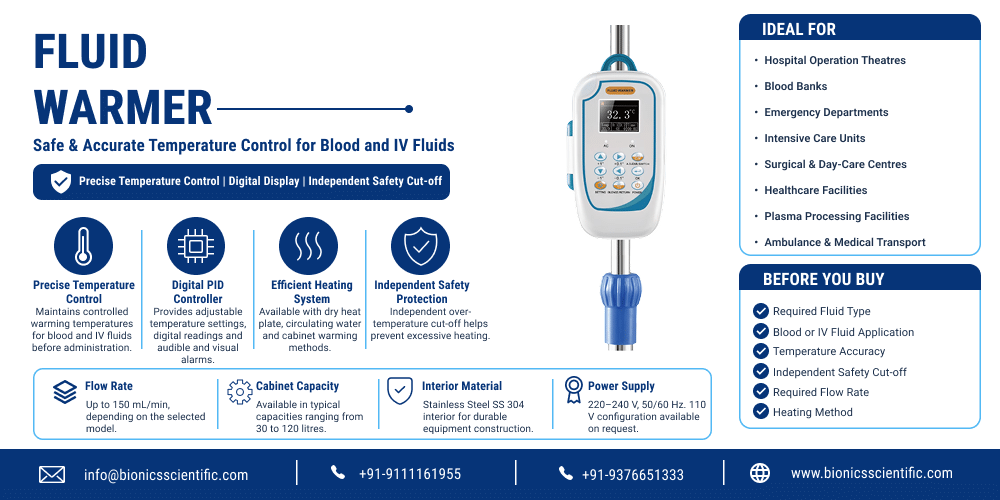
A fluid warmer is used to warm blood, IV solutions, and plasma to about 37°C before delivering it to the body of the patient. This way, the risk of hypothermia, coagulation problems, and shivering is reduced. There are two major types of equipment:
- Fluid warmer: the general term for a device that heats fluid to a safe, fixed temperature before infusion.
- Blood warmer equipment: inline units giving blood at 37°C to 38°C, backed by an independent cut-off.
- Intravenous fluid warmer: a compact unit for saline, Ringer’s solution, and irrigation fluids.
- Thawing machine: thaws frozen plasma evenly between 30°C and 37°C.
- Fluid warming cabinet: holds bags and bottles at 36°C to 41°C until someone needs them.
If you remember one thing, make it your target 37°C, and keep blood below 42°C.
Why Warming Matters
Blood comes out of storage at about 4°C. Give a patient several units in a short window, and their core temperature drops quickly. Perioperative hypothermia means a core temperature under 36°C, and it’s tied to heavier bleeding, slower wound healing, and longer recovery.
The guidance is fairly consistent on this. The UK’s NICE guideline on inadvertent perioperative hypothermia recommends warming IV fluids of 500 mL or more, plus blood products, to 37°C with a warming device.
Heating the fluid isn’t the difficult bit. Stopping at the right temperature is. Once blood passes 42°C, red cells start to break down, which is why a decent warmer carries a second protection circuit that works independently of the main controller.
How a Fluid Warmer Works
Three heating methods cover most of what’s on the market.
A dry heat plate presses the tubing against a heated aluminium surface. Setup is quick and cleaning is simple, so it’s popular for inline use.
Circulating water wraps warm water around the line. Temperature stays very steady, but the water circuit needs stricter hygiene routines.
Cabinet warming takes a different approach altogether. Whole bags sit inside a thermostat-controlled chamber ahead of time.
Operating theaters mostly go for inline warming. Wards, emergency departments, and blood banks tend to prefer cabinets and thawing equipment.
Choosing Between the Four Equipment Types
Transfusion work calls for blood warmer equipment. Check for tight outlet control and air detection. Confirm the display shows outlet temperature, not just the heater’s own, because the two can differ quite a bit.
An intravenous fluid warmer is lighter and often portable. You’ll find them in ambulances and day-surgery units where space is limited.
Blood banks that still thaw plasma in improvised water baths usually switch to a thawing machine sooner or later. Controlled thawing removes the hot spots.
A fluid warming cabinet keeps stock ready, so nobody stands around waiting for a cold bag to reach temperature.
Specification Table
This is the typical configuration of our fluid warming range. Values change from model to model, so check the datasheet before you order.
| Parameter | Typical Specification |
| Temperature range | 35°C to 41°C, adjustable |
| Blood outlet temperature | 37°C to 38°C |
| Accuracy | ±0.5°C |
| Display resolution | 0.1°C |
| Independent over-temperature cut-off | 42°C |
| Heating method | Dry plate, circulating water, or cabinet |
| Flow rate (inline units) | Up to 150 mL/min, model dependent |
| Cabinet capacity | 30 to 120 litres |
| Interior | Stainless steel SS 304 |
| Controller | Digital PID with audible and visual alarm |
| Power supply | 220 to 240 V, 50/60 Hz; 110 V on request |
| Quality system | ISO 13485; designed with IEC 60601-1 in mind |
Temperature Chart
| Application | Starting Temp | Target Temp | Never Exceed |
| Packed red cells, inline | 4°C | 37°C | 42°C |
| Crystalloid IV fluid | 20°C to 25°C | 37°C | 41°C |
| Irrigation fluid | 20°C to 25°C | 36°C to 38°C | 40°C |
| Frozen plasma thawing | -30°C | 30°C to 37°C | 37°C |
| Cabinet pre-warmed bags | 20°C to 25°C | 36°C to 41°C | 41°C |
Fluid warmer temperature chart showing target ranges and never-exceed limits for plasma thawing, irrigation fluid, IV crystalloid, inline blood, and cabinet-warmed bags
15 Points Buyers Weigh Before Ordering
- Accuracy. Ask for the tolerance in writing.
- Overheating protection. Look for a separate cut-off circuit, because software alone isn’t enough.
- Warm-up time. Nobody in an emergency can wait fifteen minutes.
- Flow rate. Trauma cases need high flow, routine infusion doesn’t.
- Disposable cost. Inline sets add up over a year.
- Cleaning. Smooth stainless surfaces shorten turnaround.
- Alarms. Both temperature and air, heard and seen.
- Calibration. Can your biomedical team verify it on site?
- Portability. Weight matters in ambulances and field hospitals.
- Power compatibility. Check voltage and plug type for your country.
- Noise. Quiet running counts in theaters and neonatal units.
- Documentation. Calibration certificate, manual, and validation support.
- Spare parts. Sensors and heater plates should be easy to get.
- Warranty and service. Who visits your site, and how quickly?
- Total ownership cost. The purchase price is only the beginning.
Regulatory Checkpoints by Region
Most markets treat blood and fluid warmers as medical devices. Before buying, find out which authority handles registration where you are. We provide datasheets, test records, and quality documents to support your file.
| Region | Countries | Authority to Check |
| North America | United States, Canada | FDA; Health Canada |
| United Kingdom | United Kingdom | MHRA (UKCA or CE marking) |
| Gulf | UAE, Saudi Arabia, Qatar, Oman, Kuwait, Bahrain | MOHAP (UAE), SFDA (Saudi Arabia); national health ministries or NHRA (Bahrain) |
| Africa | South Africa, Kenya, Tanzania, Ghana | SAHPRA; PPB; TMDA; Ghana FDA |
| Asia-Pacific | Australia, New Zealand, Singapore, Malaysia | TGA; Medsafe; HSA; MDA |
| South and Southeast Asia | Philippines, Indonesia, Vietnam, Thailand, Bangladesh, Nepal, Sri Lanka | Philippine FDA; Ministry of Health (Indonesia, Vietnam); Thai FDA; DGDA; DDA Nepal; NMRA |
Requirements change, so confirm the current rules with your local authority. Climate plays a part as well. Hospitals in the Gulf and Southeast Asia often want units that stay accurate in hot rooms, and buyers in the United States and Canada usually need 110 V.
Why Experience Counts
On paper a fluid warmer looks easy. In practice it combines heat transfer, sensor placement, and fail-safe design. Bionics Scientific has built temperature-controlled equipment for 26 years, so we’ve met the usual problems: sensors that drift, plates that heat unevenly, and controllers that overshoot after a power dip.
Each unit is temperature-mapped and safety-tested before it ships. Our engineers also walk your biomedical team through installation and calibration. If you’d like to look at the wider range, browse our laboratory and clinical equipment catalogue or read about our manufacturing background.
Care and Safety Tips
- Compare the output with a calibrated thermometer every quarter.
- Don’t warm blood bags in a water bath that hasn’t been validated.
- Replace disposable sets when the manufacturer says so.
- Log cabinet temperatures in writing for audits.
- Your hospital’s transfusion protocol comes first, always.
Frequently Asked Questions
What is a fluid warmer?
A device that heats blood or IV fluids to near body temperature before infusion.
What temperature should warmed blood reach?
About 37°C to 38°C, and never above 42°C.
Is an intravenous fluid warmer the same as blood warmer equipment?
Close, but blood units have tighter limits and extra safety features.
Can I warm blood in a regular water bath?
No. Uncontrolled heat can damage red cells.
What does a thawing machine do?
It thaws frozen plasma evenly at a controlled temperature.
How long can bags stay in a fluid warming cabinet?
Follow your hospital policy and the fluid manufacturer’s label.
How often should calibration be done?
Usually every six to twelve months, or whatever your quality system requires.
Do you supply 110 V models?
Yes, on request.
Can the unit be customized?
Yes. Capacity, controller, and finish can all be adjusted.
Do you export internationally?
Yes, to over twenty countries across Asia, Africa, the Middle East, and beyond.
Get a Quote for Your Fluid Warmer
Tell us your fluid type, daily volume, and country. We’ll suggest a suitable model within one working day. Contact Bionics Scientific for a datasheet, pricing, and a delivery timeline.