How to germinate lotus seeds comes down to one problem: the shell is almost waterproof, so a seed can sit dormant for years. You break that barrier first, then hold water and light and temperature steady until the shoot appears. Get those three things right, and most viable seeds sprout within a week. At Bionics Scientific, we have built controlled-environment equipment for 35 years, and seed germination is one of the most common reasons research labs, universities, and agri-nurseries ask us for temperature-controlled chambers. This guide covers the method, the numbers, and the equipment, written for buyers and growers from the Gulf to Southeast Asia.
Quick Answer: How to Germinate Lotus Seeds
- Pick seeds: plump, dark, heavy seeds that sink in water.
- Nick the shell: file the rounded end until the pale kernel shows. Never touch the embryo end.
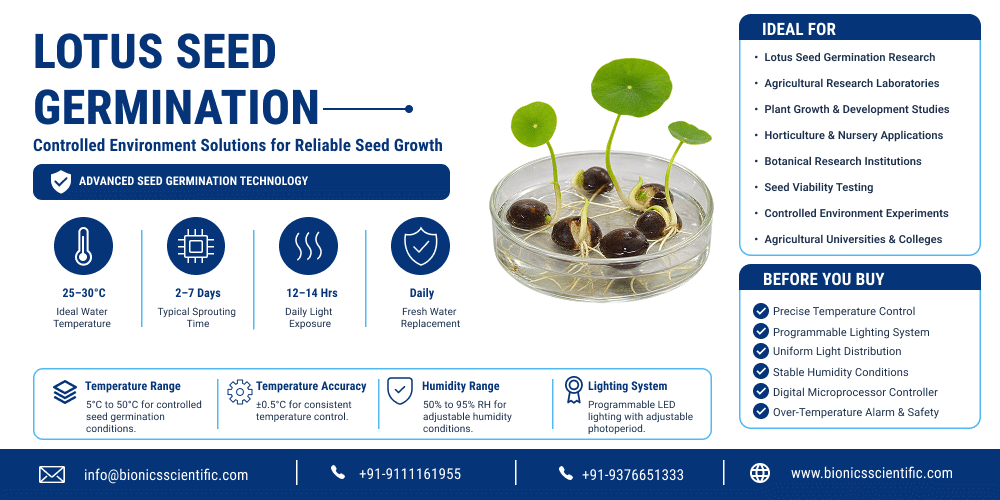
- Soak: use clean, non-chlorinated water at 25-30°C. Change it daily.
- Light: 12-14 hours of bright light.
- Sprout time: 2-7 days. First floating leaf: about 10-14 days.
- Move on: pot the seedling once it has two or three leaves.
Why Lotus Seeds Refuse to Sprout
The lotus (Nelumbo nucifera) protects its embryo with a hard, dense seed coat. Water cannot enter, so nothing happens, even in warm water. Botanists call this physical dormancy. You can read more about the plant itself in this overview of Nelumbo nucifera.
So the first step is never “add water.” It is “let water in.”
Step-by-Step Method
Step 1: Test Viability
Drop the seeds into a glass of water. Seeds that sink are usually viable. Seeds that float have often dried out or been damaged inside.
Step 2: Scarify the Shell
Hold the seed firmly. Using a nail file, sandpaper, or a small metal file, rub the rounded end (opposite the small pointed tip) until you see a cream-colored patch about the size of a pinhead to a lentil. Stop as soon as the kernel is visible. Going deeper damages the embryo.
Step 3: Soak in Warm Water
Place the nicked seeds in a clear container with rainwater, filtered water or tap water that has stood for a day. Chlorine and hard-water minerals slow things down. Keep the water between 25 and 30°C. A seed that is nicked and warm usually swells within 24 hours.
Step 4: Change the Water Every Day
Stagnant water breeds algae and rot. Refresh it daily, and discard any seed that turns soft or smells sour.
Step 5: Give Light
Place the container near a bright window or under a grow light for 12-14 hours. Lotus shoots stretch toward light and grow quickly once they emerge.
Step 6: Transplant
When the seedling has two or three small leaves and a few roots, move it to a pot of heavy loam or clay soil, cover it with a little water, and raise the water level as the plant grows.
Temperature Chart for Germination
Temperature does most of the work after the shell is broken. The ranges below come from common horticultural practice and the usual behavior of each seed type.
| Seed | Best Temperature | Typical Time to Sprout | Note |
| Lotus | 25-30°C (water) | 2-7 days after nicking | Scarify first. |
| Avocado | 20-25°C | 2-6 weeks | Suspend half-submerged. |
| Bean | 20-25°C | 3-7 days | Damp paper towels work. |
| Coconut | 28-32°C | 3-6 months | Needs humidity |
| Mango | 25-30°C | 1-3 weeks | Remove the outer husk. |
| Sage | 18-21°C | 10-21 days | Needs light |
| Hosta | 15-20°C | 3-6 weeks | Often needs a cold period first |
Below 20°C, lotus seeds stall. Above 35°C, they often rot before they sprout. This is why serious growers stop relying on a sunny windowsill, especially in places where room temperature swings widely.
How Lotus Compares With Other Seeds
Many buyers who search for lotus also research other crops, so here is how those seeds behave.
How to germinate an avocado seed: Push three toothpicks into the sides, rest the seed over a glass with the broad end down, and keep the water level at the base. Expect roots first, then a shoot.
Bean seed germination: The easiest test of all. Wrap seeds in a damp paper towel inside a bag. A common school seed germination project uses exactly this setup because roots appear within days.
Coconut seed germination: Slow and humidity-hungry. Keep the nut half-buried in warm, moist sand.
Mango seed germination: Split the husk, take out the kernel, and plant it flat in moist compost.
Sage seed germination: Sage seeds are small and need light, so press them onto the surface rather than burying them.
Germinating hosta seeds: These usually respond to a few weeks of cold, damp storage before warmth.
Types of seed germination: Botanists group germination into epigeal (seed leaves rise above ground, as in beans) and hypogeal (seed leaves stay below ground, as in peas). Knowing which type you have helps with planting depth.
Why a Controlled Chamber Beats a Windowsill
A window gives uneven heat, drifting light, and no humidity control, which ruins repeatable trials.
A purpose-built chamber holds temperature to a fraction of a degree, supplies steady light, and keeps humidity in range. In Gulf climates, where indoor air conditioning swings the room temperature, and in tropical countries like Indonesia, Malaysia, and the Philippines, where humidity runs high, a closed chamber removes the guesswork.
You can see how a chamber fits this work in our humidity temperature test chamber. For orbital incubation of liquid cultures alongside germination work, our shaking incubator is another option.
Typical Specifications: Seed Germination Chamber
The figures below describe a typical configuration. Final specifications are confirmed against your quotation.
| Parameter | Typical Specification |
| Temperature range | 5 °C to 50 °C |
| Temperature accuracy | ±0.5°C |
| Humidity range | 50% to 95% RH |
| Lighting | Programmable LED, adjustable photoperiod |
| Interior | Stainless steel (SS 304) |
| Capacity options | 150 L to 1000 L |
| Controller | Digital microprocessor with timer |
| Power supply | 220 V / 50 Hz or 110 V / 60 Hz (country-specific) |
| Safety | Over-temperature cut-off, alarm |
What Buyers Actually Ask Before Purchasing
Over 26 years, the same questions keep coming up:
- Will it hold temperature in a hot room? Compressor sizing matters in Gulf summers.
- Can I set a day-night cycle? Programmable steps suit lotus, hosta, and sage.
- Is humidity stable? Coconut and tropical seeds need it.
- What about voltage and plugs? We configure power by country.
- Who services it? Remote support and spare parts matter as much as the machine.
- Can it be validated? Research buyers want calibration records.
Supply Across the Middle East, Asia-Pacific, and Africa
Bionics Scientific ships to the United Arab Emirates (UAE), Saudi Arabia, Qatar, Oman, Kuwait, and Bahrain, with special attention to Middle East buyers working in extreme heat. We also supply Australia, Singapore, Malaysia, the Philippines, Indonesia, Vietnam, Bangladesh, Nepal, and Kenya, planning for power, documentation, and climate needs from the first enquiry.
Frequently Asked Questions
How long do lotus seeds take to germinate?
Usually 2-7 days after scarifying, in warm water.
Do I have to nick lotus seeds?
Yes. Without it, water cannot enter the hard shell.
What temperature is best?
Between 25 and 30°C.
Why are my lotus seeds floating?
They may be hollow or dried out. Sinking seeds are better.
Can I germinate lotus seeds without sunlight?
Not well. Use a grow light for 12-14 hours a day.
How often should I change the water?
Every day.
When should I transplant the seedling?
When it has two or three leaves and visible roots.
Why did my seed turn black or soft?
Usually rot from warm, dirty water. Discard it.
Can one chamber handle lotus, bean, and sage?
Yes, if you set the temperature for each batch.
Do you supply germination chambers to the Middle East?
Yes, including the UAE, Saudi Arabia, Qatar, Oman, Kuwait, and Bahrain.
Talk to Bionics Scientific
If you are planning a germination lab, a nursery trial, or a school research setup, our team can help you pick the right chamber size, temperature range, and light configuration. Share your seed type, batch size, and country, and we will send a matched quotation.
Contact Us for a quote or technical advice.