
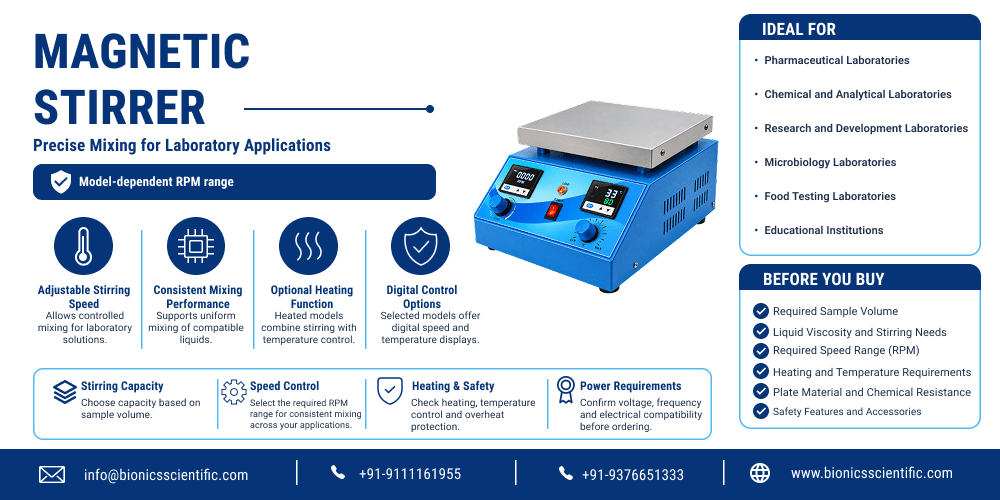
A magnetic stirrer price is the cost of a laboratory device that spins a stir bar inside a vessel using a rotating magnetic field. The figure depends mainly on stirring volume, speed stability, heating, and temperature control. Bionics Scientific has manufactured laboratory equipment for 35 years, and this guide explains what each price tier buys.
Quick Answer
- No-heat stirrer: lowest tier. Fits buffers, media, and teaching labs.
- Hot plate stirrer: mid-tier. The heating element and cutout add cost.
- Probe-controlled digital stirrer: upper tier. Holds liquid temperature closely.
- Multi-position or heavy-duty stirrer: top tier. More motors, larger plates.
- Lyophilizer equipment: a separate category, priced by shelf area and condenser capacity.
- Best value: buy for your working volume and viscosity, not the largest model listed.
Exact figures depend on specification, quantity, and destination. Request a written quotation.
What Decides the Magnetic Stirrer Price
- Stirring volume. A 20-litre unit needs a stronger magnet coupling than a 1-litre unit.
- Speed stability. Units that hold RPM as viscosity rises cost more than units that drift.
- Heating. A hot plate needs an element, a thermal cutout, and a surface that survives repeated heat cycles.
- Plate material. Ceramic-coated and stainless steel resist spills better than painted aluminum.
- Sensor type. An external PT100 probe reads the liquid, which is more accurate than reading the plate.
- Display. Digital set-and-actual readouts cost more than analogue knobs.
- Positions. Multi-position models run several beakers from one controller.
- Documentation. Calibration certificates add cost and save audit time.
Magnetic Stirrer Mixer: Specification Table
| Parameter | Standard | Hot Plate | Heavy-Duty |
| Max capacity | 5 L | 10 L | 20 L |
| Speed range | 100 to 1500 RPM | 100 to 1500 RPM | 50 to 1200 RPM |
| Plate | 135 mm, powder-coated | 155 mm, ceramic-coated | 280 x 280 mm, stainless steel |
| Heating | None | Up to 300°C | Up to 340°C |
| Sensor | None | Optional PT100 | PT100 included |
| Display | Analogue | Digital | Digital, set, and actual |
| Power | 230 V, 50 Hz | 230 V, 50 Hz | 230 V, 50 Hz |
Temperature Chart by Application
| Application | Working Temperature | Suggested Model |
| Buffer and media preparation | 20 to 40°C | Standard |
| Dissolving salts and sugars | 40 to 70°C | Hot Plate |
| Reagent heating | 70 to 150°C | Hot Plate |
| Reflux set-ups | 100 to 200°C | Heavy-Duty |
| Oil bath heating | 150 to 300°C | Heavy-Duty |
| Lyophilizer condenser (reference) | -50 to -80°C | Freeze dryer |
Without a probe, the liquid is always cooler than the plate. With a PT100 probe, control tightens to a few degrees.
15 Buyer Concerns, Answered
- Speed under load? Ask for torque data, not only the RPM range.
- Chemical resistance? Spills are routine, so check the plate coating.
- Overheat protection? A separate thermal cut-out is essential on hot plates.
- Probe support? Needed for reproducible results.
- Noise? Brushless motors run quietly on shared benches.
- Running nonstop? Look at the duty cycle for the overnight work.
- Warranty? Ask what it covers and for how long.
- Spare parts? You shouldn’t have too much trouble getting the stir bars, knobs, and probes.
- Landed cost? Write for freight, duty, and packing.
- Voltage? Specify your local supply at order point.
- Calibration papers? They are often requested by auditors.
- How long is delivery? Standard models ship faster than custom models.
- Help? If no local engineer exists, ask about remote troubleshooting.
- Bulk pricing? Multi-lab orders can be quoted collectively.
- Fit for sector? Pharma, food, agriculture, and research have different requirements.
Where Lyophilization Equipment Fits
Buyers comparing magnetic stirrer prices often evaluate lyophilization equipment in the same budget. The stirrer prepares an even solution or suspension. The lyophilizer equipment then freezes it and removes water by sublimation under vacuum. Even mixing before freezing gives uniform vials and steadier drying. Price both together so that the stirrer volume, shelf area, and condenser capacity match your batch size.
Supply Support by Country
Bionics Scientific exports to the United States (USA), United Kingdom (UK), United Arab Emirates (UAE), Saudi Arabia, South Africa, Canada, Australia, Singapore, Malaysia, Philippines, Indonesia, Kenya, Bangladesh, Nepal, Qatar, Oman, Kuwait, Bahrain, Vietnam, Thailand, Tanzania, Ghana, Sri Lanka, and New Zealand.
| Region | Countries | Typical Mains Supply |
| North America | USA, Canada | 120 V, 60 Hz |
| Europe and Oceania | UK, Australia, New Zealand | 230 V, 50 Hz |
| Gulf | UAE, Bahrain | 230 V, 50 Hz |
| Gulf | Qatar, Oman, Kuwait | 240 V, 50 Hz |
| Gulf | Saudi Arabia | 230 V, 60 Hz |
| Africa | South Africa, Tanzania, Ghana | 230 V, 50 Hz |
| Africa | Kenya | 240 V, 50 Hz |
| South Asia | Bangladesh | 220 V, 50 Hz |
| South Asia | Nepal, Sri Lanka | 230 V, 50 Hz |
| Southeast Asia | Singapore, Indonesia | 230 V, 50 Hz |
| Southeast Asia | Malaysia | 240 V, 50 Hz |
| Southeast Asia | Vietnam, Thailand | 220 V, 50 Hz |
| Southeast Asia | Philippines | 230 V, 60 Hz |
*Typical values only. Confirm your site supply and plug type before ordering.
Why Buy from Bionics Scientific
- 35 years of manufacturing of laboratory equipment.
- Application review first. Engineers recommend a model after understanding your sample, volume, and temperature.
- Documentation ready for audits and tenders.
- Export packing and voltage options for each market above.
Frequently Asked Questions
What is the average magnetic stirrer price?
It varies by tier. A basic unit costs far less than a heated, probe-controlled model. Volume, heating, and controls set the price, so request a quotation for your exact needs.
Why do two stirrers of equal capacity differ in price?
Motor quality, plate material, heater protection, and control accuracy differ. Lower-cost units often lose speed under load.
Is a hot plate stirrer worth the extra cost?
Yes, if you heat samples. One unit saves bench space and keeps heating and stirring in sync.
What size stirrer do I need?
Choose a capacity above your usual working volume. Running at the limit strains the magnet coupling.
Can a magnetic stirrer mixer handle thick liquids?
Moderately viscous liquids work. Very thick pastes need an overhead stirrer.
How accurate is the temperature control?
With an external PT100 probe, control is tighter than plate-only sensing. Ask for the tolerance on your model.
How does lyophilization equipment differ from a stirrer?
A stirrer mixes liquids. Lyophilization equipment freeze-dries them by removing ice under vacuum.
How do I choose lyophilizer equipment?
Match shelf area, condenser temperature, and chamber volume to your batch size and product.
Do you ship to my country?
Yes. We export to the USA, the UK, the UAE, Saudi Arabia, South Africa, Canada, Australia, Singapore, Malaysia, the Philippines, Indonesia, Kenya, Bangladesh, Nepal, Qatar, Oman, Kuwait, Bahrain, Vietnam, Thailand, Tanzania, Ghana, Sri Lanka, and New Zealand.
How do I get an exact quote?
Send your volume, temperature range, voltage, and quantity. Our team replies with a written quotation and delivery estimate.
Request Your Magnetic Stirrer Quote
Stop comparing incomplete price lists. Share your working volume, temperature range, and destination with Bionics Scientific. Our engineers will recommend the right stirrer and send a clear quotation. Need lyophilizer equipment too? We will price both together.
