Quick Answer
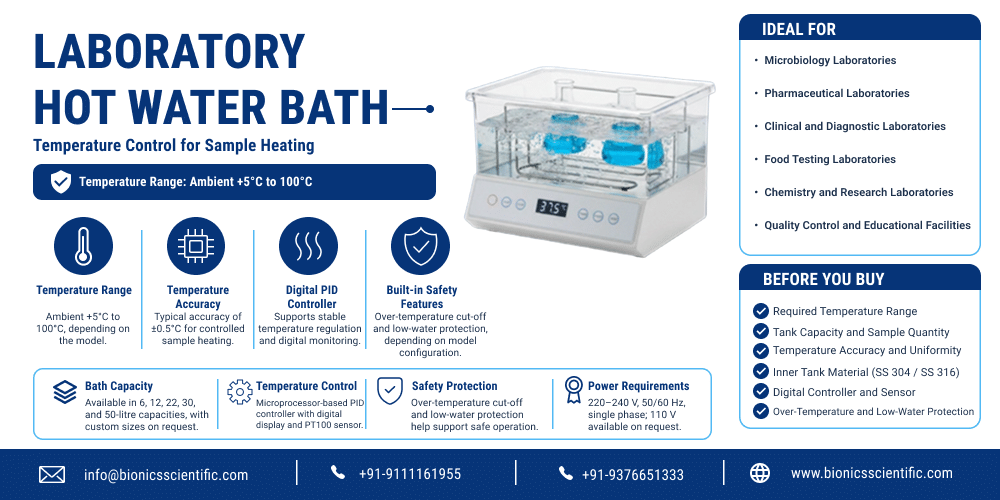
A laboratory hot water bath is a thermostat-controlled tank that holds samples at a set temperature, usually from ambient +5 °C to 100 °C, with water carrying the heat. Labs use it to melt agar, thaw reagents, run enzyme reactions, and warm samples without hot spots. Bionics Scientific has manufactured laboratory equipment for 35 years.
| Topic | One-line answer |
| Laboratory hot water bath | Heated water tank for uniform, gentle sample heating |
| Bacteriological incubator | Dry-air chamber for culturing microbes at 35-37°C |
| CO₂ incubator diagram | Shows chamber, gas sensor, heater jacket, HEPA filter, and water pan |
| Incubator in microbiology lab | Core tool for colony growth, sterility, and shelf-life tests |
| SOP of the incubator | Written steps for loading, set-point, cleaning, and logging |
| Stomacher / stomacher blender | Paddle blender that homogenizes food samples in sterile bags |
| Incubator shaker diagram | Shows platform, orbital drive, heater, and clamp layout |
What a Laboratory Hot Water Bath Does
The unit is a stainless steel tank with a heater, a sensor, and a controller. Water transfers heat into flasks and tubes more evenly than air, and it removes the open-flame risk when you warm flammable liquids.
Typical jobs in microbiology, food, pharma, and clinical labs:
- Holding molten agar at 45-50°C before plates are poured
- Thawing serum and frozen reagents
- Running enzyme assays and digestions
- Bringing samples to temperature before analysis
What Buyers Ask Before Ordering
Temperature range. Most routine work sits between 30 °C and 80 °C. Pay for a 100°C model only if your method needs it.
Uniformity. Ask for ±0.5°C or better at your working setpoint. Weak uniformity spoils enzyme and media work, and an auditor will ask for the evidence.
Tank material. SS 304 suits general use. SS 316 resists chlorides better if you add salts or saline solutions.
Safety. A separate over-temperature cut-off and low-water protection matter when the bath runs unattended.
Control. A digital PID controller holds the set point tighter than an analog dial and shows the real reading.
Capacity. Count the vessels you heat together and add about 25% headroom for racks and water movement.
Documents. Export buyers usually need a calibration certificate, a manual and clear warranty terms before approving a purchase order.
Support. Confirm who supplies spares and service in your country before you buy.
Specification Table
The values below are typical for Bionics Scientific laboratory hot water baths. Confirm exact figures for your model in the quotation.
| Parameter | Specification |
| Temperature range | Ambient +5°C to 100°C |
| Accuracy | ±0.5°C |
| Uniformity | ±0.5°C at 37°C and 60°C |
| Controller | Microprocessor PID, digital display |
| Sensor | PT100 |
| Inner tank | SS 304 (SS 316 optional) |
| Outer body | Powder-coated mild steel or stainless steel |
| Heater | Stainless sheathed immersion heater |
| Capacity | 6, 12, 22, 30, and 50 liters; custom sizes on request |
| Safety | Over-temperature cut-off, low-water protection |
| Lid | Flat or gabled stainless steel |
| Power | 220-240 V, 50/60 Hz, single phase (110 V on request) |
| Accessories | Tube racks, flask clamps, drain valve |
Temperature Chart by Application
| Application | Typical set-point | Note |
| Thawing serum and reagents | 25-37°C | Move vials gently and avoid long holds. |
| Holding molten agar | 45-50°C | Stops setting without damaging media |
| Enzyme reactions | 37-60°C | Follow the enzyme data sheet |
| Water-bath digestion | 60-80°C | Use a lid to limit evaporation. |
| Pasteurization checks | 63-72°C | Follow your standard’s method. |
| Boiling work | 95-100°C | Needs a model rated for 100°C |
Where It Sits Among Other Microbiology Equipment
Bacteriological incubator. A dry-air chamber that holds plates and tubes at 35-37°C for culture growth. The water bath warms and holds liquids; the incubator grows organisms over hours or days. Many labs melt and hold agar in the bath, pour plates, then incubate them.
Incubator in microbiology lab. It supports colony counts, sterility testing, environmental monitoring, and shelf-life studies. Stable temperature matters most.
CO₂ incubator diagram. A standard diagram shows the insulated chamber, heater jacket, CO₂ sensor, gas inlet, HEPA filter, and water pan. Cell culture work usually runs at 37°C with 5% CO₂.
Incubator shaker diagram. It shows an orbital platform, drive motor, flask clamps, heater, and fan. Use this type when broth cultures need aeration.
Stomacher and stomacher blender. Paddles press a food sample inside a sterile bag and release microbes into the diluent without cutting them. Food labs run the stomacher first, then temper tubes in a water bath and incubate the plates.
SOP for a Laboratory Hot Water Bath
- Place the bath on a level, dry bench.
- Fill with distilled or deionized water to the marked level.
- Close the drain valve and fit the lid.
- Set the target temperature and wait until the display matches a reference thermometer.
- Load vessels so water covers the sample level but stays below the cap.
- Record set point, actual reading, date, and operator.
- After use, switch off, cool, drain, and wipe the tank.
- Calibrate against a traceable thermometer at least once a year.
The SOP of incubator use follows the same logic: log temperature, limit door openings, clean with an approved disinfectant, and keep calibration records.
Care Tips
Never run the heater with low water. Change the water weekly, or sooner if it turns cloudy. In humid climates such as Singapore, Malaysia, Indonesia, and Thailand, check lids and seals more often. In hard-water areas, including parts of the Middle East and South Africa, distilled water protects the heater.
Why Bionics Scientific
Bionics Scientific brings 35 years of manufacturing experience to every unit. Buyers in the United States (USA), United Kingdom (UK), United Arab Emirates (UAE), Saudi Arabia, South Africa, Canada, Australia, Singapore, Malaysia, the Philippines, Indonesia, Kenya, Bangladesh, Nepal, Qatar, Oman, Kuwait, Bahrain, Vietnam, Thailand, Tanzania, Ghana, Sri Lanka, and New Zealand choose our equipment for microbiology, food, pharma, and research work.
Frequently Asked Questions
What is a laboratory hot water bath used for?
It heats samples evenly in controlled-temperature water. Common uses include thawing, holding agar, and running enzyme reactions.
What temperature range is available?
Most units run from ambient +5 °C to 100 °C. Choose by your method, not by the maximum figure.
Is a hot water bath the same as a bacteriological incubator?
No. A water bath heats liquids through water contact, while a bacteriological incubator holds air at about 35-37°C for culture growth.
Should I use distilled water?
Yes. It reduces scale on the heater and tank and keeps readings steady.
How often should the water be changed?
Weekly is a sound rule, and sooner if the water looks cloudy.
What does a stomacher do?
It homogenizes food or solid samples in a sterile bag with paddles, releasing microbes into the diluent for testing.
How does a stomacher blender differ from a normal blender?
It does not cut or heat the sample. Paddles squeeze the bag from outside, which protects microbes and avoids cross-contamination.
What parts appear in a CO₂ incubator diagram?
The chamber, heater jacket, CO₂ sensor, gas inlet, HEPA filter, and water pan.
How often should a water bath be calibrated?
At least once a year against a traceable thermometer, or as your quality system requires.
Does Bionics Scientific export hot water baths?
Yes, to all 24 countries listed above, with export packing and documentation.
Request a Quote
Send us your temperature range, capacity and country, and Bionics. Scientific will recommend the right laboratory hot water bath for your lab. Contact our team today for specifications and pricing.