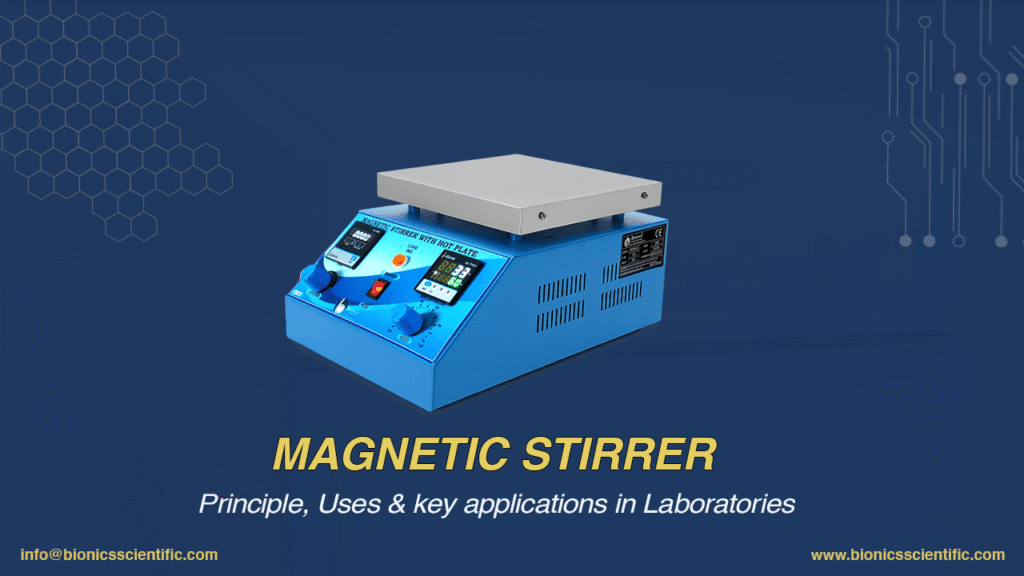
A magnetic stirrer is an instrument that is used to mix liquids by applying a magnetic field on them. A magnetic stirrer does not have any physical connection with the liquids. The stirring process is done through rotating a magnet attached to the base of the machine which rotates inside the liquid medium.
They find their application in chemistry, pharmaceuticals, microbiology, environmental studies, educational, and research laboratories. Depending on the type of application, people may select between analogue, digital, hot plate, and multiple magnetic stirrers.
Here in this article, you will learn about working principles of magnetic stirrers, types, benefits, applications, drawbacks, price in India, and selection.
Looking for reliable magnetic stirrers for your lab? Bionics Scientific Technologies offers advanced models designed for precision, durability, and safe operation.
Quick Answer
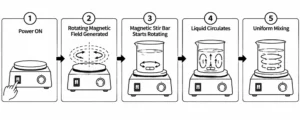
A magnetic stirrer is a laboratory instrument used for automatic mixing of liquids using a rotating magnetic field. It works by creating a rotating magnetic field that spins a stir bar placed in the solution, laboratory magnetic stirrer which ensures uniform and quiet mixing without any direct contact with the sample.
How Magnetic Stirrer Works
Types of Magnetic Stirrers
1. Analogue Magnetic Stirrer
Ideal for basic laboratory mixings where fine speed regulation is not required.
2. Digital Magnetic Stirrer
Ensures accurate speed regulation as well as the regulation of temperature if the model supports it.
3. Magnetic Stirrer and Hot Plate
Used for the simultaneous liquid mixing and heating process.
4. Multi-Position Magnetic Stirrer
Helps to mix different samples at one time.
|
Feature |
Details |
|
Main purpose |
Uniform mixing of liquids |
|
Working principle |
Magnetic coupling |
|
Mixing element |
Magnetic stir bar |
|
Typical control |
Analogue or digital |
|
Heating option |
Available with hot plate models |
|
Typical applications |
Research, pharmaceutical, chemical, microbiology and educational labs |
|
Main advantage |
Mixing without a mechanical shaft |
Principle of Magnetic Stirrers
A stirrer works on the principle of magnetic coupling. When the device is switched on, a rotating magnetic field is produced by magnets/electromagnets located beneath the plate. This field interacts with the magnetic stir bar immersed in the solution, which causes it to rotate and mix the liquid efficiently. The absence of direct mechanical contact significantly reduces the risk of contamination, making magnetic stirrers suitable for applications where controlled, low-disturbance mixing is required.
For deeper understanding of laboratory mixing techniques, you can refer to standard laboratory guidelines.
Advantages of Magnetic Stirrer
- Uniform and consistent mixing
- Reduced contamination risk due to the absence of a mechanical shaft
- Low maintenance compared with many mechanical mixing systems
- Quiet operation for laboratory environments
- Suitable for continuous mixing in appropriate applications
Key Features of Magnetic Stirrer
- Uniform and precise mixing for reproducible results.
- Minimal contamination: only the stir bar contacts the liquid.
- Ideal for sensitive reactions: no shaking or overheating.
- It is versatile to use with flasks, beakers, and test tubes.
- Compact and durable design for daily lab work.
Applications
These are widely used across industries and research fields, including:
Chemical & Research Laboratories
- Chemical solution preparation
- Reaction studies
- Evaporation-related processes
Pharmaceutical & Biotech
- Drug formulation
- Buffer preparation
- Media preparation
Environmental Laboratories
- Water sample preparation
- Soil sample testing
Education
- Laboratory demonstrations
- Student experiments
Limitations of Magnetic Stirrer
Not suitable for high viscosity liquids
Limited capacity for large volume mixing
Stir bar may slip at very high speeds
Not ideal for dense or heavy materials
Magnetic Stirrer with Hot Plate: Working & Applications
For multiple different experiments that require both heating and stirring, a magnetic stirrer with a hot plate is the ideal solution. Titrations, microbiology labs (for cell culture growth), and organic chemistry studies frequently utilise these models, which require controlled heating.
Explore our magnetic stirrer hot plate models to find the right solution for your laboratory needs.
Typical Specifications
- Temperature Range: 300 to 500°C
- Speed Range: 100 to 1500 RPM
- Plate Material: Ceramic or Aluminium
- Control Type: Digital / Analog
- Safety Features: Overheat protection and auto shutoff
How to Choose the Right Magnetic Stirrer
1. Sample volume – Choose a model capable of handling your required volume.
2. Viscosity – Highly viscous liquids may require mechanical stirring instead.
3. Heating requirement – Choose a hot plate model if heating and stirring are both required.
4. Speed range – Check whether the available RPM range matches your application.
5. Temperature control – Important when the experiment requires controlled heating.
6. Number of samples – Multi-position models are useful when several samples need simultaneous mixing.
7. Plate material – Consider ceramic or aluminium based on your application and temperature requirements.
8. Safety features – Look for overheat protection, suitable controls, and other safety features.
For labs where heating is a daily routine requirement, the magnetic stirrers with hot plate magnetic stirrer are strongly recommended.
Magnetic Stirrer Price in India
Magnetic stirrer prices in India vary depending on stirring capacity, RPM range, heating capability, control type, plate material, number of positions, and additional safety or programming features.
Basic magnetic stirrer: ₹5,000 – ₹15,000
Digital magnetic stirrer: ₹15,000 – ₹40,000
Magnetic stirrer with hot plate: ₹20,000 – ₹80,000+
Contact us to get the best price based on your laboratory requirements.
Prices may vary based on brand, capacity, and additional features like digital control and heating functionality.
Magnetic Stirrer vs Hot Plate Magnetic Stirrer
|
Magnetic Stirrer |
Magnetic Stirrer with Hot Plate |
|
Primarily used for mixing |
Used for mixing and heating |
|
No integrated heating plate |
Integrated heating plate |
|
Suitable when heating isn’t required |
Suitable when both functions are required |
|
Generally simpler setup |
More versatile setup |
Why Magnetic Stirrers Are Essential in Modern Laboratories
From educational labs to high-end research centres, these ensure safe and efficient mixing. Their reliability makes them a must-have for every laboratory seeking accuracy and consistency.
With years of industry experience and reliable installations across laboratories, Bionics Scientific ensures quality, performance, and long-term support.
Upgrade your laboratory with high-performance magnetic stirrers designed for precision and durability. Get expert consultation, best pricing, and fast delivery from Bionics Scientific Technologies. Request your quote today.
To know more about these Autoreverse magnetic stirrers with tachometers, contact us by email or just fill out the query form on the right side. Our support team will assist you with complete information you need, including price, quotation, warranty and delivery details.
FAQs
What is a magnetic stirrer used for?
It is used for uniform mixing of liquids in laboratories.
Can a magnetic stirrer heat liquids?
Only magnetic stirrers with hot plate models can heat liquids.
What is the RPM range of a magnetic stirrer?
The RPM range varies by model. Many laboratory magnetic stirrers operate around 100–1500 RPM, while some models may offer different speed ranges depending on their design and application.
What is the price of a magnetic stirrer in India?
Prices start from ₹5,000 and vary based on features.
Which magnetic stirrer is best for lab use?
It depends on your requirement. For heating and mixing, hot plate models are recommended.
Magnetic Stirrer vs Mechanical Stirrer: What Is the Difference?
Magnetic stirrers use a magnetic field for mixing, while mechanical stirrers use a motor-driven shaft, making them suitable for high viscosity liquids.