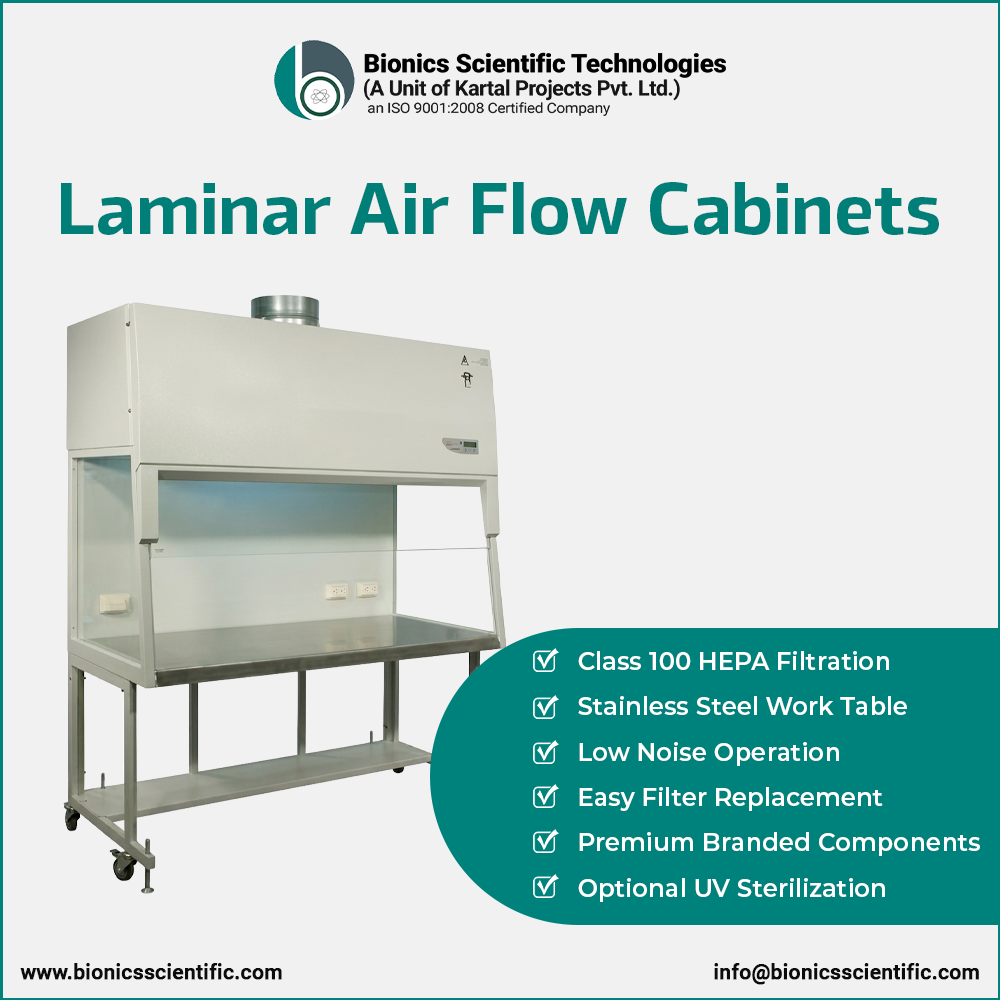
Laminar Air Flow Cabinet Manufacturer in India
Horizontal & Vertical Laminar Air Flow Cabinets
What is a Laminar Air Flow Chamber?
A laminar air flow chamber is laboratory equipment designed to provide a HEPA-filtered clean work environment for contamination-sensitive procedures. It is widely used in microbiology, tissue culture, pharmaceutical, biotechnology and electronics laboratories.
A laminar air flow cabinet provides a controlled work area using HEPA-filtered, unidirectional airflow. It is designed primarily to help protect samples, products and sensitive materials from airborne contamination during laboratory and clean-work procedures.
Laminar flow cabinets are commonly used for microbiology, tissue culture, pharmaceutical research, biotechnology, electronics and other contamination-sensitive applications. Depending on the required workflow, cabinets are available with either horizontal or vertical airflow configurations.
For additional clean-air equipment and configurations, explore our Cleanroom Equipment range.
Laminar Air Flow Cabinet Working Principle
A laminar air flow cabinet works by passing air through a filtration system and directing HEPA-filtered air uniformly across the work area. The controlled airflow helps reduce airborne particles and contamination around samples and materials.
- Room air enters the cabinet through a pre-filter, which helps remove larger airborne particles.
- A blower moves the pre-filtered air toward the HEPA filtration system.
- The HEPA filter removes fine airborne particles according to the filter grade and supplied configuration.
- Filtered air then moves across the work area in a uniform, unidirectional flow.
- In horizontal models, clean air moves from the rear of the cabinet toward the front.
- In vertical models, clean air moves downward from the top toward the work surface.
This controlled airflow is primarily intended to protect the product or work area from airborne contamination. A laminar air flow cabinet should not be treated as a substitute for a biological safety cabinet when personnel or environmental protection is required.
Laminar Air Flow Chamber Uses
A laminar air flow chamber is widely used to provide a controlled clean-air environment for handling sensitive materials, biological samples and laboratory processes. The continuous flow of HEPA-filtered air helps protect products and experiments from airborne contamination.
- Microbiology Laboratories: Used for microbial culture preparation, sample handling and testing procedures that require clean air conditions.
- Tissue Culture Laboratories: Provides an aseptic environment for plant tissue culture, cell culture and other contamination-sensitive applications.
- Pharmaceutical Industry: Supports sterile drug preparation, quality control testing and research activities where contamination control is essential.
- Biotechnology Research: Helps researchers safely handle biological samples, media and reagents under clean working conditions.
- Electronics Manufacturing: Protects semiconductor devices, circuit boards and precision electronic components from dust and airborne particles.
- Medical and Research Laboratories: Used for sterile sample preparation, laboratory experiments and handling sensitive materials.
- Food and Beverage Testing Laboratories: Assists in microbiological testing and quality assurance processes requiring contamination-free environments.
Laminar air flow cabinets are used in microbiology, biotechnology, pharmaceutical, research and electronics applications where controlled clean airflow is required to reduce airborne contamination of products or work materials.
Vertical Vs Horizontal Laminar Flow
| Feature | Horizontal Laminar Flow | Vertical Laminar Flow |
|---|---|---|
| Air Direction | Back to Front | Top to Bottom |
| Primary Protection | Product / work area | Product / work area |
| Application | Microbiology, Tissue Culture | Pharma, Electronics |
In a horizontal laminar air flow cabinet, HEPA-filtered air moves across the work zone from the rear toward the front. In a vertical laminar air flow cabinet, filtered air moves downward from the top toward the work surface. Both configurations are primarily designed to protect the product or work area from airborne contamination. The suitable airflow direction depends on the application, workspace layout and process requirements.
Laminar Air Flow Cabinet Manufacturer in India
Bionics Scientific manufactures and supplies horizontal and vertical laminar air flow cabinets for laboratory, research and contamination-control applications. The cabinets are available in multiple standard working sizes, with construction and optional accessories selected according to laboratory requirements.
Available configurations include HEPA filtration, stainless steel work surfaces, airflow control and optional accessories for different laboratory applications. For model selection, specifications, customization options and current pricing, contact Bionics Scientific with your required working size and application.
Precautions for Using a Laminar Air Flow Cabinet
- Clean the work surface before and after use according to the laboratory's approved cleaning procedure.
- Do not block the cabinet's airflow openings while equipment or materials are placed inside the work area.
- Allow the airflow system to operate according to the manufacturer's recommended procedure before starting work.
- Use appropriate personal protective equipment according to the laboratory procedure and materials being handled.
- If the cabinet is equipped with a UV lamp, operate it only according to the manufacturer's instructions and avoid direct exposure to UV radiation.
- Check filters, airflow performance and other components according to the recommended maintenance schedule.
Benefits of Laminar Air Flow Cabinet
- Delivers filtered airflow in the work zone.
- Can prevent contamination of samples or materials by air particles.
- Can provide a controlled clean airflow environment for procedures prone to contamination.
- Suitable for laboratory sample preparation and manipulation.
- Available in horizontal and vertical airflow configurations for different laboratory requirements.
Laminar Air Flow Features:
| HEPA filtration for controlled clean airflow | Cleanliness performance depends on the selected model and system configuration |
| Optional UV lamp for work-area decontamination when used according to the manufacturer's instructions | Stainless steel work table |
| Low noise level | Made from branded parts (blower etc.) |
| High airflow capacity | Easy to change filters |
Standard Dimensions
| Model | BST/VLAF-22 | BST/VLAF-32 | BST/VLAF-42 | BST/VLAF-62 | BST/VLAF-82 |
|---|---|---|---|---|---|
| Working Size | 2’x2’x2’ | 3’x2’x2’ | 4’x2’x2’ | 6’x2’x2’ | 8’x2’x2’ |
| Size of HEPA Filter | 2’x2’x6” | 3’x2’x6” | 4’x2’x6” | 3’x2’x6” | 4’x2’x6” |
| No. of HEPA Filter | 1 | 1 | 1 | 2 | 2 |
Laminar Air Flow Cabinet Specifications:
| Cleanliness | Clean-air performance depends on the selected model, HEPA filter configuration and operating conditions |
| Velocity | 90 FPM ±20% |
| HEPA Filter | HEPA filtration system; filter efficiency and grade depend on the selected model and supplied configuration |
| Pre-Filter | Washable pre-filter for initial removal of larger airborne particles |
| Cleanliness Performance | To be confirmed according to the selected model, filter configuration and applicable cleanroom requirements |
| Cabinet | Laminated High Quality Wooden Board /PCRC Sheet Powder Coated/Stainless Steel SS 304 (optional 316 grade) |
| Work Table | 304 Stainless Steel (optional 316 grade) |
| Airflow Speed | Control Speed Controller (Three Step Speed Controller) |
| Blower | High efficient centrifugal type with lifetime lubricated bearings |
| Light | High intensity, low wattage >800 lux |
| Noise Level | <55 dBA |
| Standard Accessories | Air/gas cock and mains power socket (16A) |
| Power Supply | 220-230 V,50 Hz. |
| Optional Accessories | - Microprocessor LCD Controller - Digital display for air flow rate - Transparent Front Door - Gauges Pressure (Statics Pressure Mano-Mater) - Magnahelic Gauge (for filter pressure) - U. V. Germicidal Tube in work area - Electronic Filter choke alarm - Spare HEPA Filters - Auto switch on/off for U.V. Germicidal tube & fluorescent light - Hour Meter for UV light |
Frequently Asked Questions
What is a laminar air flow cabinet used for?
A laminar air flow cabinet provides a HEPA-filtered clean work area for contamination-sensitive laboratory procedures. It is commonly used for sample preparation, microbiology, tissue culture, pharmaceutical research, biotechnology and electronics applications.
How does a laminar air flow cabinet work?
Room air passes through a pre-filter and is moved by a blower toward the HEPA filtration system. The filtered air then flows uniformly across the work area in either a horizontal or vertical direction, depending on the cabinet design.
What is the difference between horizontal and vertical laminar air flow?
Horizontal laminar flow directs filtered air from the rear of the cabinet toward the front. Vertical laminar flow directs filtered air downward from the top toward the work surface. The suitable configuration depends on the application and workspace requirements.
Does a laminar air flow cabinet protect the operator?
A laminar air flow cabinet is primarily designed to protect the product or work area from airborne contamination. It should not be used as a substitute for a biological safety cabinet when personnel or environmental protection is required.
Why is a HEPA filter used in a laminar air flow cabinet?
A HEPA filter helps remove fine airborne particles before filtered air enters the work zone. The filter grade and efficiency depend on the selected cabinet model and supplied configuration.
What sizes of laminar air flow cabinets are available?
Bionics Scientific offers multiple working sizes, including 2 ft, 3 ft, 4 ft, 6 ft and 8 ft configurations. The appropriate size depends on the required work area, laboratory space and application.
How should I choose a laminar air flow cabinet?
Consider the required working size, horizontal or vertical airflow configuration, construction material, filtration requirements and optional accessories. Model selection should be based on the laboratory process and contamination-control requirements.
What is the price of a laminar air flow cabinet in India?
The price depends on cabinet size, airflow configuration, construction material, filtration system and optional accessories. Contact Bionics Scientific with your required working size and application for current model specifications and pricing.
Request a Quote for Laminar Air Flow Cabinet
Share your required working size, airflow configuration and laboratory application to receive suitable model details, specifications and current pricing.