Quick Answer
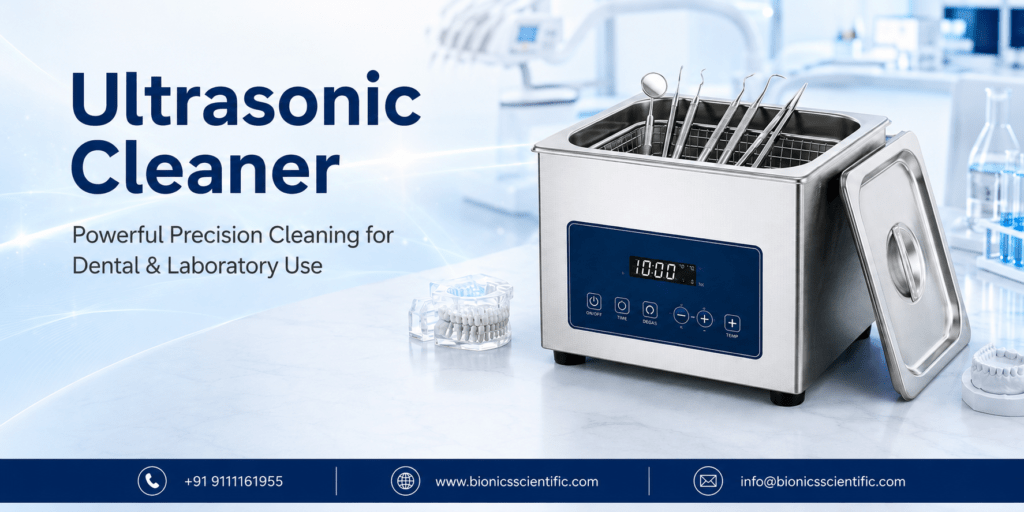
An ultrasonic cleaner uses high-frequency sound waves (typically 28–80 kHz) to create microscopic cavitation bubbles that remove debris, biofilm, and residue from instruments submerged in a liquid bath. Dental clinics generally need a 37–40 kHz bath cleaner sized to their daily instrument volume, while labs needing to break open cells or homogenize samples need a probe sonicator instead—a different tool built for sample disruption, not surface cleaning. Match frequency and basket capacity to your actual workload before comparing price.
If you’re comparing an ultrasonic cleaner for your clinic or lab, this guide is built for buyers—match tank size, frequency, and build quality to your real workload before you order.
Bionics Scientific manufactures ultrasonic cleaning systems and probe sonicators for dental clinics, diagnostic labs, and pharmaceutical QC departments.
What an Ultrasonic Cleaner Actually Does
An ultrasonic cleaner runs on one physical principle: cavitation. A generator drives transducers bonded to the tank, producing high-frequency sound waves—typically 28–80 kHz—through a liquid bath. Those waves create millions of microscopic vacuum bubbles that collapse against submerged surfaces, releasing a concentrated burst of energy that lifts dirt, biofilm, and residue out of hinges and crevices a brush cannot reach.
This is relevant for buyers because the frequency you choose changes cleaning behavior:
- Lower frequencies (28–40 kHz) produce larger, more aggressive cavitation bubbles—better for heavy soil, castings, and robust metal instruments.
- Higher frequencies (40–80 kHz) produce smaller, gentler bubbles—better for delicate, polished, or precision instruments where surface damage is a concern.
Ultrasonic Dental Cleaning Machines: Why Clinics Standardize on Them
In a dental setting, manual scrubbing before autoclaving is slow and carries a sharps-injury risk. An ultrasonic dental cleaning machine removes blood, saliva, cement, and tissue debris from forceps, scalers, burs, and handpiece components, including joints that manual cleaning misses.
Three things determine whether a unit fits a practice’s daily volume:
- Basket capacity, not tank capacity. Instruments must sit fully submerged without touching, or “shadowing” leaves zones the waves can’t reach.
- Solution turnover. Replace the solution daily at minimum, and immediately if visibly soiled.
- Cycle consistency. A digital timer and thermostat matter more than a display screen—the goal is a repeatable cycle regardless of who runs it.
For most dental cleaning tools, 37–40 kHz balances cleaning power and instrument safety, which is why it’s the default across clinical-grade machines. In most sterilization workflows, the ultrasonic cleaner sits alongside other dental cleaning tools — instrument cassettes, drying racks, and the autoclave itself — as one stage in a full reprocessing chain, not a standalone fix.
Ultrasonic Cleaner vs. Probe Sonicator: You May Need Both
This is where buyers most often get confused, since both use ultrasonic energy but solve different problems.
A bath-style ultrasonic cleaner handles surface cleaning—instruments, glassware, and small parts in a tank. A probe sonicator (sonicator instrument) is different: it uses a titanium probe inserted into a sample to disrupt cells, homogenize tissue, or break emulsions at controlled intensity. Labs doing DNA/RNA extraction, cell lysis, or nanoparticle dispersion need a probe sonicator, not a bath.
Probe sonicator prices vary more than bath cleaners because output power, probe material, and amplitude control drive cost—fixed-probe entry units sit lower; variable-amplitude systems with pulse control sit higher, usually justified by reproducibility.
Matching the Machine to Your Buying Scenario
Buyers rarely start with a frequency number — they start with a problem. Here’s how it usually maps to a purchase:
- Solo/small dental practice: 2–5 L, 37–40 kHz clinical bath cleaner, digital timer—rapid turnaround over max capacity.
- Multi-chair clinic, reprocessing bottleneck: larger basket (6 L+), heater for baked-on debris, built-in rating for continuous daily use.
- Diagnostic/pharma QC lab: lab-grade bath with degas, adjustable temperature, multi-cycle programmability—documentation matters as much as power.
- Cell lysis, DNA/RNA extraction, tissue homogenization: a bath won’t do the job — you need a probe sonicator with amplitude control and pulse cycling.
- Unsure if you need one machine or two: most labs end up with a bath cleaner for glassware and a separate probe sonicator for samples—forcing one machine to do both breeds buyer’s remorse.
The budget should follow the use case: oversizing wastes capital, and undersizing means replacing the unit within a year.
Specification Table: What to Compare Line by Line
| Specification | Compact Dental Unit | Standard Clinical Unit | Lab-Grade Bath Cleaner | Probe Sonicator |
| Capacity | 1–3 L | 3–6 L | 6–30 L | Sample-based |
| Frequency | 40–45 kHz | 37–40 kHz | 28–40 kHz | 20 kHz typical |
| Heater | Optional | Up to 60°C | Adjustable | N/A |
| Timer | Manual/digital | Digital, programmable | Digital, multi-cycle | Pulse-controlled |
| Tank material | Stainless steel | SUS304 steel | SUS304/316 steel | Titanium probe |
| Degas’s function | Rarely | Optional | Standard | Via pulse |
| Typical use | Solo/small clinic | Multi-chair clinic | Diagnostic/pharma lab | Cell lysis, extraction |
| Price band | Entry-level | Mid-range | Mid-high | Varies with power |
Comparison Table: Cleaning Method vs. Outcome
| Method | Reaches crevices | Risk to delicate parts | Staff time | Consistency | Sharps risk |
| Manual scrubbing | Poor | Moderate–high | High | Low | High |
| Bath ultrasonic cleaner | Excellent | Low | Low | High | Low |
| Automated washer-disinfector | Good | Low | Low | High | Low |
| Probe sonicator (sample prep) | N/A | Sample-dependent | Low | High | Low |
Power Supply, Safety Features, and What’s Included
Buyers often price-compare tank size and frequency but skip three details that affect daily use:
- Power supply. Most bench and clinical units run on single-phase AC, commonly 220–240V/50Hz in Indian clinics and labs, though 110V/60Hz variants exist for other markets—always confirm voltage compatibility before ordering, especially for imported units.
- Safety features. Look for auto shut-off on overheating, a low-liquid-level cutoff (running dry damages the transducer), and a lid interlock or splash guard. These aren’t optional extras in a clinical or lab setting—they protect both the equipment and the operator.
- What’s actually included. A unit’s listed price may or may not include the mesh basket, lid, and drain valve—some suppliers bundle these; others sell them separately. Cassette racks, extra baskets, or a stand are usually optional add-ons. Confirm the full in-box list before comparing prices across suppliers.
How to Verify a Unit Is Actually Cleaning Properly
A simple aluminum-foil test confirms cavitation coverage before you trust a machine with real instruments: submerge a strip of household foil vertically in the filled tank, run a 3–5 minute cycle, and then check the foil. Even, evenly distributed pitting or small perforations across the strip indicate good cavitation coverage; patchy or one-sided pitting points to dead zones in the tank—worth flagging with the supplier before the warranty window closes.
Installation and Space Considerations
- Bench or countertop space: Confirm footprint against your sterilization or lab bench, including clearance for the lid to open fully.
- Drainage access: Units with a bottom drain valve need a floor drain or catch tray nearby—checking this before installation avoids awkward workarounds later.
- Noise levels: most ultrasonic cleaners run in the 50–70 dB range, comparable to normal conversation—a factor if the unit sits in a shared clinical space.
- Ventilation: heated units generate some ambient warmth during extended cycles, so avoid enclosed cabinets with no airflow.
- Match frequency to your instrument mix, not the cheapest listing.
- Confirm basket dimensions, not just tank liters—an oversized tank with an undersized basket wastes capacity.
- Ask for actual power draw and cavitation intensity; two machines with the same tank size can perform very differently.
- Check after-sales support and warranty terms — downtime on a daily-use workhorse has a direct cost.
- For probe sonicators, confirm amplitude range and pulse control, since fixed-output units limit what protocols you can run.
Bulk and Institutional Orders
Dental colleges, hospital chains, diagnostic lab networks, and pharmaceutical companies often need multiple units across departments or branches, sometimes with matching specifications for standardized protocols. If you’re ordering at that scale, ask upfront about bulk pricing, customization (tank size, frequency, or basket configuration), and consolidated delivery—most manufacturers, including Bionics Scientific, handle institutional and multi-unit orders differently from single-unit retail purchases.
Why Buyers Choose Bionics Scientific
Bionics Scientific builds ultrasonic cleaning and sonication equipment for dental, diagnostic, and pharmaceutical environments—stainless steel construction, digital cycle control, and frequency options matched to real workloads rather than a one-size-fits-all design. Specification sheets and application-specific guidance are available directly from our technical team before you order.
Frequently Asked Questions
What frequency ultrasonic cleaner is best for dental instruments?
37–40 kHz — it balances strong debris removal with low risk to delicate instruments.
How is a probe sonicator different from a bath ultrasonic cleaner?
A bath cleans surfaces in a tank; a probe sonicator inserts into a sample to disrupt cells or homogenize tissue.
Why does probe sonicator price vary so much between models?
Output power, amplitude control, probe material, and pulse-cycling support all drive cost.
Can an ultrasonic cleaner fully sterilize dental instruments?
No — it’s a pre-cleaning step before autoclaving, not a sterilization method.
How often should ultrasonic cleaning solution be changed?
At least once daily, and immediately if visibly soiled.
What tank size does a small dental clinic actually need?
2–5 liters for solo/small practices; 6 liters or more for multi-chair clinics.
Does a higher frequency always mean gentler cleaning?
Generally yes — higher frequencies produce smaller, gentler bubbles suited to delicate instruments.
Can the same machine handle both dental instruments and lab glassware?
Yes, if basket and tank dimensions fit both, though dedicated clinical units add dental-specific features.
What causes incomplete cleaning even with a working unit?
Overcrowding the basket—instruments touching creates “shadow zones” waves can’t reach.
Is it worth paying more for a degas function?
Yes, for lab-grade work, degassing removes dissolved air that otherwise weakens cavitation.
Get the Right Machine the First Time
Choosing between tank sizes, frequencies, and probe sonicator specifications shouldn’t be guesswork. Talk to the Bionics scientific and technical team with your instrument list and daily volume, and get a specification match—not a generic recommendation—before you buy.
Contact Bionics Scientific today to get a tailored ultrasonic cleaner or sonicator recommendation for your clinic or lab.