- What is an autoclave?
- How Does the Sterilization Process Work?
- Manual vs. Automatic Autoclaves: A Quick Comparison
- Key Features to Consider When Choosing an Autoclave
- How to Use an Autoclave
- Main Parts of an Autoclave
- Typical Autoclave Sterilization Parameters
- Pre-Operation Checklist
- Step-by-Step Guide to Using an Autoclave
- Why use an autoclave machine for hospital and lab safety?
- Maintenance and Best Practices
- Autoclave Machine Diagram and Main Components
- Anatomy of an Autoclave: Key Components
- Horizontal vs. Vertical Autoclave: Which Diagram Fits Your Lab?
- The Role of an Autoclave Diagram in Microbiology
- Best Autoclave Price in India
- Equipment cost in India: Type & Pricing Breakdown
- Factors That Affect Autoclave Price in India
- 5 Things to Check Before Buying an Autoclave
- 3 Common Mistakes When Comparing Autoclave Prices
- Principle of Autoclave
- How Moist Heat Inactivates Microorganisms
- Validation of the Sterilization Cycle
- Frequently Asked Questions (FAQs)
- Conclusion
- Need the Right Autoclave for Your Application?
What is an autoclave?
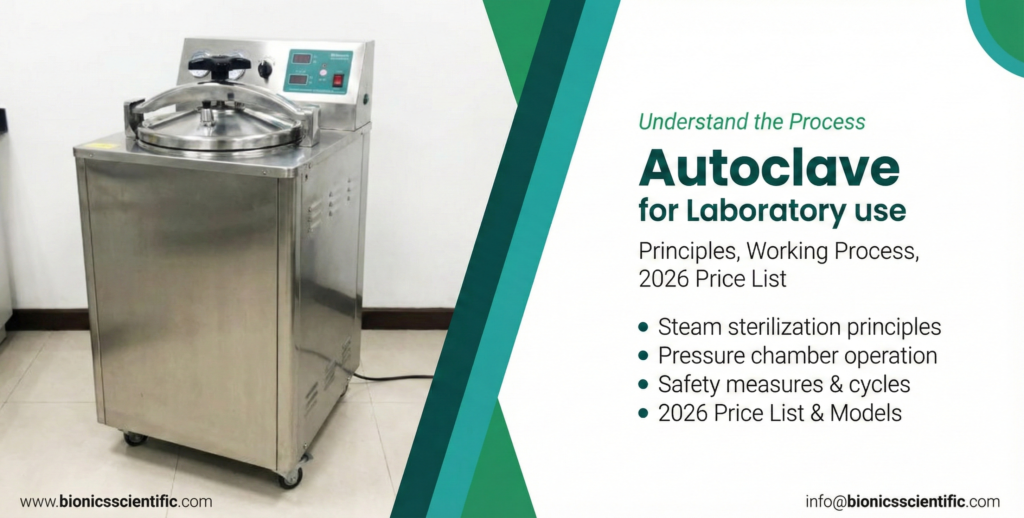
An autoclave is a pressurized steam sterilizer used to sterilize laboratory, medical, and industrial materials using saturated steam at high temperature and pressure. It is commonly used for glassware, laboratory media, instruments, and other materials that can safely withstand steam sterilization.
In this guide, you will learn the principle and working of an autoclave, its main parts, operating cycle, types, applications, buying considerations, and autoclave price ranges in India.
Searching for a reliable laboratory simple autoclave diagram that is both ISO 9001 and CE certified?
Bionics Scientific simple autoclave diagram deliver efficient, safe, and consistent sterilization for all your critical lab and medical procedures. Choose our certified range for guaranteed performance and pressure stability. Contact our experts at info@bionicsscientific.com or call +91 9111161955 | 9376651333.
How Does the Sterilization Process Work?
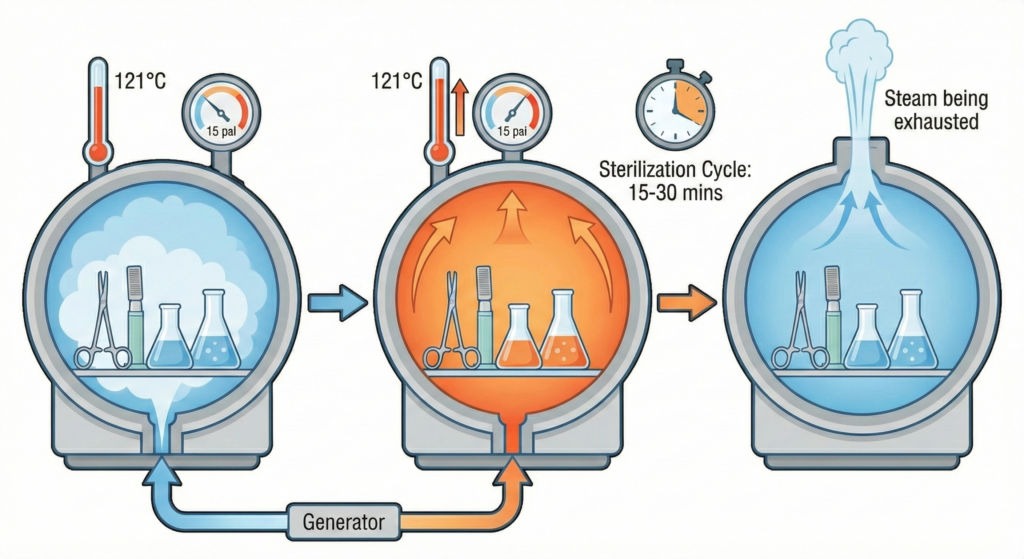
An autoclave sterilizes materials using saturated steam under pressure. Pressure allows steam to reach temperatures above the normal boiling point of water, while direct steam contact transfers heat efficiently to the load.
Sterilization cycle phases
A standard sterilization cycle typically consists of three main stages.
- Heating/Purge Phase: Air is removed from the chamber and replaced with steam.
- Sterilization Phase: The temperature and PSI (Pounds per Square Inch) are held constant for a set amount of time (usually 15 – 30 minutes).
- Exhaust/Cooling Phase: The pressure is gradually released and the items are allowed to cool before they are safely removed.
Manual vs. Automatic Autoclaves: A Quick Comparison
Choosing the right type of equipment depends on your specific needs and how often you plan to use it.
| Feature | Manual Autoclave | Automatic Autoclave |
| Operation | Requires manual control of valves and timers. | One-touch operation with digital cycles. |
| Precision | Relies on the operator’s expertise. | High precision with automated sensors. |
| Maintenance | Simpler mechanics, but needs closer monitoring. | Self-diagnostic features for easier care. |
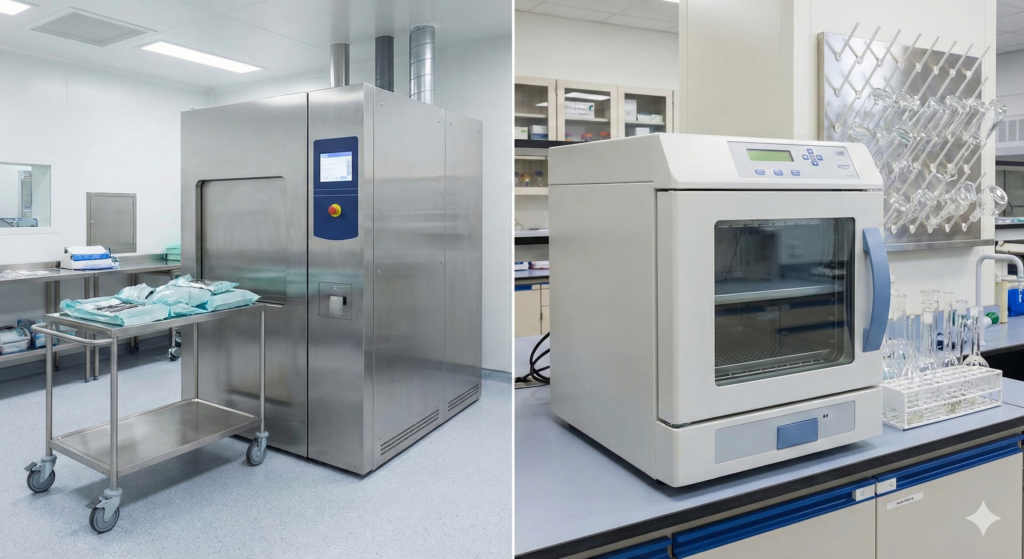
| Ideal Use | Small labs with basic sterilization needs. | Busy hospitals and high-volume labs. |
Key Features to Consider When Choosing an Autoclave
Before selecting an autoclave, consider the chamber capacity, construction material, operating pressure, level of automation, safety features, validation requirements and after-sales support.
• Chamber Capacity: Select a size suitable for your typical load without overcrowding.
• Chamber Material: Choose corrosion-resistant construction suitable for repeated steam cycles.
• Controls and Automation: Decide whether manual controls or automated cycles better suit your workload.
• Safety Features: Look for suitable pressure controls, safety valves, and door-locking mechanisms.
• Validation and Calibration: Consider how the unit will be monitored and validated for your application.
• Service Support: Check the availability of technical support, spare parts, and maintenance.
How to Use an Autoclave
Safe autoclave operation depends on correct loading, cycle selection, steam exposure, and controlled depressurization. Always follow the operating instructions for the specific autoclave model and the requirements of your sterilization process.
Main Parts of an Autoclave
The machine works on the principle of thermal energy. When water is heated under high chamber pressure it turns into saturated steam. this steam carries significantly more energy than boiling water allowing it to penetrate the cell walls of microorganisms and destroy them instantly.
Typical Autoclave Sterilization Parameters
For an equipment to be effective it must reach specific technical benchmarks standard sterilization protocols usually require the laboratory sterilizer to reach 121°C (250°F).to achieve this temperature the machine must increase the internal chamber pressure to 15 PSI. this combination of heat and pressure ensures that even the most resilient biological threats, such as Geobacillus stearothermophilus (the biological indicator used for testing) are completely destroyed.
Autoclave Cycle Reference Table
| Parameter | Recommended Setting | Purpose |
| Autoclave Machine Temperature | 121°C | Kills spores and viruses |
| Chamber Pressure | 15 PSI | Reaches necessary heat levels |
| Cycle Time | 15–30 Minutes | Ensures full penetration |
| Biological Indicator | Geobacillus stearothermophilus | Validates sterilization success |
Pre-Operation Checklist
A successful sterilization cycle starts before you even turn on the equipment. Follow these safety and maintenance steps.
- Check the drain: Ensure the drain strainer in the bottom of the autoclave sterilizer chamber is clean If it is clogged, the steam will wonot circulate, and your items will not be sterile.
- Water level: Check the base chamber Check the required water level and water quality according to the autoclave manufacturer’s operating instructions.
- Inspect your load: Ensure all items are autoclave principle safe Never put volatile chemicals or heat-sensitive plastics inside.
- Prepare safety gear: Always have heat-resistant gloves nearby. Steam burns are a serious risk when operating an autoclave machine for hospital or lab use.
Step-by-Step Guide to Using an Autoclave
Now that you are prepared, follow these steps to use autoclave machine systems effectively.
Step 1 – Preparation
Ensure the power is connected. Open the chamber door and verify that the drain is clear of debris. Add water according to the level and quality specified in the equipment manufacturer’s instructions.
Step 2 – Loading the Items
Place your instruments or glassware into the sterilizer chamber. Do not crowd the items; steam must be able to touch every surface of every object.
- Expert Tip—Use autoclave tape indicator strips on the outside of your packages. Chemical indicator tape or strips can provide a visual indication that the package has been exposed to specified process conditions, but they should not be treated as proof of successful sterilization.
Step 3 – Sealing and Starting
Close the door and lock it securely. Check the settings on the control panel. Once the chamber is securely closed, select the appropriate sterilization cycle according to the equipment instructions and load requirements.
Step 4 – Sterilization phase
The machine will now use pressurized steam to kill any microbial life. Monitor the autoclave machine temperature to ensure it hits 121°C. The PSI should stabilize around 15 The cycle will typically run for 20 minutes once the target temperature is reached.
Step 5 – Exhaust and cooling
After the cycle finishes, the machine will release the pressure. Wait until the pressure gauge reads zero before attempting to open the door.
Step 6 – Unloading
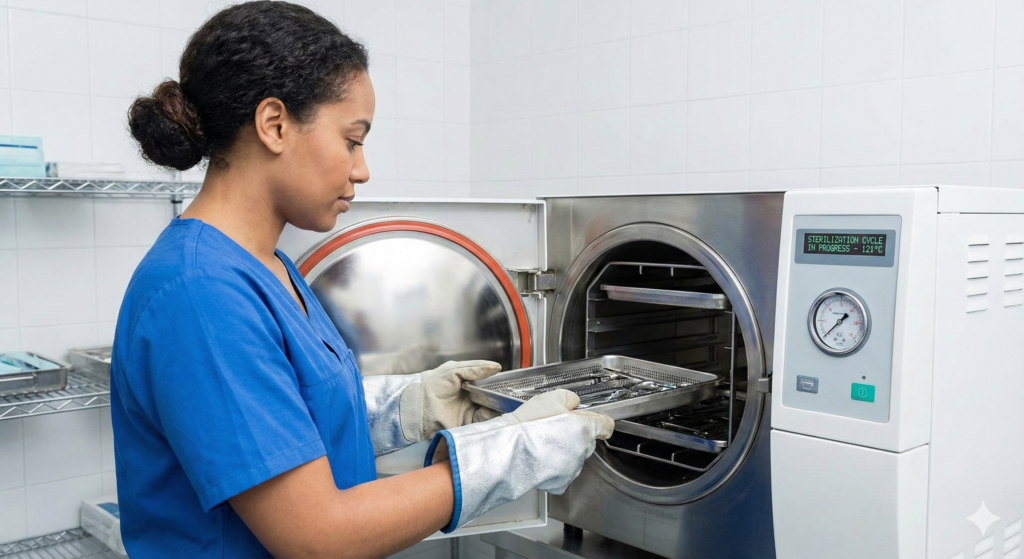
Carefully open the door just a crack to allow the remaining steam to escape. After a few minutes, use your heat-resistant gloves to remove the items. Let them air dry completely before storage.
Why use an autoclave machine for hospital and lab safety?
The primary reason we rely on the equipment is its capability to handle biohazardous waste and reusable medical tools. Standard washing or even chemical baths can leave behind spores. Because an autoclave machine uses steam under pressure to kill harmful bacteria, viruses, fungi, and spores, it provides the highest level of decontamination possible.
In a hospital setting, the autoclave machine for hospital use is the gold standard. It ensures that surgical tools are 100% sterile, reducing the risk of postoperative infections and saving lives.
Maintenance and Best Practices
To keep your autoclave machine running at peak performance, follow these maintenance tips.
- Daily Cleaning—always check the drain strainer A small piece of paper or debris can cause a cycle to fail.
- Weekly Testing—use a biological indicator like Geobacillus stearothermophilus once a week. If the bacteria survive the cycle, your autoclave machine needs immediate repair.
- Monitor the seals—the door gasket is vital for maintaining chamber pressure If you notice steam leaking from the door, the gasket needs to be replaced.
- Professional Calibration—Have a technician check the autoclave machine temperature and pressure gauges annually to ensure they are accurate.
Autoclave Machine Diagram and Main Components
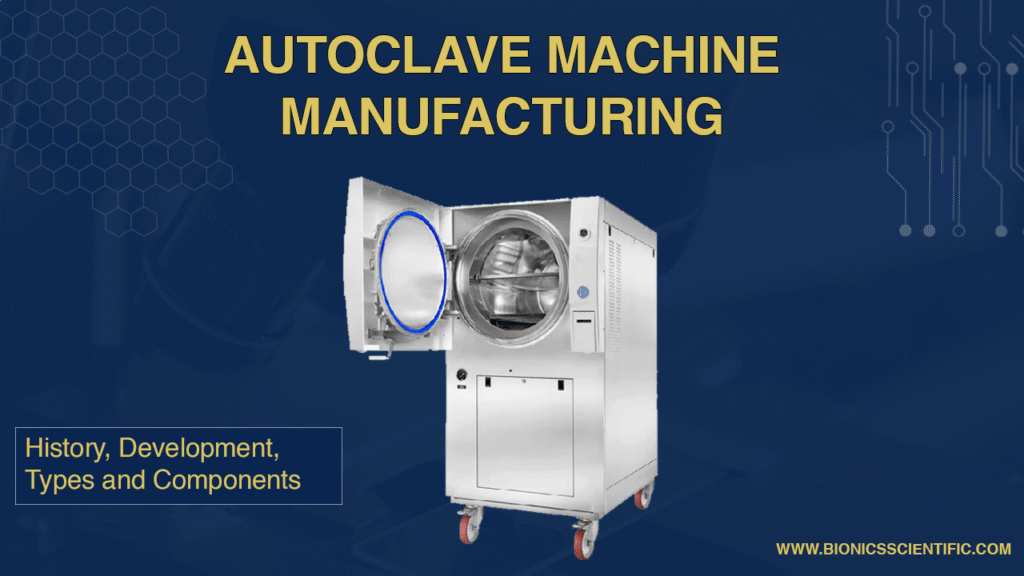
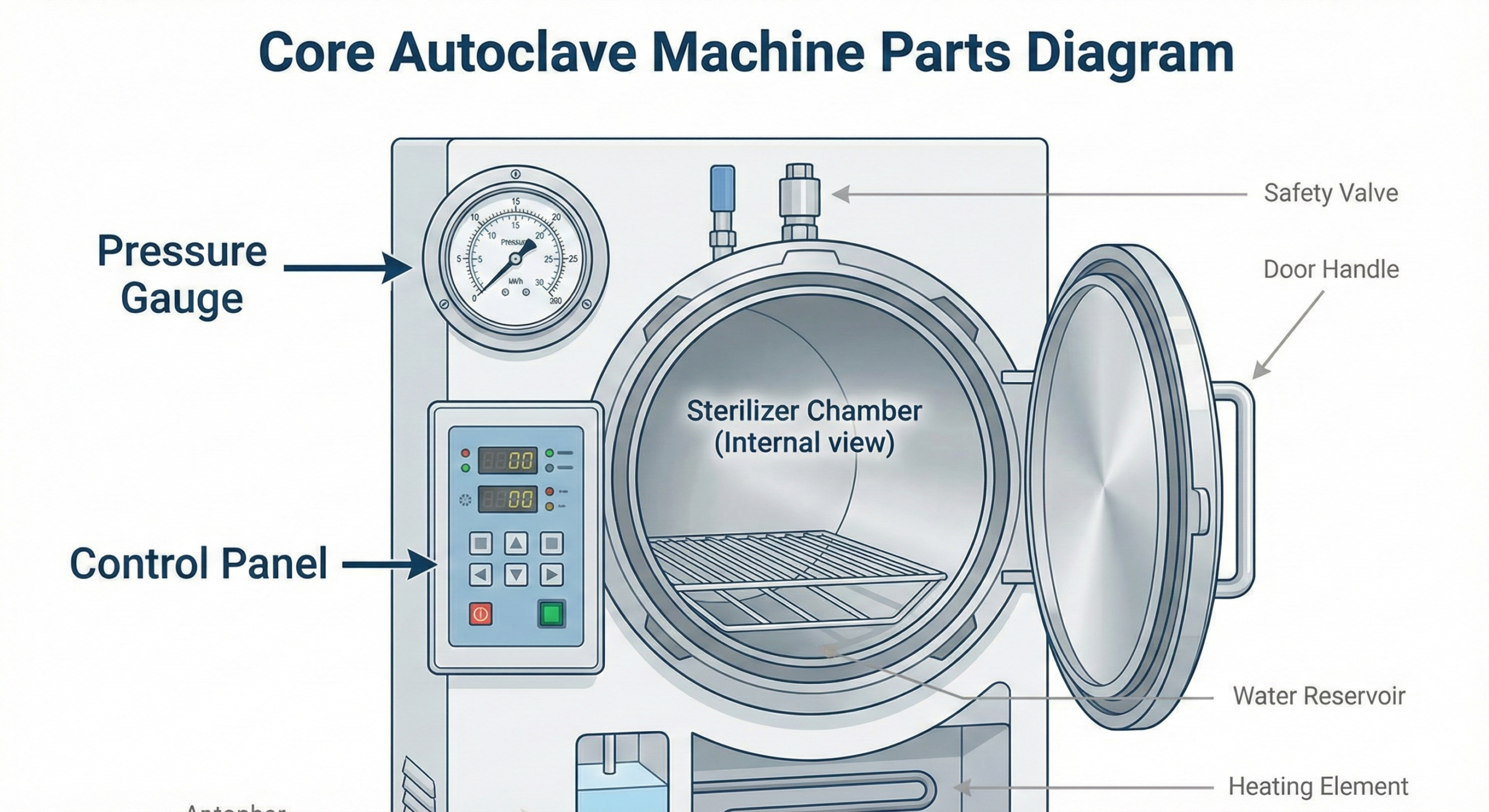
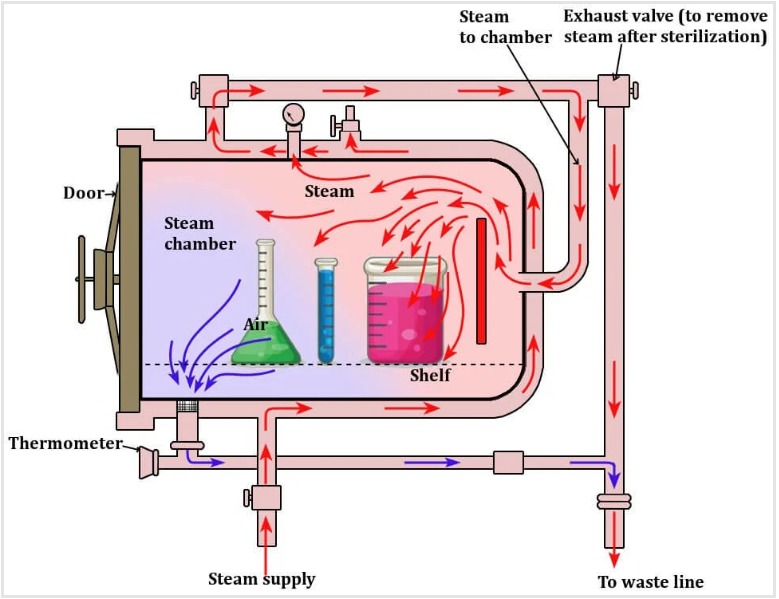
An autoclave diagram helps identify the components responsible for steam generation, pressure control, sealing, air removal, and safe operation. The exact design varies by autoclave type, but the following components are commonly found in steam sterilization systems.
Anatomy of an Autoclave: Key Components
To truly understand a schematic diagram of autoclaves, you need to know the role each part plays. A high-quality autoclave diagram with a label typically highlights several critical components that work in harmony to create a pressurized, high-heat environment.
1. The Pressure Vessel and Outer Jacket
The heart of any autoclave machine diagram is the pressure vessel. This is the inner chamber where you place your laboratory media or surgical tools. Most modern units also feature a jacketed chamber, an outer layer that surrounds the inner vessel to help maintain consistent temperatures and reduce condensation.
2. Steam Generator (The Boiler)
Often referred to as the powerhouse of the unit, the steam generator heats water to produce saturated steam. This steam is what actually performs the sterilization.
3. Safety Valve and Pressure Gauge
Safety is paramount when dealing withs high pressure steam. Every autoclave diagram with enough labels for an beginner will always feature a safety valve. This component acts as a fail-safe, releasing excess pressure if it exceeds the chamber’s limits. The pressure gauge allows the operator to monitor the internal environment in real time.
4. Gasket Seal
The gasket seal is a heavy-duty rubber or silicone ring that ensures the door remains airtight. Even a tiny leak in the gasket can prevent the machine from reaching the necessary pressure, rendering the sterilization cycle ineffective.
5. Thermostatic Trap
This is a specialized valve thats allows air and cooled water (condensate) to exit the chamber while trapping the HOT steam inside. Efficient air displacement is key to preventing cold spots inside the machine.
Horizontal vs. Vertical Autoclave: Which Diagram Fits Your Lab?
When choosing a sterilizer, you will likely encounter two main structural designs. Both follow similar scientific principles but differ in how they are loaded and where they fit in your workspace.
Comparison Table: Vertical vs. Horizontal Structures
| Feature | Vertical Autoclave | Horizontal Autoclave |
| Loading Style | Top-loading (items stacked) | Front-loading (items on shelves) |
| Space Efficiency | Compact; ideal for small labs | Requires more floor space |
| Capacity | Limited by vertical stacking | High capacity for bulky loads |
| Best Used For | Microbiology media, small flasks | Hospitals, large-scale industrial use |
| Structure | See vertical autoclave diagram | See horizontal autoclave diagram |
The Role of an Autoclave Diagram in Microbiology
In a biological setting, the autoclave diagram in microbiology is slightly more specialized. It often emphasizes the sterilization of biohazardous waste and laboratory media Microbiologists use the machine to hit the thermal death time of resilient organisms like Geobacillus stearothermophilus (the standard biological indicator).
Using an autoclave diagram with label as a reference, students can learn how to avoid common pitfalls such as trapping air in bottles or failing to reach the holding time required for total decontamination.
Best Autoclave Price in India
Choosing the right sterilization equipment is a critical decision for a medical laboratory or professional facility. Whether you are setting up a new dental clinic or upgrading a hospital wing, understanding the autoclave price and the technical features that drive it is essential. Reliability in sterilization is not just a regulatory requirement; it is a commitment to safety.
Equipment cost in India: Type & Pricing Breakdown
The equipment cost in India varies significantly based on the technology, capacity, and the specific industry it serves. From a portable steam sterilizer used in small clinics to high-end equipment, each type carries a different price point. Below is a detailed breakdown of the typical price ranges you can expect in the market today.
India Autoclave & Sterilizer Price List (2026)
| Machine Type & Specification | Ideal Application (Best Use) | Estimated Price Range (INR) |
| 1. Portable Autoclave (10L – 25L, Single Wall) | Small Clinics, General Practice, Tattoo Studios | ₹5,500 – ₹12,500 |
| 2. Small/Tabletop Autoclave (15L – 25L, Non-Vacuum) | Dispensaries, Small Labs, OPD Centers | ₹15,000 – ₹45,000 |
| 3. Vertical Autoclave (22L – 100L, Double/Triple Wall) | Microbiology Labs, Pathology, Bio-Waste | ₹25,000 – ₹1,30,000 |
| 4. Horizontal Cylindrical (75L – 300L, High Volume) | Nursing Homes, Small Hospitals (Bulk Loads) | ₹1.50 Lakh – ₹4.80 Lakh |
| 5. Horizontal Rectangular (200L – 500L+, Sliding Door) | Corporate Hospitals, CSSD, Pharma Production | ₹5.50 Lakh – ₹15.00 Lakh |
| 6. Double Door Autoclave (Pass-Through System) | Pharma Cleanrooms, Sterile Barrier Zones | ₹2.90 Lakh – ₹12.00 Lakh |
| 7. Class B Dental Autoclave (18L – 23L, Vacuum Type) | Dental Clinics (Drills), Eye Surgery, Hair Transplant | ₹70,000 – ₹3.40 Lakh |
| 8. Pulse Vacuum Sterilizer (Industrial Grade) | Pharma Manufacturing, Textiles (Porous Loads) | ₹4.75 Lakh – ₹30.00 Lakh |
| 9. Plasma Sterilizer (H₂O₂) (Low Temp 55°C) | Robotic Surgery, Laparoscopy, Delicate Electronics | ₹11.00 Lakh – ₹72.00 Lakh |
| 10. Dry Heat Sterilizer (Depyrogenation Oven) | Glassware, Ointments, Powder (Endotoxin Removal) | ₹16,500 – ₹20.00 Lakh |
| 11. Rotary Retort Sterilizer (Industrial Food) | Ready-to-Eat Curries, Retort Pouches, Milk | ₹12.35 Lakh – ₹45.00 Lakh |
| 12. Superheated Water Spray (Terminal Sterilizer) | IV Fluids, Sealed Liquid Bottles (BFS) | ₹8.50 Lakh – ₹65.00 Lakh |
| 13. Air Steam Mixture (Ventilator Autoclave) | Pre-filled Syringes, Soft Bags, Blister Packs | ₹10.00 Lakh – ₹50.00 Lakh |
| 14. Cement/Tile Autoclave (High Pressure 300 psi) | Construction Material Testing (Soundness Test) | ₹38,000 – ₹2.05 Lakh |
| 15. Glass Bead Sterilizer (Instant Heat) | Chairside Dentistry (Tips, Files, Forceps) | ₹930 – ₹2,500 |
Factors That Affect Autoclave Price in India
When researching the steam sterilizer, it is important to look beyond just the sticker value. Several technical specifications and components play a major role in determining the final steam sterilizer cost.
1. Classification (Class N vs Class B vs Class S)
- Class N: Suitable for simple, unwrapped solid instruments. This is usually the most budget friendly equipment cost option.
- Class B: These units feature vacuum cycle sterilization, which is necessary for porous or hollow instruments. The b class autoclave price is higher due to this advanced technology.
- Class S: Custom-designed for specific types of loads as defined by the manufacturer.
2. Capacity and Components
The size of the chamber, such as a small 12L dental sterilizer versus a larger 22-liter autoclave, directly impacts the equipment cost in India. Additionally, the quality of components like stainless steel autoclave drum sizes, replacement heating elements, and the durability of the autoclave gasket price will affect long-term maintenance costs.
5 Things to Check Before Buying an Autoclave
To ensure you get the best value for your equipment cost, follow this checklist before making a purchase.
- Material Quality: Look for high-grade stainless steel (SS 304 or SS 316) for both the chamber and the autoclave drum price considerations to ensure longevity.
- Certification: Ensure the equipment is certified by relevant bodies (ISO, CE) for safety and performance.
- Warranty & AMC: Check if the supplier offers an Annual Maintenance Contract. Low AMC costs can save you significant money over the years.
- GST Impact: Verify the GST on medical equipment in India (typically 12% or 18%) to understand the final landed equipment cost in India.
- Brand Reputation: Compare imported vs. domestic autoclave brands. Domestic brands often offer better budget-friendly sterilization equipment with easier access to spare parts.
3 Common Mistakes When Comparing Autoclave Prices
Many buyers make the mistake of choosing the lowest equipment cost without considering the operational risks.
- Ignoring the Vacuum Cycle: Buying a Class N machine when you need a equipment cost model for hollow tools can lead to sterilization failure.
- Neglecting Maintenance: Using poor-quality sterilization indicator tape or ignoring a worn-out gasket can compromise safety.
- Overlooking the Drum: Not checking the autoclave drum price or size can lead to inefficient loading and higher electricity bills.
Principle of Autoclave
The principle of an autoclave is moist-heat sterilization using saturated steam under pressure. Increasing pressure allows steam to reach temperatures above the normal boiling point of water, while condensation on cooler load surfaces transfers heat efficiently. The exact operating conditions depend on the autoclave, load and validated sterilization cycle.
The Role of Saturated Steam
When we discuss the autoclave principle, the quality of steam matters. Saturated steam is highly efficient because it carries a massive amount of energy known as the Latent heat of vaporization. When this steam contacts cooler surfaces of lab equipment, it condenses and releases this energy, instantly heating the material and killing pathogens. This efficiency is why the working principle of an autoclave is superior to other methods.
How Moist Heat Inactivates Microorganisms
Moist heat primarily inactivates microorganisms by damaging essential proteins and cellular structures.
- Thermal Coagulation of Proteins: High-temperature steam causes the proteins and enzymes essential for microbial life to uncoil and clump together Once these proteins are coagulated, the microbe can no longer function.
- Hydrolysis of Macromolecules: The moisture in the steam aids in the hydrolysis of macromolecules, breaking down the cellular structure of bacteria and viruses.
By combining these two processes the autoclave principle and working cycle ensures that no living organism, including highly resistant spores, survives the process.
Validation of the Sterilization Cycle
Sterilization cycles can be monitored using physical, chemical and biological indicators according to the applicable validation procedure.
| Indicator Type | Description | Purpose |
| Chemical Indicators | Autoclave tape that changes color. | Shows the item reached a certain temperature. |
| Biological Indicators | Uses Geobacillus stearothermophilus spores. | The ultimate test if these spores die, the cycle was successful. |
Safety First
Steam sterilization involves high temperature and pressure, so operators should follow the equipment manufacturer’s safety instructions and facility procedures.
Frequently Asked Questions (FAQs)
What is an autoclave?
An autoclave is a sterilization device that uses high-pressure saturated steam to eliminate microorganisms from laboratory, medical, and industrial equipment.
What temperature is commonly used during sterilization?
Most cycles operate at 121°C or 134°C depending on the load and sterilization requirements.
What materials can be sterilized?
Glassware, surgical instruments, laboratory media, pharmaceutical tools, and biomedical waste can be effectively sterilized.
What is the difference between vertical and horizontal models?
Vertical models are suitable for laboratories, while horizontal units are designed for hospitals and industrial applications.
How long does a typical cycle take?
The duration usually ranges from 15 to 60 minutes depending on temperature, pressure, and load size.
What is the average price of an autoclave in India?
The price depends on capacity, chamber size, automation level, and application requirements, ranging from small laboratory units to large hospital-grade systems.
Conclusion
Autoclaves provide reliable steam sterilization when the correct equipment, load preparation and validated operating cycle are used. When selecting an autoclave, consider the required capacity, chamber design, automation level, application, validation needs, and long-term service support.
Understanding these factors can help laboratories, medical facilities, and industrial users select equipment suited to their sterilization requirements.
Need the Right Autoclave for Your Application?
Get expert assistance in selecting the ideal laboratory or hospital autoclave. Contact Bionics Scientific Technologies for product recommendations, technical specifications, and the latest pricing information. Request a quote today.