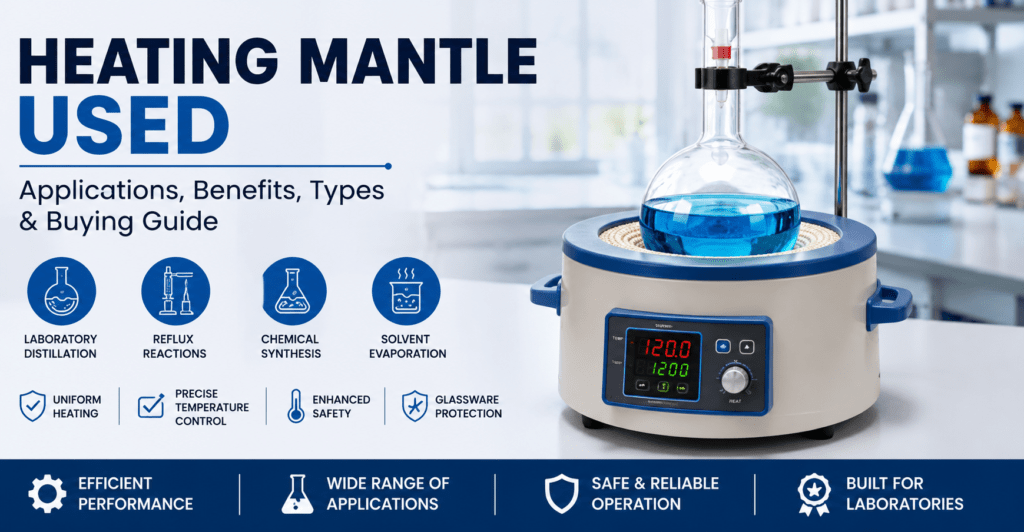
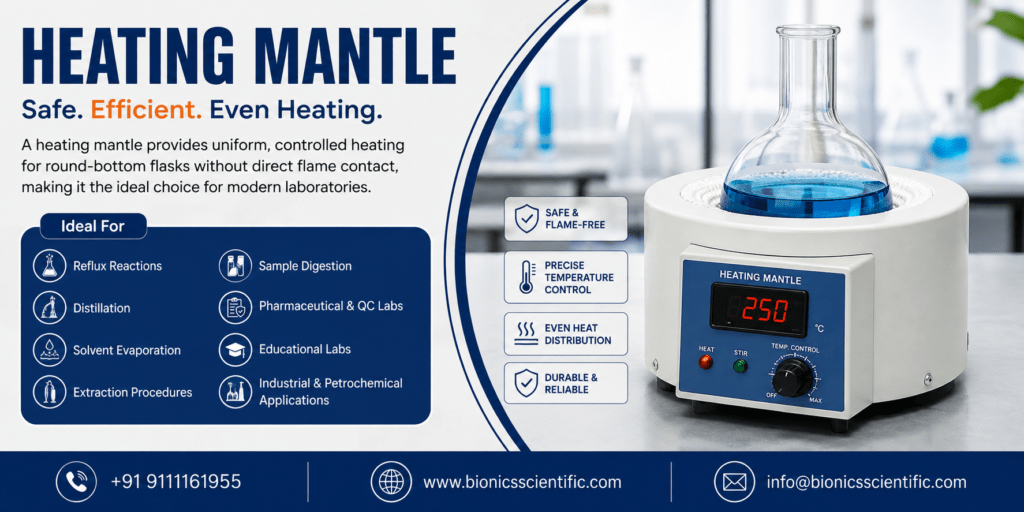
A round-bottom flask sitting over an open Bunsen flame is how most people picture “heating” in a lab. It’s also how most solvent fires start. A heating mantle replaces that flame with an enclosed, insulated heating element shaped to cradle the flask—no naked flame, no scorched glass, no guesswork on temperature.
For any lab running reflux, distillation, or extraction on a regular basis, it is one of those pieces of equipment that quietly prevents accidents rather than causing headlines.
At Bionics Scientific, we’ve been building laboratory heating equipment for 35 years, and heating mantles are one of the products our engineering team gets asked to explain the most—what wattage to pick, whether a digital controller is worth the extra cost, how it’s different from a hot plate. This guide answers those questions directly, the way we’d answer a walk-in buyer at our factory.
Quick Answer
A heating mantle is an electrically heated, fabric- or metal-enclosed device designed to heat round-bottom flasks and other laboratory glassware evenly, without direct flame contact. It typically operates between 0°C and 450°C, is sized to match specific flask volumes (100 mL to 20 L or more), and is the standard choice over open flame or a lab hot plate whenever flammable solvents, uniform heat distribution, or precise temperature control are required.
What Is a Heating Mantle and How Does It Work
Inside a heating mantle, a resistive heating element — usually nichrome wire — is woven into fiberglass cloth or embedded in a rigid, form-fitted shell. This shell wraps around the lower half of a round-bottom flask, so heat transfers across the full curved surface instead of one hot spot at the base. A rotary dial or digital PID controller regulates power output, which in turn controls temperature.
Because the heating element never directly contacts the glassware or the liquid inside it, there’s no risk of localized overheating that cracks a flask or scorches a sample—a real problem with a hot plate or open flame when heating viscous or sensitive solutions. Many models also include a magnetic stirring base, letting you stir and heat in a single unit during reflux or synthesis work.
Heating Mantle Uses
The heating mantle uses span nearly every wet-chemistry workflow:
- Reflux reactions — sustained, even heating for synthesis and hydrolysis without solvent flash-off risk
- Distillation — controlled, gradual heat rise for fractional and simple distillation setups
- Solvent evaporation and concentration — steady low-to-medium heat for slow solvent removal
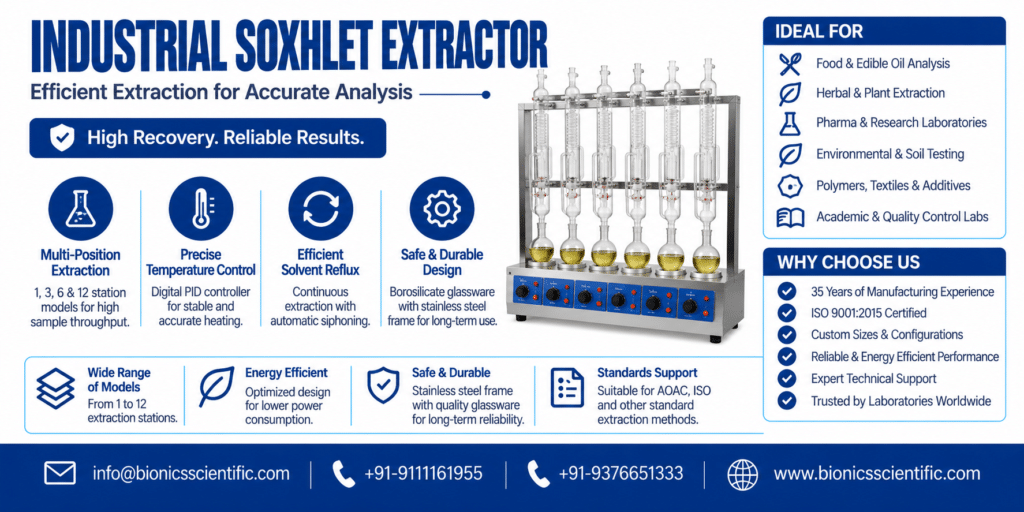
- Extraction procedures — Soxhlet and similar setups that run for hours unattended
- Sample digestion — controlled heating ahead of analytical testing
- Educational and academic labs — a safer alternative to Bunsen burners for student use
- Pharmaceutical and QC labs — repeatable temperature control for validated processes
- Petrochemical and industrial testing — heating flammable samples where an open flame is a genuine hazard
It’s worth clarifying a common mix-up: a thermal plate or lab hot plate heats from a flat surface upward, which works for beakers and flat-bottomed vessels but leaves round-bottom flasks unstable and unevenly heated. A hot plate in a dentistry or dental lab setting—used for softening wax or warming impression materials—is a related but separate application, built for flat trays and dental compounds rather than glass flasks.
A hot plate rectangular in shape is common in general-purpose lab and dental use precisely because it’s meant for trays, dishes, and flat-bottomed containers, not spherical glassware. If your work centers on round-bottom flasks, a heating mantle is the correct tool; a hot plate chemistry setup remains better suited to beakers, evaporating dishes, and general low-precision heating.
Heating Mantle Diagram — Key Components
A standard laboratory heating mantle diagram includes these parts:
- Outer shell—aluminum or fiberglass-reinforced casing that holds its shape and insulates outward heat loss
- Heating element — nichrome wire woven into fiberglass fabric, distributing heat evenly around the flask cavity
- Flask cavity/basket—the concave, form-fitted seat sized to a specific flask volume
- Temperature controller — analog rotary dial or digital PID display for setting and holding temperature
- Power cord and plug—rated to the mantle’s wattage and input voltage
- Support ring/stand mount — for positioning over a stirrer or lab jack
- Optional magnetic stirrer base — for combined heating and stirring in synthesis setups
- Thermocouple/temperature probe port—where fitted, allows a K-type probe to be inserted directly into the sample for accurate feedback rather than relying on the mantle’s own reading
Specification Table
| Parameter | Typical Range |
| Flask capacity | 100 mL – 20 L |
| Temperature range | Ambient to 450°C |
| Power supply | 220–240V, 50 Hz (also available in 110V) |
| Wattage (by size) | 100 W (100 mL) to 3000 W (20 L) |
| Control type | Analog rotary / Digital PID with LED display |
| Temperature accuracy | ±5°C (analog) / ±1°C (digital PID) |
| Outer body | Aluminum housing / fiberglass fabric |
| Stirring (optional) | Magnetic, up to 2500 RPM |
| Probe compatibility | K-type thermocouple |
| Safety features | Over-temperature cutout, spill protection insulation |
Temperature Chart by Capacity
| Flask Size | Approx. Wattage | Max Operating Temperature | Typical Use |
| 100–250 mL | 100–150 W | 380°C | Small-scale synthesis, student labs |
| 500 mL – 1 L | 250–450 W | 400°C | Standard reflux, distillation |
| 2 L – 5 L | 650–1100 W | 400–450°C | Pilot-scale reactions, extraction |
| 10 L | 1800–2100 W | 400°C | Industrial/QC batch heating |
| 20 L | 2500–3000 W | 350–400°C | Large-volume distillation |
Actual maximum temperature and wattage vary by model and controller type — always check the datasheet for the specific unit before use.
Buyer’s Guide: What Labs Actually Ask Before Ordering
When labs and procurement teams call us about a heating mantle, the questions cluster around a handful of practical concerns:
- “Will this fit my existing flask?” Mantles are sized to specific flask volumes, so measure the flask first — an oversized cavity heats unevenly, and an undersized one won’t seat the flask properly.
- “Analog or digital?” Analog dials are lower-cost and reliable for routine, repeatable heating. Digital PID controllers cost more but hold temperature within a tighter band, which matters for validated or temperature-sensitive protocols.
- “Do I need a stirring base?” If the process involves reflux with continuous mixing, a combined heating-and-stirring mantle saves bench space and eliminates a second piece of equipment.
- “What’s the warranty and service support?” Since a heating mantle is a long-service item, buyers ask about spare heating elements, replacement fabric shells, and whether a technician can service it on-site or it needs to be shipped back.
- “Can it handle continuous industrial use, or is it lab-bench only?” Industrial and QC buyers specifically ask about duty cycle and build quality for multi-shift operation, not just occasional use.
These are exactly the questions our sales engineers walk through with every buyer before a unit ships—because the right mantle depends on flask size, process, and duty cycle, not just price.
Why Labs Choose Bionics Scientific
We’ve manufactured laboratory heating and processing equipment for 35 years, and in that time we’ve dispatched over 1200 units of laboratory equipment across India and to international customers.
That track record isn’t a marketing line—it’s the reason our engineering team can walk a first-time buyer through wattage selection, controller type, and flask compatibility with the same directness as a lab regularly reordering consumables. Every heating mantle we build is tested for temperature accuracy and heating uniformity before it leaves our facility, and our team stays reachable after the sale for spares, service, and calibration support.
Get the Right Heating Mantle for Your Lab
Not sure which capacity or controller type fits your process? Talk to our engineering team at Bionics Scientific—we’ll help you match the right heating mantle to your flask size, temperature needs, and budget and get it dispatched to your lab, anywhere in India or worldwide. Request a quote today.
FAQs
For what purpose is a heating mantle used?
It is used to heat round bottom flasks and other similar apparatus uniformly during reflux, distillation, extraction, and sample digestion without placing the flask under an open flame.
What is the difference between a heating mantle and a hot plate?
In a heating mantle, the round bottom flask is surrounded by the heating mantle and gets heated; in the case of a hot plate, there is a flat surface from which the flask is heated upwards.
Up to what temperature can a heating mantle heat?
The range of most laboratory heating mantles is 400-450°C, starting from ambient temperature.
Is the heating mantle safer than the Bunsen burner?
Yes, it is safe because of insulation and no open flames that make a higher chance of fire when heating flammable solvents.
Can the heating mantle be used with a magnetic stirrer?
Yes, different ones are equipped with built-in stirrer bases, whereas others are used in combination with the magnetic stirrer.
How can I choose the right mantle size?
The mantle should be chosen properly in terms of wattage based on your flask size.
How do digital and analog heating mantles differ?
Digital heaters come with PID controller and LED display, while analog heaters come with rotary dial control.
How do digital and analog heating mantles differ?
Digital heaters include a PID controller and LED display, while analog heaters use rotary dial controls.
Can a heating mantle be used outside the academic laboratory?
Yes, higher wattage and higher capacity heating mantles are designed for continuous industrial and QC use.
Does Bionics Scientific ship heating mantles outside India?
Yes, Bionics Scientific dispatches laboratory equipment, including heating mantles, both pan-India and to international customers.
How long does a laboratory heating mantle typically last?
With proper use and periodic checks on the heating element and fabric shell, a well-built heating mantle can serve a lab reliably for several years; replacement elements and shells are usually available without replacing the full unit.