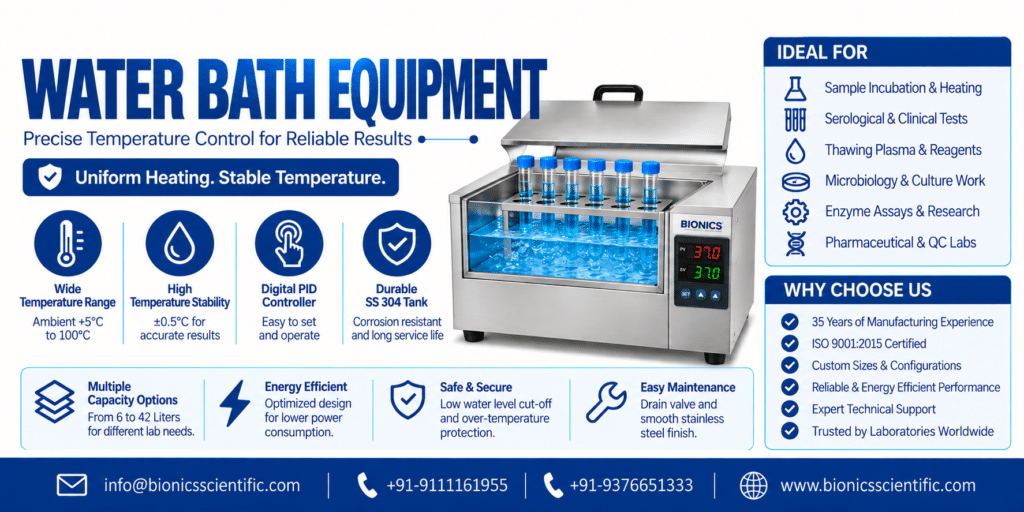
Water bath equipment holds samples in a heated liquid that changes temperature slowly and evenly, which is why it is the standard fix when an incubation fails because the temperature drifted. This guide explains how it works, which type suits which job, and what to check before you order. It comes from Bionics Scientific, a manufacturer with 35 years of experience building laboratory heating and testing instruments.
Quick Answer
- What it is: an insulated tank of water, heated by an element and held at a set point by a controller.
- Typical range: ambient +5°C up to 100°C. Oil baths go beyond that.
- Main types: serological, shaking, circulating, boiling, and laboratory oil bath.
- Best for: incubating samples, thawing plasma, warming reagents, melting agar, and running enzyme assays and serological tests.
- Key specs to compare: capacity, uniformity, stability, controller type, and tank material.
- Before buying: confirm the temperature accuracy you actually need, then choose the type.
What Is Water Bath Equipment?
Water bath equipment is a laboratory instrument that heats a tank of water to a stable temperature so that tubes, flasks, or beakers sit in an even, gentle heat. Water carries heat well, so samples never meet a hot surface directly. That is why it is preferred over a hot plate for biological and chemical work.
The same idea appears in the kitchen. A water bath containing hot water used for cooking, such as sous vide or a bain-marie, uses the same principle: indirect, even heat that will not scorch. The laboratory version simply adds tighter control, safety cut-outs, and a corrosion-resistant tank.
Types of Water Bath Equipment
Serological water bath
Built for clinical and blood bank work, the serological water bath keeps a steady 37°C to 56°C for complement inactivation, agglutination, and antibody tests. Stability matters more than speed here. Even a one-degree swing can change a result.
Shaking water bath
A shaking water bath adds a reciprocating or orbital tray. Agitation keeps cultures oxygenated and speeds up dissolution and enzyme reactions. Microbiology, biotechnology, and pharmaceutical teams use it daily.
Circulating water bath
A circulating water bath uses a pump to move water through the tank, which improves uniformity. Buyers who search for a Julabo water bath are often after this kind of circulation and tight stability. At Bionics Scientific we build circulating models for the same demanding applications, with pump-driven flow and digital control, so you can compare them against imported options on specification rather than brand name.
Boiling water bath
A boiling water bath runs at or close to 100°C. It is used for sterilising small items, digesting samples, determining certain food and water parameters, and carrying out heat-based tests.
Laboratory oil bath
When the target is above 100°C, water is no longer suitable. A laboratory oil bath uses silicone or mineral oil and reaches roughly 250°C. It suits melting-point work, high-temperature reactions, and calibration.
MBRT water bath
The MBRT water bath is used for milk quality testing. The methylene blue reduction test measures how fast bacteria decolorize the dye in a milk sample at 37°C. Dairy labs need uniform tube positions and a bath that recovers quickly after the lid is opened.
Hot Water Bath Diagram (How It Is Built)
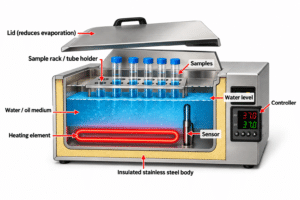
The sensor reads the liquid temperature. The controller compares it with the set point and switches the heater.
A secondary thermostat cuts power if the water level drops or the temperature overshoots.
Working Procedure and SOP of Water Bath
A clear SOP of water bath use protects results and people. This is the procedure our service engineers recommend.
- Position the unit on a flat, dry bench near the grounded power outlet.
- Fill the tank with distilled or deionized water up to the mark. Tap water forms scale and reduces element longevity.
- Turn on the unit and input the set point. Wait for the tank to get up to temperature before loading samples.
- Confirm with a calibrated thermometer since there may be some difference between the display and the liquid.
- Load the samples so that the liquid is above them in the tube.
- Run the test for the specified time. The lid should remain closed to minimize heating and evaporation.
- Unload samples using tongs or a rack but not with your hands.
- Turn off the unit, allow the water to cool and drain, and then wipe the tank.
- Enter the date of use, the operator, and any cleaning in the equipment logbook.
Weekly cleaning with a mild descaler and a monthly temperature check keep the instrument in good condition. Add a biocide if the bath stays warm for long periods to stop algae and bacterial growth.
Specification Table
| Parameter | Serological / General | Shaking | Circulating | Oil Bath |
| Temperature range | Ambient +5 to 100°C | Ambient +5 to 99°C | Ambient +5 to 100°C | Ambient +10 to 250°C |
| Stability | ±0.5°C | ±0.5°C | ±0.1 to ±0.2°C | ±1°C |
| Capacity | 6 to 42 liters | 10 to 30 liters | 10 to 30 liters | 5 to 20 liters |
| Controller | Digital PID | Digital PID | Digital PID | Digital PID |
| Tank material | SS 304 | SS 304 | SS 304 | SS 304 |
| Agitation | None | 20 to 200 rpm | Pump circulation | Optional stirrer |
| Safety | Low-level cut-off, over-temperature | Same, plus motor protection. | Same | Over-temperature cut-off |
| Power supply | 220–240 V / 110 V, 50/60 Hz | Same | Same | Same |
Specifications are indicative. Custom sizes and voltages are available on request.
Temperature Chart by Application
| Application | Typical temperature | Recommended bath |
| Serological testing | 37°C | Serological |
| Complement inactivation | 56°C | Serological |
| Milk MBRT test | 37°C | MBRT |
| Bacterial culture growth | 30–37°C | Shaking |
| Enzyme assays | 25–60°C | Shaking / circulating |
| Thawing plasma and reagents | 37°C | Serological |
| Melting agar | 80–100°C | Boiling |
| Sample digestion | 90–100°C | Boiling |
| Melting-point tests | 100–250°C | Oil bath |
15 Points Buyers Weigh Before Ordering
- Required temperature range and accuracy.
- Stability, not just maximum temperature.
- Capacity and number of tubes or flasks.
- Stainless steel grade of the tank.
- Digital PID control rather than a simple thermostat.
- Over-temperature and low-water protection.
- Lid design and condensation control.
- Shaking speed range, if agitation is needed.
- Ease of cleaning and draining.
- Local voltage and plug type.
- Calibration certificate and traceability.
- Spare parts availability.
- Installation and training support.
- Warranty terms.
- Delivery time and export documentation.
Why Labs in Many Countries Choose Bionics Scientific
We have spent 35 years designing, testing, and shipping lab equipment, and we know that a bath working in a cool Canadian lab must also survive a humid Singapore summer. We supply water bath equipment to buyers in the United States, the United Kingdom, the UAE, Saudi Arabia, South Africa, Canada, Australia, Singapore, Malaysia, the Philippines, and Indonesia. Our customers also include laboratories in Kenya, Nigeria, Bangladesh, Nepal, Qatar, Oman, Kuwait, Bahrain, Vietnam, Thailand, and Tanzania, along with Ghana, Sri Lanka, and New Zealand. Each shipment is voltage-matched, tested before dispatch, and supported with documentation for customs and audits.
Frequently Asked Questions
What are water baths used for?
Water bath equipment is used for maintaining samples in a controlled temperature environment for incubation, defrosting, heating, and other heat-related assays.
How does water bath differ from oil bath?
Water baths function up to 100°C. A laboratory oil bath is operated using oil and can function up to 250°C.
Which water bath is best for serological tests?
A serological water bath with ±0.5°C stability at 37°C and 56°C.
What is a shaking water bath?
It combines heating with a moving tray so liquids mix while they incubate.
How is a circulating water bath different from a standard one?
A pump moves the water, so temperature is more uniform across the tank.
Can I use tap water?
Distilled water is better. Tap water causes scale and corrodes elements over time.
How often should I calibrate it?
Check against a reference thermometer monthly, and calibrate formally at least once a year.
What is the MBRT water bath used for?
It supports the methylene blue reduction test, which estimates bacterial load in milk.
Is a boiling water bath safe to leave on overnight?
No. Water level can fall. Use a unit with low-level cut-off and never leave it unattended.
Does Bionics Scientific ship internationally?
Yes. We export to more than two dozen countries and match voltage, plug, and paperwork to your location.
Get a Quote From Bionics Scientific
Need a water bath that holds its temperature and arrives ready for your lab? Share your required temperature range, capacity, and country, and our team will recommend the right model within one working day. Request a quote or technical datasheet from Bionics Scientific today.