Quick Answer
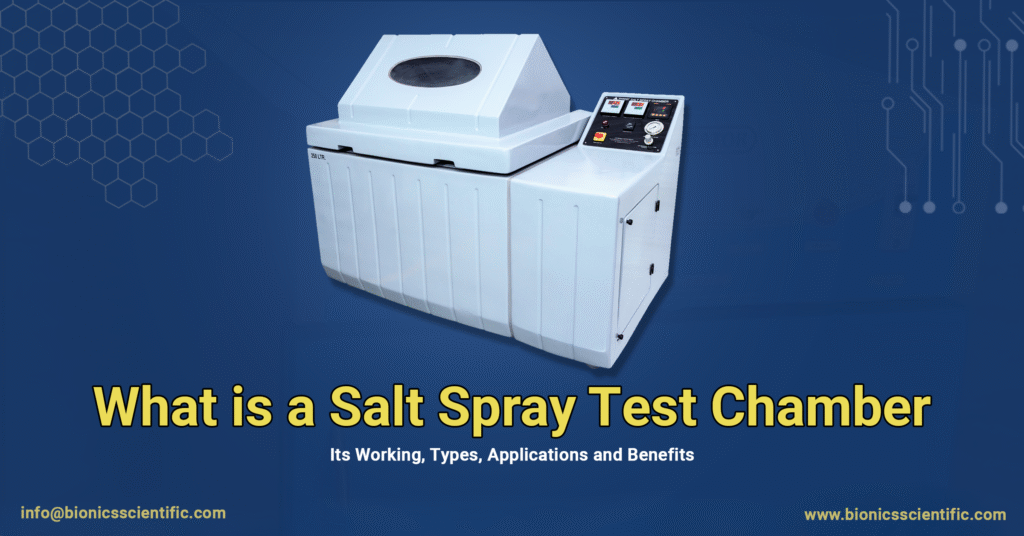
A salt spray corrosion test chamber sprays a controlled salt fog over coated, plated, or painted samples, so you can see how they resist rust without waiting years for the field to tell you. Most tests run neutral salt spray (NSS) at 35 °C with a 5% sodium chloride solution, following ASTM B117 or ISO 9227. Bionics Scientific has built laboratory and scientific equipment for 35 years and supplies salt spray chambers to buyers in India and overseas.
In this guide:
- Working principle: what happens inside the cabinet, and the settings auditors check first
- Temperature chart: NSS, AASS, and CASS conditions in one table
- Specification table: a checklist for comparing quotes
- Common setup mistakes: what quietly ruins a test
- 15 buyer questions: what to settle before you order
- Price factors, manufacturer shortlist, global markets, 10 FAQs, and a quote request
What Is a Salt Spray Corrosion Test Chamber?
Picture a sealed cabinet where the weather is always a salty coastal storm. Fog settles on your samples at a fixed temperature, hour after hour, and you watch for rust, blistering, or white corrosion products.
Know what it can and cannot tell you. It will not give you a service life in years. It ranks which coating outlasts which, whether this batch matches last month’s, and whether a supplier’s plating is as good as the certificate says. It also exposes pinholes, thin edges, and weak pretreatment before parts leave your gate.
Buyers use several names for the same machine: salt spray test chamber, salt spray chamber, and salt spray corrosion chamber. Whatever the quote calls it, the questions below apply.
How the Chamber Works
Compressed air is humidified in a heated tower and then rushes past a nozzle. That pulls salt solution up from a reservoir and breaks it into fine fog. A heater holds the cabinet at the set temperature while the fog drifts down onto the samples. Collection cylinders measure how much fog lands, and that reading is your proof the test is running as intended.
The ASTM B117 neutral test calls for:
- Chamber temperature of 35°C
- 5% NaCl solution with a pH between 6.5 and 7.2
- 1.0 to 2.0 mL of fog per hour for every 80 cm² of horizontal collection area
- Samples held at an angle, usually 15° to 30° from vertical
Miss any of these and your numbers stop matching another lab’s, which is exactly why auditors check them first. Mix the solution with purified water and plain sodium chloride, not table salt with iodine or anti-caking agents.
Temperature and Test Condition Chart
| Test type | Standard | Chamber temperature | Solution | pH |
| Neutral salt spray (NSS) | ASTM B117, ISO 9227 | 35°C (ISO 9227 tolerance ±2°C) | 5% NaCl | 6.5–7.2 |
| Acetic acid salt spray (AASS) | ISO 9227 | 35°C ± 2°C | 5% NaCl plus acetic acid | 3.1–3.3 |
| Copper-accelerated acetic acid salt spray (CASS) | ISO 9227 | 50°C ±2°C | 5% NaCl, copper chloride, acetic acid | 3.1–3.3 |
The air saturator runs warmer than the cabinet so the fog does not cool and evaporate on the way in. Set it as the standard directs, and check the tolerances in the current edition your customer cites.
Specification Table: What to Compare
| Parameter | What to check | Bionics scientific detail |
| Capacity | Match to your largest part and batch size | 108, 270, 480, and 980 liters confirm the current model list |
| Construction | Corrosion-proof cabinet and lid | FRP confirms material for every model |
| Test modes | NSS only, or also AASS and CASS | modes offered per model |
| Temperature control | Stability within the standard’s tolerance | controller type, range, accuracy |
| Air saturator | Heated and temperature-controlled | specification |
| Fog collection | Funnels and cylinders included | quantity supplied |
| Salt solution tank | Capacity and refill method | liters per model |
| Timer and alarms | Test duration, low-level alerts | features |
| Power supply | Voltage and phase for your country | options for export markets |
| Documentation | Calibration and test certificates | documents supplied |
Setup Mistakes That Spoil a Test
Most failed audits come from the routine, not the machine.
- Samples touching each other. Corrosion products from one part stain the next.
- Drip from the lid. Condensate falling on a sample is not fog. Angled lids prevent it.
- A clogged nozzle. Dried salt crystals block it. Flush it after every run.
- Skipping fog collection checks. If nobody reads the cylinders, nobody knows the test was valid.
- An unlevelled cabinet. Fog and drainage both suffer.
Where Buyers Use It
Automotive suppliers test fasteners, brackets, and painted panels. Electroplaters and powder coaters verify zinc, nickel, and chrome layers. Electrical makers check enclosures and terminals. Marine, defense, and construction buyers test parts that live near the coast. Universities and R&D labs compare coating formulations side by side.
15 Points Buyers Weigh Before Ordering
- Which standard does your customer’s specification name?
- Is neutral salt spray enough, or do you also need AASS or CASS?
- What is the largest sample you will load?
- One batch at a time, or continuous runs?
- How stable is 35°C across a 96- or 240-hour test?
- Will the cabinet material survive salt and acid for years?
- How is salt solution fed, and how often is it topped up?
- Can you read fog collection easily?
- Does the controller show elapsed hours?
- Are nozzles and towers available as spares nearby?
- What power and compressed air does your site have?
- Who installs the chamber and trains your operator?
- What does the warranty cover, and what does it leave out?
- Can the manufacturer supply calibration paperwork?
- What is the full cost, including consumables and service?
Salt Spray Chamber Price: What Moves the Quote
Anyone searching for salt spray chamber price or salt spray test chamber price will notice wide gaps between quotes. The cause is usually specification, not margin.
- Capacity: bigger cabinets need more material and heating power.
- Test modes: CASS needs a higher temperature range and better acid resistance.
- Controller: a basic timer costs less than a programmable controller.
- Build quality: nozzle material, saturator design, and heater placement.
- Paperwork: calibration and documentation take time to prepare.
- Freight, duty, and installation on overseas orders.
We do not print a single price, because two chambers of the same liter size can differ in what they include. Send your sample size, standard, and country, and we will quote in writing.
Choosing a Salt Spray Chamber Manufacturer in India
If you are comparing salt spray test chamber manufacturers in India, look past the brochure. Ask for a specification sheet written against your standard, reference installations, a spare-parts policy, and a service response time.
Bionics Scientific has manufactured laboratory and scientific equipment for 35 years. Our ISO 9001:2015 certificate is issued to Kartal Projects Private Limited; the parent company confirms the certificate scope covers environmental test chambers before publishing. You are welcome to request a factory discussion before ordering.
Global Markets We Serve
Corrosion conditions differ by region, and so do buyer priorities.
- Middle East (UAE, Saudi Arabia, Qatar, Oman, Kuwait, Bahrain): hot, salty coastal air makes coating validation important for construction, oil, and gas suppliers.
- Southeast Asia (Singapore, Malaysia, Philippines, Indonesia, Vietnam, Thailand): humid marine climates and large automotive and electronics supply chains.
- South Asia (Bangladesh, Nepal, Sri Lanka, India): growing coating, fastener, and engineering industries.
- Africa (South Africa, Kenya, Nigeria, Tanzania, Ghana): coastal infrastructure, mining and manufacturing.
- North America, the UK, and Oceania (USA, Canada, UK, Australia, and New Zealand): ASTM and ISO audit-driven quality systems.
Bionics Scientific handles inquiries from all of these markets, confirming export destinations and shipment history before publishing.
Frequently Asked Questions
What is a salt spray corrosion test chamber used for?
It compares how well coatings, platings, and metals resist corrosion under controlled salt fog. Labs use it for quality control, supplier approval, and material selection.
Which standard applies to a salt spray test chamber?
ASTM B117 and ISO 9227 are cited most often. Automotive and industrial customers may add their own specifications, so confirm which one your buyer requires.
What temperature does a salt spray test run at?
Neutral salt spray runs at 35 °C, and CASS runs at 50 °C. ISO 9227 defines the tolerances for both.
What salt concentration is used?
ASTM B117 and ISO 9227 both specify a 5% sodium chloride solution by mass, made with purified water. The pH range depends on the test type.
How long does a salt spray test last?
From 24 hours to over 1,000 hours, depending on the coating. Your customer’s drawing or standard sets the duration.
How much does a salt spray chamber cost?
It depends on capacity, test modes, controller, materials, and documentation. Bionics Scientific quotes against your specification rather than a fixed list price.
Can one chamber run NSS, AASS, and CASS?
Some models can, provided the cabinet handles acid and the higher temperature. Confirm supported modes for the exact model.
How do I choose the right capacity?
Choose a chamber that holds your largest sample with space between parts, because crowding blocks fog. Leave room for the exposure angle.
Do salt spray results predict real-world life?
Not directly. The test ranks performance under one accelerated condition. Combine it with other tests before making service-life claims.
Do you supply salt spray chambers outside India?
Bionics Scientific handles inquiries from India and overseas. Share your country, voltage, and standard, and we will quote accurately and confirm the export process.
Get a Quote for Your Salt Spray Test Chamber
Tell us your sample size, standard (ASTM B117 or ISO 9227), test duration, and country. Our team will recommend a capacity and send a written quotation.
Email: info@bionicsscientific.com Phone: +91 9111161955 / +91 9376651333 Website: bionicsscientific.com
Request your salt spray corrosion test chamber quote today.