Quick Answer
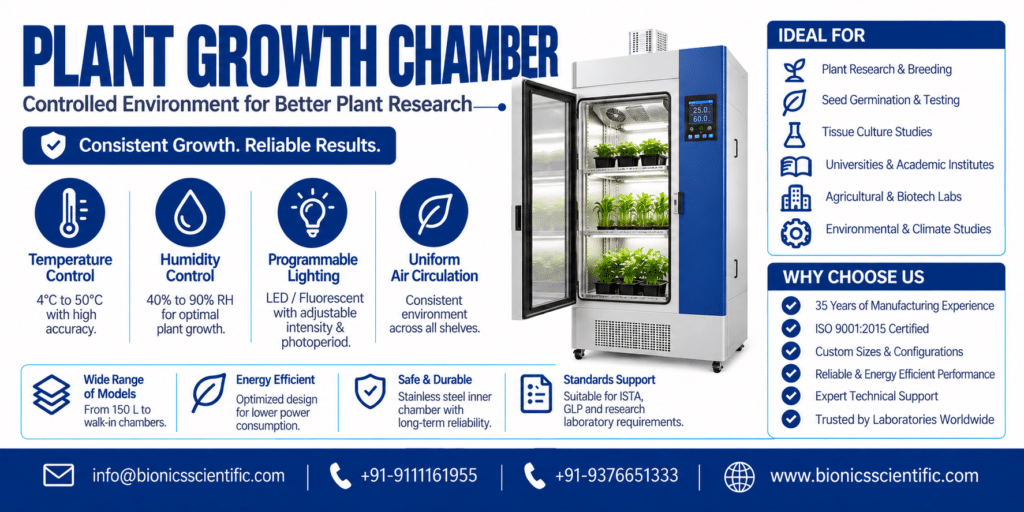
A plant chamber is an enclosed cabinet or walk-in room that controls temperature, humidity, light, and sometimes CO₂, so plants grow under repeatable conditions regardless of outdoor weather. Researchers use it for seed germination, tissue culture, stress trials, and breeding work. In wastewater engineering, the same phrase loosely covers grit and screen chambers, which are different technologies. Bionics Scientific builds the first kind: the plant growth chamber.
What Is a Plant Chamber?
Field trials depend on rain, heat, and season. A plant chamber removes that uncertainty. Inside, a refrigeration and heating system holds air temperature, a humidifier and dehumidifier manage moisture, and programmable lighting imitates day length. The controller runs the whole program, so a trial run in March matches one run in September.
That repeatability is why universities, seed companies, agricultural institutes, and biotech labs rely on the equipment. If two trays of wheat differ, you want the variety to be the reason, not a cold night.
Plant Chamber vs. Grit Chamber and Screen Chamber
Buyers often search several related terms at once, so here is the distinction.
- Plant growth chamber: a laboratory environment for growing plants under control. This is our product.
- Screen chamber in a sewage treatment plant: the first stage, where bar screens catch rags, plastics, and large debris before they damage pumps.
- Grit chamber in a sewage treatment plant: the stage after screening, where velocity is reduced so sand, gravel, and other heavy inorganic particles settle out.
Screen and grit chambers are civil structures built on site. They are not purchased from a laboratory equipment maker. If your work involves growing plants in treated wastewater or studying constructed wetlands, a growth chamber is still what you need to test plant response under controlled conditions.
How a Plant Growth Chamber Works
- Sensors read air temperature, relative humidity, and light intensity.
- The PID controller compares readings with your programmed set points.
- Compressor and heaters correct temperature; a humidifier adds or removes moisture.
- LED or fluorescent panels follow a photoperiod schedule, with adjustable intensity.
- Air circulation keeps conditions even from top shelf to bottom.
- Data logging records the run for audits and publications.
Typical Specifications
The values below are typical ranges for laboratory units. Exact figures depend on the model and can be tailored to your protocol.
| Parameter | Typical Specification |
| Temperature range | 4°C to 50°C (with light on) |
| Temperature accuracy | ±0.5°C to ±1°C |
| Humidity range | 40% to 90% RH |
| Humidity accuracy | ±3% to ±5% RH |
| Light source | LED or cool white fluorescent, dimmable |
| Light intensity | Up to 15,000 lux or as specified |
| Photoperiod | Programmable, multi-step |
| Inner chamber | Stainless steel, corrosion resistant |
| Outer body | Powder-coated mild steel |
| Controller | Microprocessor PID with touch or LCD display |
| Shelves | Adjustable, perforated |
| Refrigerant | Eco-friendly, CFC-free |
| Power supply | 220 to 240 V single phase, 50 Hz (60 Hz on request) |
| Capacity | 150 L to walk-in sizes |
Temperature Chart by Crop Stage
Set points vary by species. Use these as starting references and adjust to your own protocol.
| Application | Day Temp (°C) | Night Temp (°C) | Humidity (% (RH) |
| Wheat and barley germination | 18 to 22 | 12 to 15 | 60 to 70 |
| Rice seedling growth | 28 to 30 | 22 to 25 | 70 to 80 |
| Tomato and chili growth | 24 to 26 | 18 to 20 | 60 to 70 |
| Maize seed germination | 25 to 28 | 20 to 22 | 65 to 75 |
| Tissue culture room | 24 to 26 | 22 to 24 | 50 to 60 |
| Cold stress / vernalization | 4 to 8 | 4 to 8 | 60 to 70 |
| Heat stress trial | 35 to 40 | 25 to 28 | 50 to 60 |
Where It Is Used by Buyers
Seed Testing & Germination: ISTA-based germination tests require controlled temperature and humidity conditions.
- Plant Breeding: quicker generation cycles via manipulation of the photoperiod.
- Stress Physiology: drought, salinity, heat, and cold tolerance studies.
- Tissue Culture: shelf lighting and temperature control for cultures.
- Environmental Studies: phytoremediation and wastewater irrigation investigations.
- Educational: teaching laboratories for agricultural and life sciences students.
- Our Product Supply: Where We Ship To
Bionics Scientific ships laboratory environmental equipment worldwide to:
North America & Oceania: USA, Canada, Australia & New Zealand.
Europe & Middle East: UK, UAE, Saudi Arabia, Qatar, Oman, Kuwait & Bahrain.
Africa: South Africa, Kenya, Nigeria, Tanzania, & Ghana.
South and Southeast Asia: Bangladesh, Nepal, Sri Lanka, Singapore, Malaysia, the Philippines, Indonesia, Vietnam, & Thailand.
Each region has its own voltage, humidity, and climate challenge. Gulf buyers need strong cooling at high ambient temperature; tropical buyers in Malaysia, Indonesia, or the Philippines need robust dehumidification; and African and South Asian labs often need voltage stabilization. We configure units for these conditions before dispatch.
Why Bionics Scientific (Experience and Trust)
We have manufactured laboratory equipment for 35 years. That history means we have seen how chambers behave after years in real labs, not only on a test bench. Our approach rests on three habits: every unit is tested and calibrated before shipping, documentation is supplied with the machine, and service support stays available after installation. Ask us for calibration certificates, reference installations, and installation guidance for your country.
15 Points Every Buyer Should Check
- Working temperature range, including performance with lights on.
- Temperature uniformity across all shelves.
- Humidity control method and range at low temperatures.
- Light type, spectrum, and intensity suited to your crop.
- Photoperiod programming with multiple steps.
- Controller quality and ease of use.
- Inner chamber material and corrosion resistance.
- Usable capacity versus outer dimensions.
- Refrigeration reliability and compressor brand.
- Data logging and alarms for unattended runs.
- CO₂ control option if your research needs it.
- Power compatibility with your local supply.
- Calibration certificate and traceability.
- Warranty, spares, and service response in your country.
- Total running cost, including energy use.
Frequently Asked Questions
What is a plant chamber?
A controlled enclosure that regulates temperature, humidity, and light for growing plants in research and testing.
Is a plant chamber the same as a plant growth chamber?
Yes, in laboratory use the terms are interchangeable. Growth chamber is the more common technical name.
What does a grit chamber do in a sewage treatment plant?
It slows incoming flow so sand, gravel, and other heavy grit settle, protecting downstream equipment from wear.
What is a screen chamber in a sewage treatment plant?
It is the entry stage with bar screens that remove rags, plastics, and large solids from raw sewage.
Does Bionics Scientific make grit or screen chambers?
No. Those are civil structures. We manufacture plant growth chambers for laboratories.
What temperature range should I choose?
For most crop work, 4°C to 50°C covers cold treatment through heat stress. Choose based on your most extreme protocol.
LED or fluorescent lighting: which is better?
LEDs use less energy, generate less heat, and allow spectrum tuning. Fluorescent suits budget-conscious setups.
Can the chamber run a day and night program automatically?
Yes. The controller stores multi-step programs for temperature, humidity, and light.
Can you supply units to my country?
We ship to the countries listed above and can configure voltage and climate options for your region.
How do I get a quotation?
Send your required capacity, temperature range, and crop details, and our team will recommend a model.
Get Your Plant Chamber Quote Today
Tell us your crop, capacity, and country, and Bionics Scientific will suggest the right plant growth chamber within one working day.
Request a quote: +91 9111161955 | 9376651333 | info@bionicsscientific.com