Quick Answer
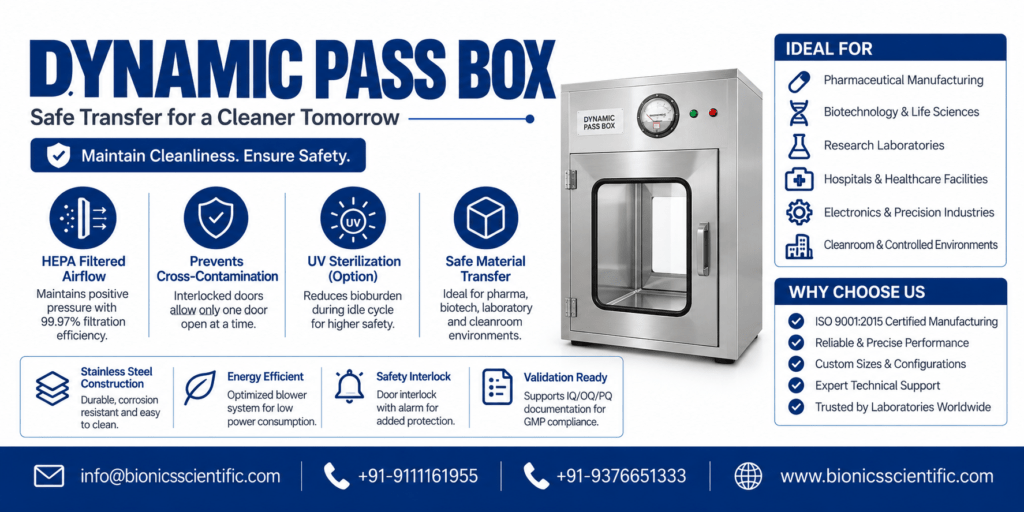
A dynamic pass box is a HEPA-filtered transfer chamber between two clean rooms that uses its own blower to force air through a HEPA filter, keeping the chamber positively pressurized every time a door opens. A static pass box has no independent air handling—it simply holds whatever pressure cascade already exists between the two rooms. This dynamic pass box SOP covers the interlocking sequence, purge cycle, and cleaning steps operators must follow at every transfer.
Dynamic vs. Static Pass Box
A pass box in pharma and cleanroom settings solves one problem: moving materials between rooms of different cleanliness classes without opening a direct door between them. A pass box clean room unit has two interlocked doors—only one opens at a time—which blocks a direct air path between environments.
- Static pass box: no independent filtration; relies on the surrounding rooms’ pressure cascade. Suited to lower-risk transfers between similarly classified rooms.
- Dynamic pass box: fitted with a blower, HEPA filter (typically 99.97% efficient at 0.3 microns), and usually a UV-C lamp that runs between transfers to reduce bioburden.
Which one you need is dictated by the room classifications and material risk profile in your facility’s clean room qualification documentation—not by preference.
How It Works
Air passes through a pre-filter and HEPA filter, then discharges into the chamber in a laminar pattern, holding it at positive pressure relative to the lower-classification side. The UV lamp is interlocked to shut off whenever a door is open and runs during the idle, closed state for surface disinfection.
Step-by-Step SOP
- Pre-use check. Confirm both doors are closed and interlocked; verify the differential pressure gauge is within its validated range.
- Airflow stabilization. Run the blower for the stabilization period in your validated SOP before the first transfer.
- Disinfect the item. Wipe the item’s exterior with an approved disinfectant before loading—the pass box filters air, not surfaces.
- Load from the dirty side. Open only the lower-classification door; confirm the interlock blocks the opposite door.
- Close and hold. Run the UV/purge dwell cycle (commonly 10–15 minutes, but set per your facility’s validation) before opening the second door.
- Unload from the clean side. Remove the item and close the door immediately.
- Log the transfer. Record time, item, and pressure reading per your GMP documentation.
- Post-use cleaning. Wipe interior surfaces each shift; watch for rising differential pressure signaling filter loading.
- Requalify periodically. Re-verify HEPA integrity (DOP/PAO), airflow velocity, and interlock function on your facility’s validation schedule.
Applications
Pharmaceutical formulation and filling suites, sterile API handling, injectable manufacturing, biotech labs, hospital pharmacies, and electronics clean rooms all use dynamic pass boxes wherever airborne particulate control matters more than simple pressure cascading. Facilities running a [laminar airflow workstation] or [biosafety cabinet] alongside a pass box should qualify both under the same clean room package. In pharma, the pass box is typically part of the facility’s IQ/OQ/PQ documentation as a barrier-system component.
Specifications
| Parameter | Typical Range (Manufacturer-Specified) |
| Chamber sizes | 300×300×300 mm to 900×900×900 mm (custom available) |
| Filtration | HEPA, 99.97% efficiency at 0.3 microns |
| Airflow pattern | Unidirectional, top-to-bottom, or horizontal |
| UV-C lamp | Optional/standard; interlocked off when a door is open |
| Door interlock | Mechanical or electromagnetic |
| Construction | SS 304/316 interior; powder-coated or SS exterior |
| Viewing panel | Toughened glass |
| Power supply | 220–240V AC, single phase |
Confirm exact dimensions and filter grade against your unit’s own datasheet.
Pressure Chart
| Zone Relationship | Typical Differential Pressure |
| Pass box vs. adjoining lower-class area | 10–15 Pa positive (facility-specified) |
| Clean room vs. corridor (reference) | 10–15 Pa positive |
| Grade A/B vs. Grade C/D (pharma cascade) | Per site’s HVAC validation |
Cascade pressures are governed by ISO 14644 and your facility’s own HVAC qualification—never treat these as universal fixed figures.
Why Bionics Scientific
A pass box becomes part of your facility’s documented barrier system and shows up in your audits, so a supplier’s certification scope matters directly to your compliance file. Bionics Scientific has manufactured clean room and laboratory equipment for 35 years, certified under ISO 9001:2015, CE (MDD 93/42/EEC), and GMP, with clean room equipment explicitly named in the certification scope. Our dynamic pass boxes are supplied across the USA, UK, UAE, Saudi Arabia, South Africa, Canada, Australia, Singapore, Malaysia, the Philippines, Indonesia, Kenya, Nigeria, Bangladesh, Nepal, Qatar, Oman, Kuwait, Bahrain, Vietnam, Thailand, Tanzania, Ghana, Sri Lanka, New Zealand, and across India.
Get a Quote
Need a dynamic pass box built to your facility’s exact pressure cascade, size, and validation requirements? Contact Bionics Scientific’s engineering team for a technical consultation and quotation.
Related Searches
Pass box price in India, dynamic pass box vs static pass box, pass box for clean room GMP, HEPA filter for pass box, pass box interlocking system, clean room pass box manufacturers, and pass box validation protocol.
TL;DR
- A dynamic pass box actively filters and pressurizes its own air; a static pass box does not.
- The interlock allows only one door open at a time, blocking direct air exchange.
- The SOP centers on pre-use pressure checks, the UV/purge dwell cycle, and transfer logging.
- Standard in pharma, biotech, and hospital clean rooms wherever particulate control is critical.
- Dwell times, pressure ranges, and filter grades must match your facility’s own validation documents.
FAQs
What is the difference between dynamic and a static pass box?
A dynamic unit has its own blower and HEPA filter to actively purify chamber air; a static unit relies entirely on the surrounding rooms’ pressure difference.
When is a dynamic passbox required over a static one?
When rooms differ significantly in classification or the material carries a higher contamination risk, confirm against your clean room qualification protocol.
How long should the purge cycle run?
The purge cycle duration is set by your facility’s validation study, typically lasting 10–15 minutes, but this should never be treated as a fixed industry standard.
Can both doors open at once?
No—the interlock is specifically designed to prevent this.
Does it need periodic requalification?
Yes—HEPA integrity, airflow velocity, and interlock function on your facility’s validation schedule.
What HEPA efficiency is standard?
Typically 99.97% at 0.3 microns; confirm against your model’s datasheet.
Is a UV lamp mandatory?
Commonly fitted for bioburden reduction, but mandatory status depends on your facility’s own risk assessment.
Can it replace a laminar airflow unit?
No—a pass box transfers materials; it isn’t an aseptic workstation.
What documentation should accompany the SOP?
IQ/OQ/PQ records, HEPA test certificates, interlock verification, and a transfer log or batch record entry.
How is it cleaned?
Wipe interior surfaces each shift with an approved disinfectant and monitor filter differential pressure regularly.