Model evidence: Specifications come from the Bionics Scientific ILR product page. Test reports and certificates are supplied as agreed in the quotation.
Quick Answer
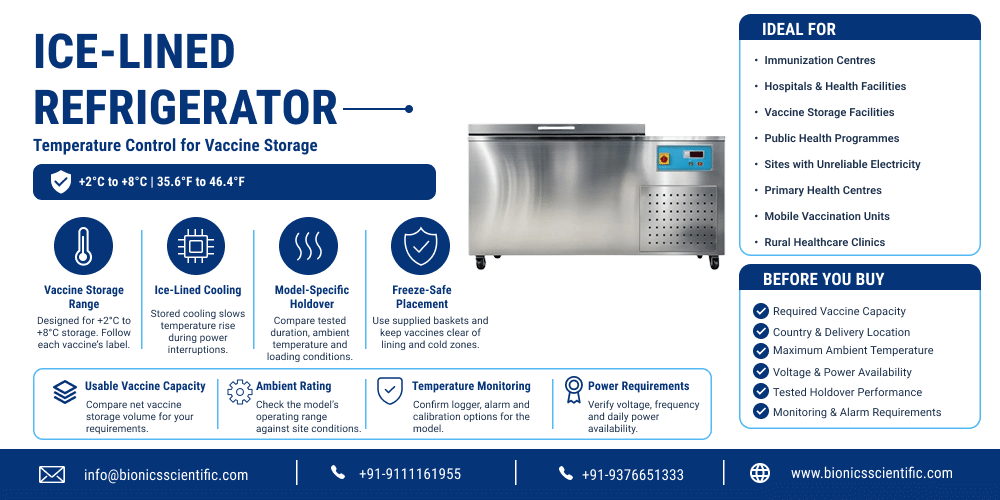
An ice lined refrigerator temperature (ILR) keeps vaccines between +2°C and +8°C (35.6°F to 46.4°F) and uses a lining of frozen water packs to slow warming during power cuts.
- Range: +2°C to +8°C. Freeze risk can exist near the lining, so placement matters.
- Holdover: model-specific; use the tested figure and conditions.
- ILR vs. deep freezer: different equipment with different jobs.
- Monitoring: read daily, log minimum and maximum, act on every excursion.
- Price: depends on model and options; request a written quotation.
What Is an Ice-Lined Refrigerator?
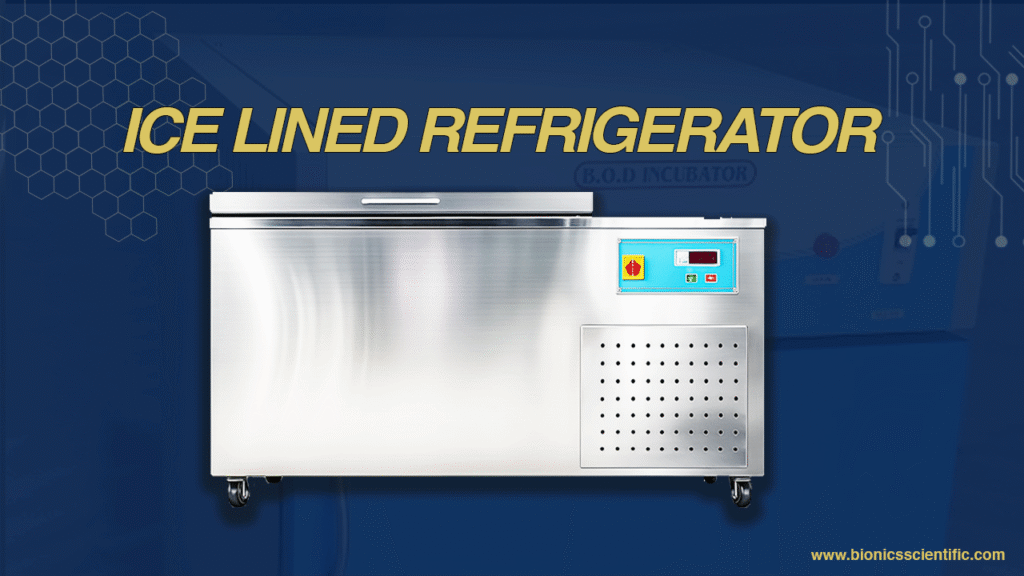
An ice-lined refrigerator, also called an ILR fridge or ice line refrigerator, is a vaccine refrigerator with water-filled panels around the cabinet. The compressor freezes the water during normal power hours. When power fails, the melting ice absorbs heat and slows the temperature rise.
The lining stabilizes temperature but does not make freezing impossible. The area near it can fall below +2°C depending on design, loading, and ambient conditions, so check freeze-protection data for your model. Bionics Scientific is a laboratory equipment manufacturer with 35 years of manufacturing experience.
ILR Temperature Range Explained
| Zone | Celsius | Fahrenheit | Meaning |
| Freeze risk | Below +2°C | Below 35.6°F | Can permanently damage freeze-sensitive vaccines, often invisibly. |
| Storage band | +2°C to +8°C | 35.6°F to 46.4°F | Accepted band for most refrigerated vaccines |
| Heat risk | Above +8°C | Above 46.4°F | Reduces potency; check vaccine vial monitor (VVM) status. |
Use the set point in the manual. Lowering it for extra holdover increases freeze risk.
Holdover Time
Holdover is how long the cabinet stays within +2°C to +8°C after power stops. It depends on the model, room temperature, loading, and lid openings. Bionics Scientific states that its ILR models have a holdover time of 20 to 24 hours; please confirm the test conditions for each model in the quotation.
Cold Storage Equipment Compared
| Equipment | Purpose | Typical range |
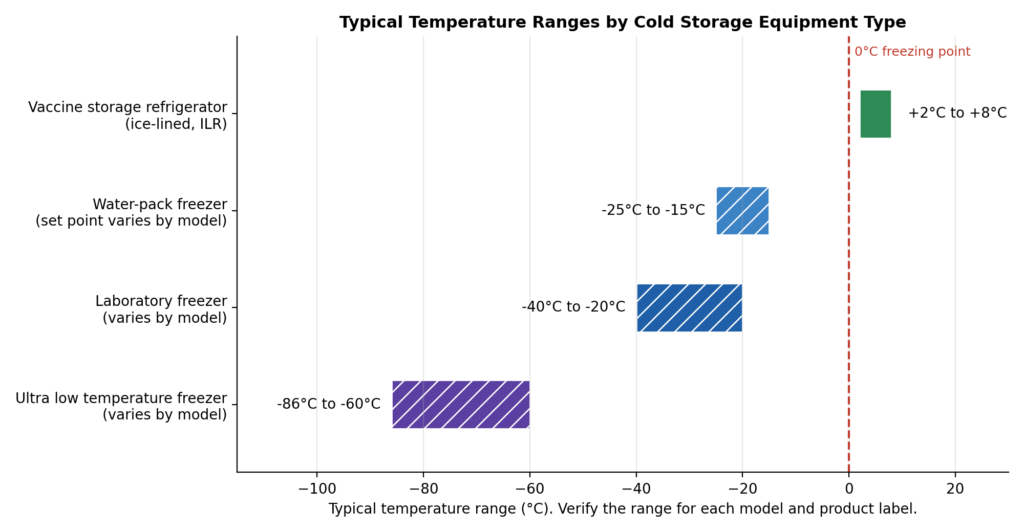
| Vaccine storage refrigerator (ILR) | Vaccines, with ice-lining thermal reserve | +2°C to +8°C |
| Laboratory refrigerator | Reagents, media, and samples are not validated for vaccines unless stated. | +2°C to +8°C, set point varies |
| Water-pack freezer | Freezing water packs for vaccine carriers | Model-specific, commonly below -15°C |
| Laboratory freezer | Samples, selected reagents | -20°C to -40°C or lower, varies by model |
| Ultra low temperature freezer | Research samples, products whose label requires it | -60°C to -86°C or lower, varies by model |
Freezer ranges are general industry values, not Bionics Scientific data. Buyers searching “ILR freezer” usually mean the water-pack freezer beside an ILR; an ILR is not a freezer. Not every mRNA vaccine needs ultra-low storage: some labels say -90°C to -60°C, others -50°C to -15°C. Follow the current product label.
ILR Vaccine Sequence: How to Load the Cabinet
- Identify freeze-sensitive vaccines, usually including hepatitis B, DTP-containing, TT, Td, DT, inactivated polio, and HPV. Confirm on each label.
- Place them in the baskets, away from walls, clear of the ice lining and cabinet floor.
- Freeze-dried vaccines may tolerate freezing, but their diluents must never freeze.
- Diluents: store as the label states, and cool to +2°C to +8°C before reconstitution where required.
- Leave air gaps, label each basket, and use earliest-expiry stock first.
- Store only vaccines, never food, drinks, or flammable chemicals.
An ILR suits laboratory reagents only if the product label allows +2°C to +8°C. Follow your national immunization program and manufacturer instructions.
Monitoring and Out-of-Range Action
Read the thermometer at the start and end of each day, record minimum and maximum values, keep the probe near vaccines, calibrate on schedule, and use a data logger with an alarm for weekends.
If a reading leaves +2°C to +8°C:
- Do not discard or use the stock yet; label it “do not use” and keep it cold.
- Record temperature, duration, and time found.
- Check VVM status; if freezing is suspected, do the shake test per national guidance.
- Report to your supervisor, national program, or vaccine manufacturer for a decision.
- Find the cause: power, door seal, set point, loading, or sensor.
Product Specifications: Bionics Scientific ILR Models
| Model | Gross | Usable (net) | Ambient | Holdover | Freeze protection | Monitoring | Datasheet |
| BST-ILR64 | 64 L | 48 L | 10°C to 43°C | 20 to 24 h | Data in quotation | PT100, alarm, optional logger | Page |
| BST-ILR136 | 136 L | 75 L | 10°C to 43°C | 20 to 24 h | Data in quotation | PT100, alarm, optional logger | Page |
| BST-ILR218 | 218 L | 105 L | 10°C to 43°C | 20 to 24 h | Data in quotation | PT100, alarm, optional logger | Page |
| BST-ILR235 | 235 L | 216 L | 10°C to 43°C | 20 to 24 h | Data in quotation | PT100, alarm, optional logger | Page |
Size by usable volume, not gross volume. Holdover is the declared range across models.
| Parameter | All models |
| Dimensions (H x W x D, inches) | 33 x 28 x 27; 33 x 36 x 27; 33 x 50 x 28 (ILR218 and ILR235) |
| Temperature range | +2°C to +8°C (35.6°F to 46.4°F) |
| Controller and alarm | Microprocessor controller, LED/LCD display, high/low audio-visual alarm |
| Optional monitoring | Data logger, chart recorder, computer interface, door-open, sensor-fault, and condenser-fault alarms |
| Construction | SS 304 interior, galvanized or CRCA exterior, PUF insulation, forced air circulation |
| Cooling and defrost | Hermetically sealed compressor; manual or automatic defrost |
| Power and protection | 220 / 240 V; high/low voltage cut-off with time-delay restart |
Price: What Changes the Cost
Price varies by model. It depends on usable capacity, holdover and ambient rating, power accessories such as voltage stabilizers, monitoring options, documentation, and delivery and installation.
International Availability
Bionics Scientific welcomes inquiries worldwide. Delivery, installation, and service coverage are confirmed per destination at quotation.
- Ambient temperature: compare site conditions with the 10°C to 43°C rating, especially in the Gulf states (UAE, Saudi Arabia, Qatar, Oman, Kuwait, Bahrain) and tropical markets such as Kenya, Ghana, and Thailand.
- Electrical supply: the listed supply is 220 / 240 V. The USA and Canada commonly use lower voltage at 60 Hz, so confirm the voltage and frequency.
- Shipping: Share the delivery location early for remote or inland sites.
- Local compliance: import rules and certificates differ by country.
Frequently Asked Questions
What is the correct ice-lined refrigerator temperature?
+2°C to +8°C, or 35.6°F to 46.4°F.
What does ILR stand for?
Ice-lined refrigerator, also written ILR fridge.
How long does an ILR hold temperature without power?
Bionics Scientific declares 20 to 24 hours; confirm your model’s conditions.
Can vaccines freeze in an ILR?
Yes, against the lining or in cold zones. Keep freeze-sensitive vaccines in baskets, away from walls.
Is an ILR the same as a deep freezer?
No. An ILR is a +2°C to +8°C refrigerator; a deep freezer stores frozen products.
What is an ILR freezer?
Usually, the water-pack freezer is located next to an ILR. An ILR itself is not a freezer.
Do all mRNA vaccines need ultra-low freezers?
No. Follow the current product label.
What is the best ILR thermometer setup?
A calibrated digital thermometer with minimum and maximum memory, near the vaccines, plus a daily log.
What affects the ILR price?
Volume, holdover, ambient rating, monitoring, documentation, and delivery.
How do I order?
Send the buyer checklist details below.
References
- WHO PQS Catalogue, Category E003: Refrigerators and freezers
- WHO, Immunization in Practice, Module 2: The vaccine cold chain
- WHO, Model EVM SOP manual
- CDC, Vaccine Storage and Handling Toolkit
- Vaccine manufacturer package inserts and current labels
Buyer Checklist: Request a Quotation
Send us:
- Required vaccine capacity (usable liters at peak stock)
- Country and delivery location
- Ambient temperature range at the site
- Power supply: voltage, frequency, outage pattern
- Monitoring features: alarm, data logger, chart recorder, or computer interface
Request a quotation or email info@bionicsscientific.com.
Bionics Scientific, laboratory equipment manufacturer.