A Muffle furnace price can range from a modest bench unit to a heavy industrial system, and the gap is rarely explained. If you are comparing offers from the Gulf, South Asia, Southeast Asia, Africa, or Australia, the number on the quotation tells you very little until you know the chamber size, maximum temperature, insulation, and controller behind it.
Muffle furnace manufacturer Bionics Scientific has built heating equipment for 35 years. This guide explains how pricing is formed, what to check before you order, and how to avoid paying for features your lab will never use.
Quick Answer
- Muffle furnace price: Small 1000–1100°C lab units sit at the lower end. Prices climb with temperature, chamber volume, and control quality.
- Muffle furnace manufacturer: A manufacturer controls design, wiring, and testing, so you get direct support and traceable build quality.
- Muffle furnace suppliers: Suppliers resell. Ask who actually builds the unit and who services it.
- Laboratory muffle furnace: Compact, precise, and used for ashing, loss on ignition, and small-batch heat treatment.
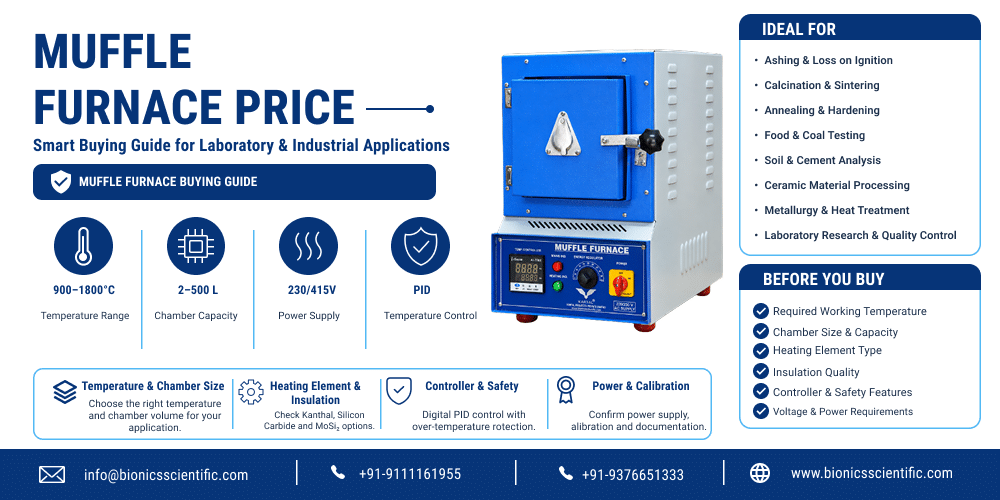
- Muffle furnace specifications: Temperature, chamber size, heating element, insulation, controller, and power rating.
- Industrial muffle furnace Bigger chamber, heavier insulation, higher throughput
- Electric muffle furnace: Heated by resistance elements; gives clean, even heat with no flame contact.
- Muffle furnace temperature: Usually 900°C to 1800°C depending on the type of element.
- Applications of muffle furnace: ashing, sintering, calcination, annealing, hardening, and material testing.
What Is a Muffle Furnace?
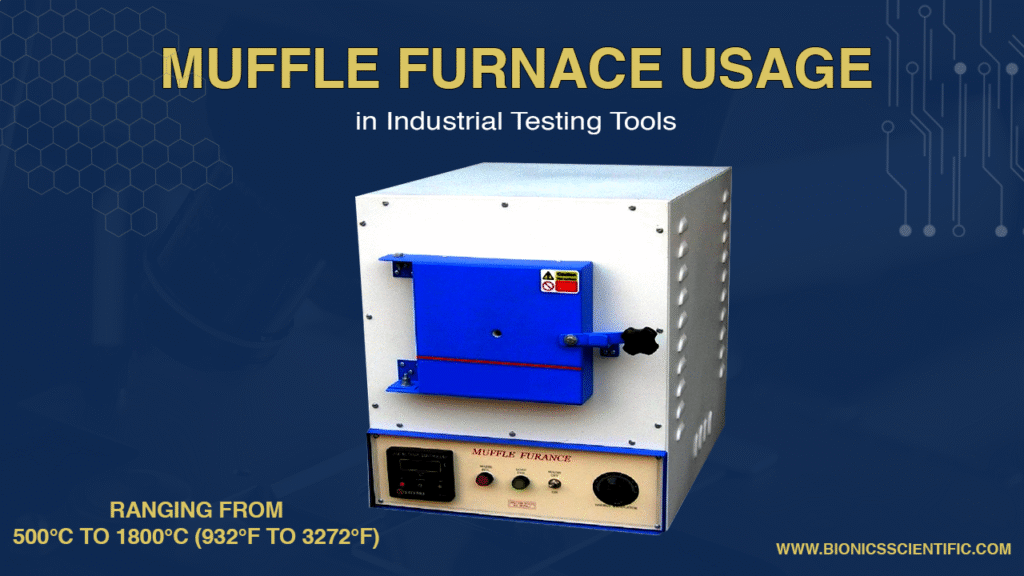
A muffle furnace heats samples inside an insulated chamber that keeps them separate from the heating source. Because the sample never meets the flame or element, the atmosphere stays clean and results stay repeatable. That is why a muffle furnace is standard in testing laboratories, ceramics units, metallurgy workshops, and quality-control departments. For a general technical background, see this overview of the muffle furnace.
Indicative Muffle Furnace Price Ranges
The figures below are indicative only. Final cost depends on configuration, programmer type and destination.
| Type | Max Temperature | Typical Chamber | Indicative Price (INR) |
| Basic laboratory unit | 1000°C | 2–5 liters | ₹30,000 – ₹80,000 |
| Programmable laboratory unit | 1100–1200°C | 5–14 liters | ₹70,000 – ₹1,80,000 |
| High-temperature unit | 1400–1600°C | 3–20 liters | ₹2,50,000 – ₹8,00,000 |
| Industrial muffle furnace | 1000–1200°C | 50–500 liters | ₹3,00,000 – ₹15,00,000+ |
For export orders to the UAE, Saudi Arabia, Qatar, Oman, Kuwait, or Bahrain, add packing, freight, and any local certification requirements. Request a written quote so every line is visible.
What Drives the Price
- Maximum temperature. Going from 1100°C to 1400°C changes the element and insulation and the price with them.
- Chamber volume. A bigger chamber needs more insulation, more power, and a stronger shell.
- Heating element. Kanthal wire, silicon carbide, and molybdenum disilicide serve different ranges and cost differently.
- Insulation. Ceramic fiber heats up faster and saves energy compared with older brick-type lining.
- Controller. A simple digital dial costs less than a multi-segment programmable PID controller.
- Build material. Stainless steel or powder-coated mild steel shells affect durability in humid regions.
- Safety features. Over-temperature cut-off, door interlock, and thermocouple break alarms add cost and add protection.
- Calibration and documentation. Test certificates matter for accredited labs.
Manufacturer or Supplier: Who Should You Buy From?
A muffle furnace manufacturer designs the chamber, winds or selects the elements, wires the panel, and tests every unit before dispatch. When a heating coil fails in Nairobi or a controller needs replacing in Dhaka, the manufacturer already knows the part.
Muffle furnace suppliers can be useful for quick local delivery, but ask three questions: Who builds it? Who holds spare parts? Who answers the warranty call? Direct manufacturer purchase usually shortens all three answers.
Laboratory vs Industrial Muffle Furnace
A laboratory muffle furnace prioritizes accuracy, a small footprint, and programmable cycles. It suits universities, pharma QC, food testing, and soil or coal analysis.
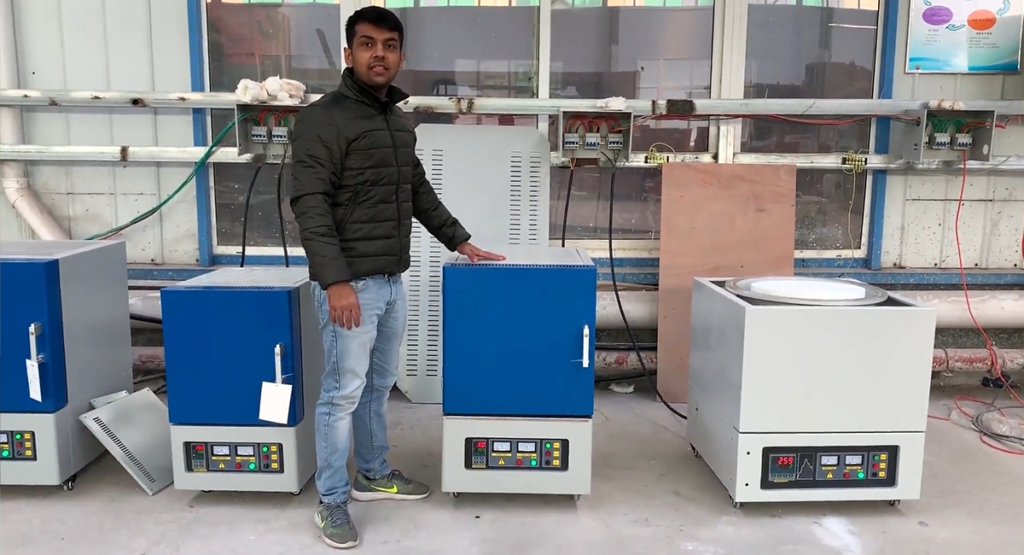
An industrial muffle furnace prioritizes volume, ruggedness, and long duty cycles. It suits foundries, ceramic plants, glass workshops, and heat-treatment lines. Our standard muffle furnace models cover both, from 900°C to 1800°C maximum. If you want the mechanism in more depth, read how a muffle furnace works.
How an Electric Muffle Furnace Works
An electric muffle furnace passes current through resistance elements embedded around the chamber. Heat radiates inward through the muffle, a ceramic liner that isolates your sample. A thermocouple reads chamber temperature, and the PID controller adjusts power to hold the setpoint, typically within ±1 to ±5 °C.
Muffle Furnace Specifications
| Parameter | Typical Specification |
| Temperature range | Ambient to 1100°C / 1200°C / 1400°C / 1800°C |
| Chamber size | 2 to 500 liters |
| Heating element | Kanthal wire, silicon carbide, MoSi₂ |
| Insulation | High-grade ceramic fiber |
| Temperature accuracy | ±1 to ±5°C |
| Controller | Digital PID, programmable multi-segment |
| Sensor | K-type or S-type thermocouple |
| Shell | Stainless steel or powder-coated steel |
| Power supply | 230 V single-phase / 415 V three-phase |
| Safety | Over-temperature cut-off, door switch |
Muffle Furnace Temperature Chart
| Temperature Range | Typical Heating Element | Typical Application |
| 105–250°C | Kanthal wire | Moisture drying, pre-ashing |
| 400–600°C | Kanthal wire | Organic ashing, loss on ignition |
| 700–900°C | Kanthal wire | Calcination, coal, and soil ash tests |
| 900–1100°C | Kanthal wire | Annealing, glass, and ceramic firing |
| 1100–1450°C | Silicon carbide | Sintering, metal hardening |
| 1450–1800°C | Molybdenum disilicide (MoSi₂) | Advanced ceramics, zirconia, research |
Choosing a muffle furnace temperature rating roughly 100–200°C above your working need extends element life. pharma,
Muffle Furnace Uses
- Ash content testing in food, coal, pharma, and plastics
- Loss on ignition in cement and soil labs
- Calcination of powders and catalysts
- Sintering ceramics and dental materials
- Annealing and hardening small metal parts
- Gravimetric analysis and crucible conditioning
15 Points Buyers Should Check Before Ordering
- Confirm the real working temperature, not just the maximum.
- Match chamber size to batch size.
- Verify element type and replacement cost.
- Ask the insulation material and thickness.
- Ask how fast it heats up and how long it takes to cool. If you run a few batches a day, a slow cool-down eats your afternoon.
- Find out how evenly the chamber heats. A furnace that runs hotter at the back gives results you can’t repeat.
- Pick a programmable controller if you work in set cycles. It handles the ramp, hold, and cool-down while you get on with other work.
- Check the thermocouple type and whether you can buy a spare locally. It is the part most likely to drift or fail first.
- Make sure there is over-temperature protection. If the controller ever misbehaves, the cut-off stops the chamber running away.
- Confirm voltage and phase for your country.
- Ask for a calibration certificate.
- Check warranty length and what it covers.
- Confirm spare-part availability in your region.
- Request installation and operator training support.
- Compare total cost of ownership, not just the purchase price.
Serving the Middle East, Asia-Pacific, and Africa
We supply laboratories across the United Arab Emirates (UAE), Saudi Arabia, Qatar, Oman, Kuwait, and Bahrain, with special focus on the wider Middle East. We also ship to Australia, Singapore, Malaysia, the Philippines, Indonesia, Vietnam, Bangladesh, Nepal, and Kenya. Furnaces for hot, humid, or dusty sites can be built with corrosion-resistant shells and voltage options to suit local grids.
Why Bionics Scientific
With 26 years of manufacturing experience, we build each furnace in-house, test it under load, and document the results. Our engineers help you select the right range instead of the most expensive one, so your muffle furnace price stays tied to what your process needs.
Get Your Muffle Furnace Quote
Share your temperature, chamber size, and destination country, and our team will send a clear, itemized quotation. Contact Bionics Scientific today and get a furnace matched to your lab.
Frequently Asked Questions
What is the muffle furnace price in India?
Small lab units start near ₹30,000. Programmable and high-temperature models cost more.
Why do muffle furnace prices vary?
Temperature, chamber size, element type, insulation, and controller all change the cost.
Which temperature should I choose?
Pick a rating 100–200°C above your working temperature.
What is the difference between manufacturer and supplier?
A manufacturer builds and services the unit. A supplier resells it.
What is a laboratory muffle furnace used for?
Ashing, loss on ignition, calcination, and small-batch heat treatment.
How long does an electric muffle furnace last?
With proper use, many run for ten years or more, with periodic element replacement.
Can you ship to the Middle East?
Yes. We export to the UAE, Saudi Arabia, Qatar, Oman, Kuwait, and Bahrain.
Does a muffle furnace need special power?
Small units use single phase. Larger models need three phases.
How often should it be calibrated?
Once a year is common, or more often for accredited labs.
Do you provide custom sizes?
Yes. Chamber, temperature, and controller can be tailored to your process.