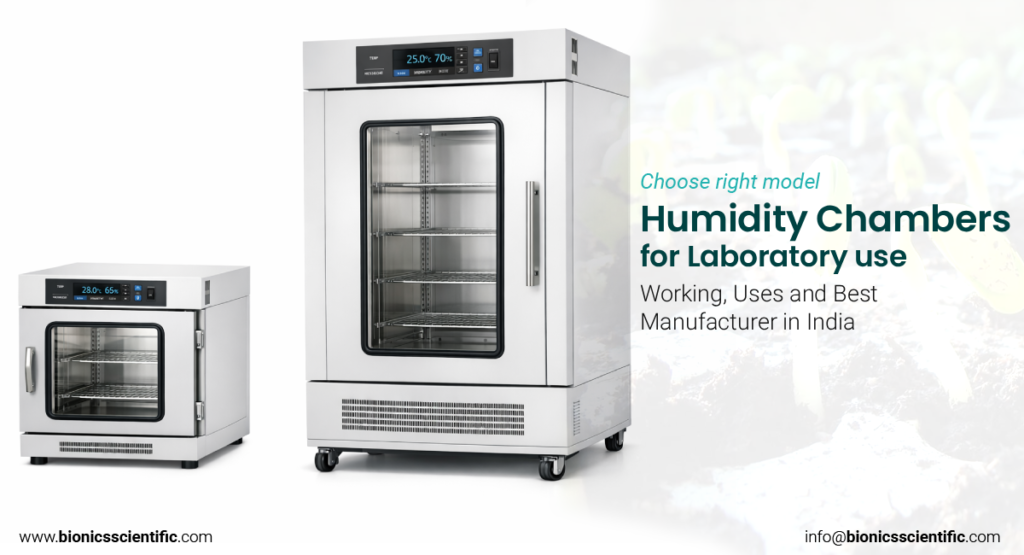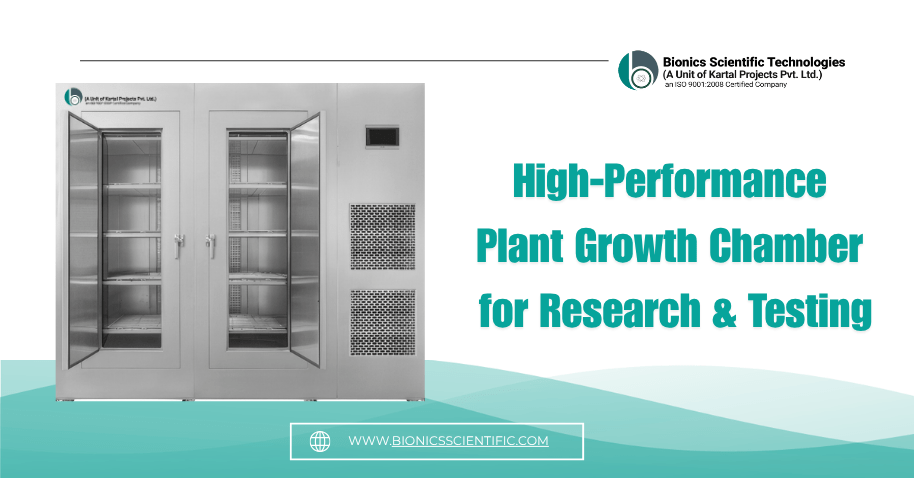
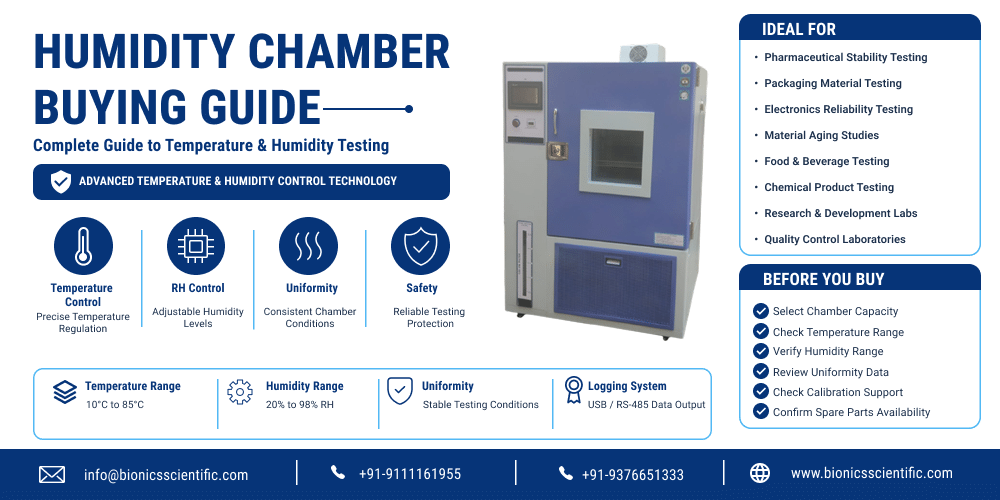
Humidity Chamber Buying Guide testing lets you reproduce hot, damp conditions on your bench, with a set temperature and a set moisture level, for as many days as the test needs. That matters because a product that passes inspection in a dry lab can still swell, rust, clump, or lose potency on a humid shelf in Jeddah, Dhaka, or Mombasa.
Bionics Scientific has manufactured laboratory equipment for 35 years. This guide explains how these chambers work, what to compare, and how to read quotes, so you can shortlist with confidence.
Quick Answer
- What it is: an insulated cabinet that holds a fixed temperature and relative humidity (RH).
- Why buy it: stability studies, packaging tests, material aging, and electronics reliability.
- Typical range: about 10°C to 85°C and 20% to 98% RH, depending on the model.
- What drives price: volume, temperature and humidity range, refrigeration, controller, and data logging.
- Best fit for hot-humid markets: 30°C/65% RH, 30°C/75% RH, and 40°C/75% RH programs.
- What to ask a supplier: mapping data, sensor calibration support, water-quality guidance, and spare-part availability.
What a Humidity Chamber Buying Guide Does
Think of it as a small, controlled climate. A heater and a humidifier raise temperature and moisture, a refrigeration circuit (on lower-range models) pulls them down, and a fan keeps the air moving so every shelf sees similar conditions. A controller reads the sensors several times per second and corrects any drift.
Buyers also search for it as a humidity chamber buying guide, a temperature and humidity chamber, or a humidity test chamber. The names differ, but the job is the same: hold two variables steady while your samples sit inside.
How It Works, Step by Step
- You enter a setpoint, for example, 40°C and 75% RH.
- The heater brings the workspace to temperature.
- A steam generator or evaporative humidifier adds moisture until the RH sensor reads the target.
- If the room is too warm or the air too wet, cooling or dehumidification takes over.
- The controller logs the readings so you can show the run held its conditions.
Distilled or deionized water matters here. Hard water leaves scale on the humidifier and sensor, which is the most common cause of drifting RH readings in Gulf and South Asian labs. A laboratory water distiller beside the chamber solves this at low cost.
Temperature and Humidity Chart
These are the conditions most buyers program. Your own protocol always takes priority.
| Test condition | Temperature | Relative humidity | Typical use |
| Long-term, temperate | 25°C | 60% | Stability storage |
| Long-term, hot-dry | 30°C | 35% | Zone IVa/Zone III-type checks |
| Long-term, hot-humid | 30°C | 65% | Zone IVa studies |
| Long-term, very hot-humid | 30°C | 75% | Zone IVb studies |
| Accelerated | 40°C | 75% | Shelf-life screening |
| Packaging stress | 50°C | 90% | Carton and adhesive checks |
| Electronics soak | 85°C | 85% | Component reliability |
Stability programs for medicines follow the climatic zones set out in the ICH Q1A(R2) guideline, which is the reference most regulators in these regions build on.
Specification Table
Values below are typical configurable ranges. Final figures are confirmed in the quotation for the model you select.
| Parameter | Typical specification |
| Capacity | 80 L to 1000 L and larger on request |
| Temperature range | 10°C to 85°C |
| Humidity range | 20% to 98% RH (within the temperature-humidity envelope) |
| Temperature fluctuation | ±0.5°C |
| Humidity fluctuation | ±2.5% RH |
| Controller | Programmable touch or microprocessor, multi-segment profiles |
| Chamber interior | Stainless steel |
| Insulation | CFC-free, high-density |
| Humidification | Steam generator or evaporative |
| Safety | Over-temperature cut-off, low-water alarm, door switch |
| Data | USB or RS-485 output, alarm log |
| Power | Single-phase or three-phase, to match local supply |
Humidity can only be held within a safe envelope. You cannot get 95% RH at 10°C and 85°C at once, so check the operating envelope diagram before you sign off.
What Buyers Actually Ask Before Purchase
Across inquiries from the Gulf, Southeast Asia, and East Africa, the same questions keep coming up.
Will it hold humidity in a hot room? Where the lab is poorly air-conditioned, ask for a model with proper cooling capacity and confirm the ambient limit.
Is uniformity proven? Accuracy and uniformity are different. Accuracy is how close the display is to the true value; uniformity is how even the conditions are across shelves. Ask for a mapping report.
Can I calibrate it locally? Sensor drift is normal. Choose a supplier who supports calibration and gives clear procedures.
What happens during a power cut? Ask about auto-restart and alarm behavior, especially for long studies.
How fast can I get spares? Heaters, sensors, humidifier parts, and door gaskets should be stocked, not special-ordered.
What Affects Humidity Chamber Price
Many buyers search for humidity chamber prices first. Cost is not a single number; it moves with:
Volume: a 1000 L unit costs a lot more than a 150 L bench model.
Temperature and RH range: the wider the ranges, the more refrigeration and dehumidification required.
Controller and software: basic displays are cheaper than programmable, networked controllers.
Documentation: calibration certificates, mapping add effort.
Shipping & Installation: freight, duty, and local power adaptation.
Get each supplier to quote on the same capacity and range so you can compare the figures.
Supply to the Middle East, Asia-Pacific, and Africa
Bionics Scientific serves buyers across the Middle East, including the United Arab Emirates (UAE), Saudi Arabia, Qatar, Oman, Kuwait, and Bahrain, where high summer temperatures and coastal humidity make stability testing essential. We also ship to Australia, Singapore, Malaysia, the Philippines, Indonesia, Vietnam, Bangladesh, Nepal, and Kenya.
Gulf buyers often need 50 Hz units suited to high ambient temperatures. South-East Asian labs frequently ask for tropical-climate performance with constant monsoon humidity. Tell us your country and supply voltage, and we will set up the specification for it before dispatch. For details on a standard range, see our humidity temperature test chamber.
Why Choose Bionics Scientific
As a humidity chamber manufacturer with 26 years in the field, we build the cabinet, wiring and control logic ourselves, which makes service answers faster. We provide drawings, operating guidance, and after-sales support in writing, and we match specifications to your protocol rather than selling a fixed catalogue item.
Frequently Asked Questions
What is a humidity chamber used for?
It holds set temperature and humidity to test how products behave under moisture, such as medicines, packaging, food, and electronics.
What is the difference between a humidity chamber and a temperature humidity chamber?
Nothing in practice. Both control temperature and RH together. The names are used interchangeably.
What temperature range should I choose?
Choose based on your protocol. Most pharma work sits between 25°C and 40°C; electronics tests may need up to 85°C.
Which humidity range is typical?
Most chambers cover 20% to 98% RH, though the usable range narrows at very low or very high temperatures.
How accurate are these chambers?
Typical control is about ±0.5°C and ±2.5% RH. Confirm values and mapping data in the quotation.
What water should I use?
Distilled or deionized water. Tap water causes scale and unstable humidity readings.
How often should it be calibrated?
Usually once a year, or as your quality system requires. Critical studies may need shorter intervals.
How do I compare humidity chamber prices between suppliers?
Request quotes for the same volume, range, controller, and documentation. Then compare service and spare-part terms.
Can it run in hot Gulf or tropical conditions?
Yes, if specified for your ambient temperature. State your room conditions when enquiring.
Do you supply to my country?
We supply to the UAE, Saudi Arabia, Qatar, Oman, Kuwait, Bahrain, Australia, Singapore, Malaysia, the Philippines, Indonesia, Vietnam, Bangladesh, Nepal, and Kenya.
Get a quotation
Send us your capacity, temperature and RH range, and country. Our team will reply with a matching specification and price. Contact Bionics Scientific today.