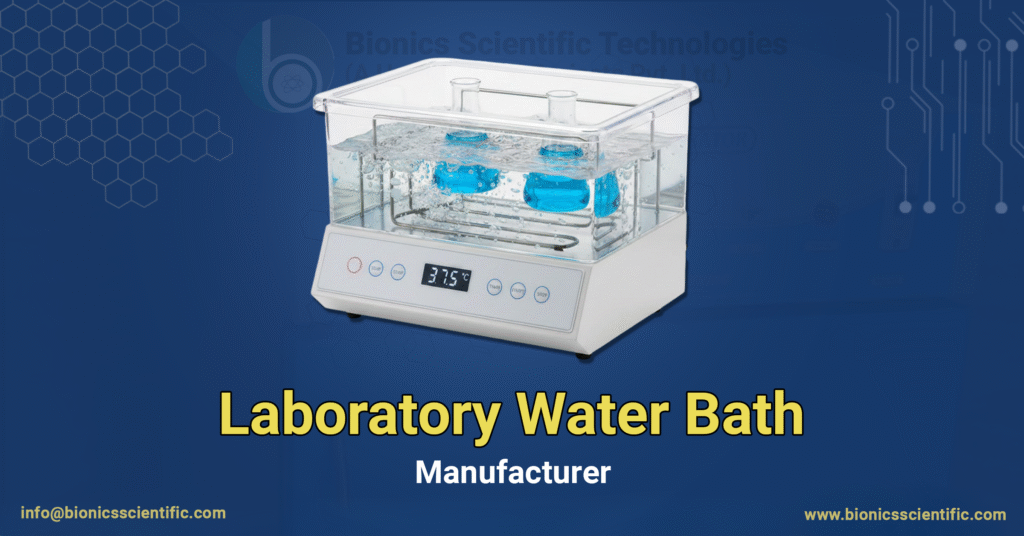
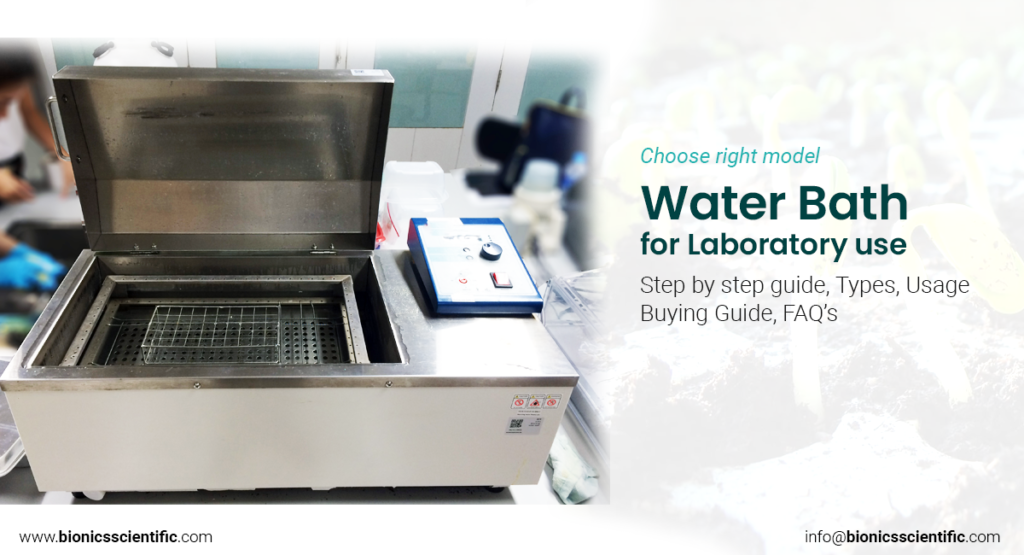
A laboratory water bath is used to heat and maintain samples at a controlled temperature using heated water. It is commonly used for sample incubation, reagent warming, thawing, and other laboratory procedures that require stable and uniform heating.
The right water bath depends on the required temperature range, chamber capacity, and application. Common types include general-purpose, serological, shaking and circulating water baths. This guide explains their uses, operating procedure, and the key specifications to compare before selecting a model.
What Is a Laboratory Water Bath?
A laboratory water bath is a temperature-controlled device used to heat or incubate samples in water for a specified period. The water transfers heat around containers such as test tubes, beakers and flasks, helping maintain controlled heating conditions for laboratory applications.
Unlike an open flame or a hot plate, which can create hot spots, a heating device surrounds the sample container’s beaker, flask or test tube with heated water. This helps the heat spread evenly through the sample from all sides because of the natural movement of warm water.
Why is it preferred over other methods?
- Uniformity: It is used to maintain a steady temperature for a prolonged time when incubating samples.
- Safety: It is safer for heating flammable chemicals as there is no open flame.
- Temperature Control: Digital laboratory water baths may use PID controllers to maintain the selected temperature with stable and consistent control.
4 Main Types of Laboratory Water Baths
Different types of laboratory water baths are designed for different applications. Compare the four common types below based on their typical use and key features.
Use this Quick Comparison Table to find exactly what you need:
|
Water Bath Type |
Best Application |
Key Feature |
|
Serological Water Bath |
Blood banking, serology, vaccine thawing |
Precise temperature control for temperature-sensitive applications |
|
Shaking Water Bath |
Cell culture, hybridization, microbiology |
Built-in agitation for mixing samples while heating |
|
Circulating Water Bath |
Enzymatic reactions, high-uniformity tests |
Water circulation helps maintain uniform temperature |
|
Rectangular / General Purpose Water Bath |
General warming, thawing, basic incubation |
Suitable for routine laboratory heating applications |
Step by Step Guide: How to Operate a Water Bath Safely
For proper water bath use in a laboratory, understanding the correct Standard Operating Procedure is essential. Follow these steps to ensure safe operation and long lasting performance:
WHO Maintenance Manual for Laboratory Equipment
- Preparation : Place the water bath on a steady and level surface.
- Filling: Fill the stainless steel chamber with Distilled or Deionized water.
- Important Note: Use the water quality recommended by the equipment manufacturer or your laboratory SOP. Water with high mineral content may cause scale deposits inside the bath.
- Always make sure the water level is high enough to cover the heating element but low enough to prevent overflowing.
- Power On : Switch on the unit and set the desired temperature using the Digital PID Controller.
- Example: Set to 37°C for standard incubation.
- Wait for Equilibrium : Allow the bath to reach the set temperature and stabilize.
- Insert Samples : Carefully place your test tubes or flasks into the rack.
- Cover It: Always use the Gabled Lid. This prevents condensation from dripping back into your samples and contaminating them.
Buying Guide : 3 Specs You Must Check
When selecting a laboratory water bath, compare these three specifications based on your application, required temperature control and workload:
1. Temperature Accuracy : PID vs. Thermostat
For applications that require stable temperature control, a digital water bath with a PID controller can help maintain the selected temperature consistently. Choose the controller and temperature range according to your laboratory application.
2. Material Quality : SS 304
Check the inner chamber material when selecting a water bath. SS 304 stainless steel is commonly used because it provides good corrosion resistance and is suitable for routine laboratory use.
3. Capacity in litres
Choose the chamber capacity according to your sample size, number of containers and routine workload:
Get Water Bath Price & Specifications
Simple Solutions to Everyday Problems
Even the best equipment needs care. Avoid these common mistakes to keep the lab running smoothly.
| Problem | Possible Cause | Solution |
|---|---|---|
| Water not heating | Heater burnout or Fuse blown. | Check if water level was too low. |
| Temperature fluctuating | Unstable environment or lack of circulation. | Move away from vents or choose a Circulating Water Bath. |
| White scale or deposit in tank | Use of Tap Water. | Drain, clean with mild acid and switch to Distilled Water. |
| Rust spots appearing | Chemical spillage or poor material. | Clean immediately. Ensure chamber is SS 304. |
Why Top Agencies Trust Bionics Scientific
We take pride in being a global manufacturer of water bath systems that are Made in India yet engineered for the world. Bionics Scientific is an ISO Certified company which delivers industrial grade engineering that meets the rigorous standards of premier organizations.
Our commitment to quality is supported by our registrations and trusted partnerships with prestigious organizations such as the:
- Defence Research and Development Organization
- Indian Space Research Organization
We also follow the high safety and manufacturing standards acknowledged by UNICEF and the World Health Organization. As a government verified entity, we are also proudly registered with NSIC and MSME to ensure reliability you can count on.
FAQs regarding Water Bath Laboratory Use
Here are the top questions users generally ask, answered by experts:
1. Which type of water should be used in a laboratory water bath?
Always use Distilled or Deionized water. Because Tap water contains salts and minerals that cause scaling or white deposits on the heating element and chamber.
2. What is the difference between an Incubator and a Water Bath?
An Incubator uses dry heat air to maintain temperature but on the other hand Water Bath uses wet heat water. Water transfers heat more efficiently and uniformly than air.
3. How often should a water bath be calibrated?
For critical laboratory use: calibration should be checked annually or semi annually. This ensures that the temperature displayed on the Digital PID controller matches the actual water temperature.
4. Can a laboratory water bath boil water?
Most standard water baths have a temperature range of Ambient to 100°C. While they can reach 100°C but if you need vigorous, continuous boiling then it is better to use a specialized model to handle the evaporation safely.
5. What is the purpose of a shaking water bath?
A Shaking Water Bath is used when samples need to be mixed while heating. This is essential for Cell Culture and microbiological applications to ensure aeration.
6. What is a Dry Bath vs. a Water Bath?
A Dry Bath uses heated metal blocks to hold test tubes, whereas a Water Bath uses liquid. Water baths offer better temperature uniformity but Dry Baths eliminate the risk of cross contamination from water.
7. Why do I need a Gabled Lid?
A Gabled Lid is shaped like a roof. It allows condensation to run down the sides of the lid back into the tank instead of dripping directly into your open test tubes which prevents sample contamination.
8. What does PID Controller mean?
PID stands for Proportional Integral Derivative. It is a digital control algorithm that strictly monitors the temperature. It prevents the water bath from getting too hot or overshooting or too cold that ensures high precision.
9. How to prevent rust in water bath?
First, ensure you buy a model made of SS 304 Stainless Steel. Second, never use bleach or high salt solutions inside the bath. Third clean the bath regularly.
10. How does low water level affects in a water bath?
If the water drops is below the heating element then it can cause the heater to get overheat and even burn out.So it is always better to make sure the water level is sufficient before turning the machine on.
Conclusion
Choosing the right equipment for water bath laboratory use is about matching the model to your specific application ,whether you need the gentle mixing of a Shaking Water Bath or the absolute precision of a Serological model.
By selecting a model with a PID controller and SS 304 construction, you ensure your experiments remain accurate and the equipment lasts for years.
Ready to upgrade your lab equipment? Do not risk your research with inferior heating methods. Explore the complete range of ISO certified Bionics Scientific Water Baths or request a price quote today.