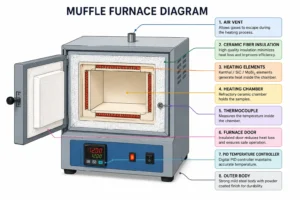
A muffle furnace diagram shows the main components of a laboratory muffle furnace, including the heating chamber, heating elements, insulation, thermocouple, and temperature controller. Understanding these parts helps users learn how the furnace generates and controls high temperatures for laboratory testing, material analysis, and heat treatment.
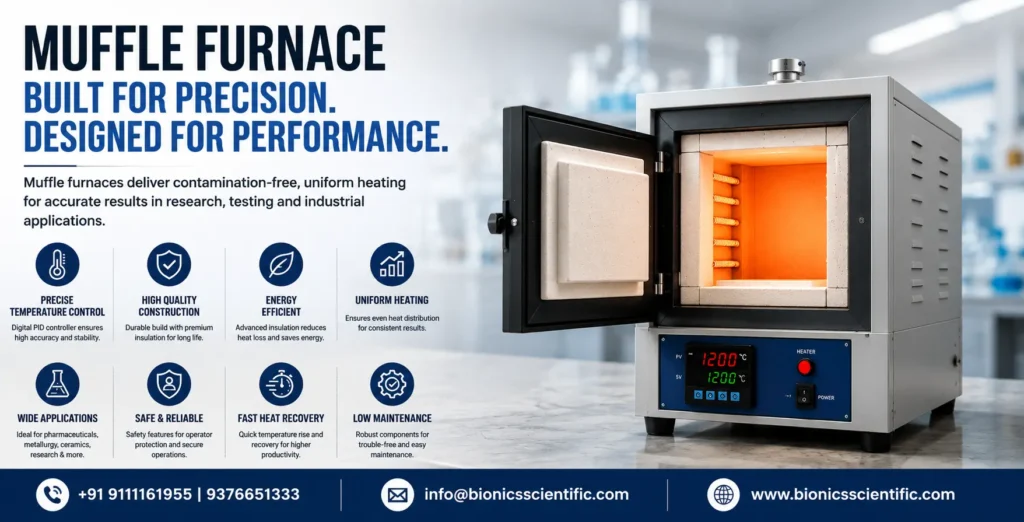
Bionics Scientific produces high-quality laboratory muffle furnaces with precision temperature control, high thermal uniformity, energy efficiency, and durability. Our products are extensively employed in pharmaceutical laboratories, research laboratories, metallurgy, ceramics, education institutions, and quality control laboratories.
What is Muffle Furnace?
The muffle furnace is an electric laboratory furnace which produces a temperature inside a thermally insulated box without coming into contact with flames and combustion gases. The contamination-free temperature produced in such furnaces assures consistent laboratory results.
The temperature range of most laboratory muffle furnaces lies between 300°C and 1200°C. The temperature of more sophisticated research muffle furnaces exceeds 1700°C.
Muffle Furnace Diagram Explanation
Heating Chamber
The heating chamber is the part used to hold the samples. The heating chamber is made of refractory ceramics that can withstand high temperatures without getting deformed. A good design of the heating chamber makes sure that there is even heat distribution.
Heating Elements
The heating elements are the parts that transform electrical energy into heat. Depending on the temperature needed, Kanthal wire, Silicon Carbide (SiC), or Molybdenum Disilicide (MoSi₂) is used. These are put around the heating chamber, which ensures that heating occurs from all sides. The chamber must not be overloaded because that makes it difficult for heat to circulate.
Ceramic Fiber Insulation
Ceramic fiber insulation prevents heat loss, increases the energy efficiency, decreases heating time, and reduces the heat of the furnace exterior.
Temperature Controller PID
The modern muffle furnace has a digital temperature controller that uses the PID principle to control the temperature in the chamber automatically. The device controls the amount of power given to the heating elements in order to maintain the exact temperature in the furnace chamber.
Thermocouple
The thermocouple measures the temperature in the chamber and feeds back information to the PID temperature controller. Proper calibration of the thermocouple is very important in order to ensure reliable laboratory results.
Furnace Door, Air Vent and Outer Body
The insulated furnace door reduces heat losses and protects the operator against high surface temperatures. The air vent allows gases to leave the chamber safely during the heating process.
How Does a Muffle Furnace Work?
A muffle furnace works on the principle of indirect electric heating. First, the sample is placed inside the heating chamber and the required temperature is set using the PID controller. The heating elements convert electrical energy into heat, while the insulation helps retain heat inside the chamber. A thermocouple measures the chamber temperature and sends feedback to the controller, which regulates the power supplied to the heating elements. This process allows controlled high-temperature heating without direct flame contact.
Technical Specifications
| Parameter | Typical Specification |
| Working Temperature | 800°C–1700°C (model-dependent) |
| Maximum Temperature | 900°C–1800°C (model-dependent) |
| Temperature Accuracy | ±1°C |
| Temperature Controller | PID Controller |
| Heating Elements | Kanthal A-1 / Silicon Carbide (SiC) / Molybdenum Disilicide (MoSi₂) |
| Temperature Sensor | Model-dependent thermocouple |
| Chamber Construction | Ceramic Board and Grooved Refractory Chamber |
| Insulation | Ceramic Wool Insulation |
| Power Supply | 220V / 440V |
Note: Specifications may vary depending on the furnace model, maximum operating temperature, chamber size, and heating element configuration. Please refer to the individual product datasheet for exact specifications.
Who Should Use a Muffle Furnace?
The laboratory muffle furnace is meant for organizations and individuals who need accurate, contaminant-free, and high-temperature heating.
Individuals who use the muffle furnace include:
- Laboratories in the pharmaceutical industry to conduct tests for ash content analysis.
- Research and Development laboratories to perform thermal analysis.
- Educational institutes for performing engineering and chemistry experiments.
- Metallurgical laboratories for tests on heat treatments.
- For sintering and firing, laboratories serve ceramic and glass manufacturers.
- Laboratories for analysis of residues and soil in the environment.
- Laboratories for industrial quality control and product testing.
Applications
Muffle furnaces are commonly used for ash content determination, calcination, sintering, ceramic firing, heat treatment, and material testing. They are also used in pharmaceutical, metallurgical, environmental, and research laboratories for controlled high-temperature applications.
Advantages of a Laboratory Muffle Furnace
A laboratory muffle furnace offers several benefits for high-temperature testing. Its insulated chamber helps reduce heat loss, while the digital PID controller maintains the selected temperature. Electric heating provides controlled heating without direct flame contact, making it suitable for ash testing, calcination, and material analysis.
Safety and Maintenance
Proper functioning and regular maintenance are key factors to increase furnace lifespan and enhance the safety of operators.
Safety Guidelines
- Use heat-proof gloves and safety glasses.
- Do not use the device above its maximum operating temperature rating.
- Wait until the chamber cools down after performing high-temperature tests before you open the furnace.
- Avoid any flammable substances around the device.
- Ventilation is needed when heating gas-releasing substances.
- Switch off the power before servicing.
Maintenance Guidelines
- Cleaning up ash and other residues after each usage.
- Regular check-up of heating elements and the furnace chamber.
- Periodical calibration of the thermocouple.
- Checking the condition of door gaskets and ceramic insulating materials.
Test of PID controller and electrical connections’ integrity and accuracy.
Common Errors in Using a Muffle Furnace
The most accurate muffle furnace found in a laboratory can give erroneous data if used improperly. Here are some errors you should avoid in order to prolong equipment service and ensure the accuracy of measurements.
- Overfilling the heating area to prevent proper heat distribution.
- Opening the furnace door when the device is working at high temperatures.
- Not calibrating the thermocouple regularly and getting wrong temperature measurement
- Using the wrong type of crucible or container that cannot sustain high temperatures
- Plugging the air vent to stop proper gas discharge
Muffle Furnace vs Hot Air Oven
| Feature | Muffle Furnace | Hot Air Oven |
| Heating Method | Radiant electrical heating | Forced hot air circulation |
| Temperature Range | Up to 1200°C or higher | Up to 300°C |
| Primary Use | Ashing, calcination, heat treatment | Drying and sterilization |
| Sample Contact | No combustion gases | Heated air circulation |
| Suitable Materials | Metals, ceramics, minerals | Glassware and laboratory instruments |
In case your application involves temperatures higher than 500°C, contamination-free heating, or testing of any material, then a muffle furnace is the best option.
How to Select the Correct Muffle Furnace
The choice of a lab muffle furnace should be made according to testing requirements, specimen sizes, and the temperatures used. While buying, it is advisable to take into account the following points:
- Operating temperature according to your needs.
- Appropriate chamber size for the size of the sample.
- Heating speed and the time needed to recover the temperature.
- Digital PID temperature controller.
- Type and calibration capability of the thermocouple.
- Material of the heating element, including Kanthal, SiC and MoSi₂
- Ceramic fiber insulating materials to increase the energy efficiency
- Electrical compatibility and power consumption
- Over-temperature protection features
Availability of warranty services, spare parts and technical support
Selection of a reputable manufacturer will ensure the proper performance of the equipment, accurate temperature control, and efficient service.
Why Choose Bionics Scientific?
Bionics Scientific is one of the renowned suppliers of scientific laboratory instruments in India. The muffle furnaces that we manufacture have high-quality refractory lining along with a PID temperature controller and high-quality heating elements.
Our Advantages
- Precision-built construction
- Uniform temperature distribution
- Energy-saving ceramic insulation
- Quality heating elements
- Digital programmable controller systems
- Robust powder-coated steel body
- Customized chamber size and temperature range
- Technical support and after-sales services
If you need a furnace for pharmaceutical, metallurgical, or ceramic testing and research purposes, then we have got everything that you want.
FAQ’s
What is a muffle furnace diagram?
A muffle furnace diagram is a labeled illustration showing the main parts of a furnace, including the heating chamber, heating elements, insulation, thermocouple, temperature controller, and outer body.
What are the main components of a muffle furnace?
The main components include the heating chamber, electric heating elements, insulation, thermocouple, PID temperature controller, furnace door, and outer casing.
What is the use of a muffle furnace?
A muffle furnace is used for high-temperature applications such as ash content determination, calcination, sintering, ceramic firing, and heat treatment.
What is the maximum temperature of a muffle furnace?
The maximum temperature depends on the furnace model and heating element configuration. Many laboratory models operate up to 1200°C, while specialized models can support higher temperatures.
Why is ceramic fiber used in a muffle furnace?
Ceramic fiber is used as an insulating material. It helps reduce heat loss, maintain chamber temperature, and improve thermal efficiency.
What is the function of a PID controller in a muffle furnace?
A PID controller monitors the temperature and regulates power to the heating elements to maintain the selected temperature.
What are the common applications of muffle furnaces?
Muffle furnaces are commonly used in laboratories and industries for ash testing, calcination, sintering, heat treatment, ceramic processing, and material analysis.
How often should a muffle furnace be calibrated?
Calibration frequency depends on usage, operating conditions, and laboratory quality requirements. Follow the manufacturer’s recommendations and your laboratory’s calibration schedule.
What maintenance does a muffle furnace require?
Regular maintenance includes cleaning the chamber, checking heating elements, inspecting insulation and door seals, and checking temperature sensor performance. Always follow the manufacturer’s maintenance instructions.
Conclusion
Understanding a muffle furnace diagram helps laboratory users identify its main components and understand how the equipment controls high-temperature heating. From the heating chamber and elements to the thermocouple and PID controller, each component contributes to furnace operation. Bionics Scientific offers laboratory muffle furnaces designed for different high-temperature testing and research applications.
High Performance Muffle Furnace
Are you on the lookout for muffle furnaces, which are high-performance and suitable for conducting tests in the laboratory environment? At Bionics Scientific, we offer muffle furnaces that provide high-performance temperature control, insulation, and sturdy construction.