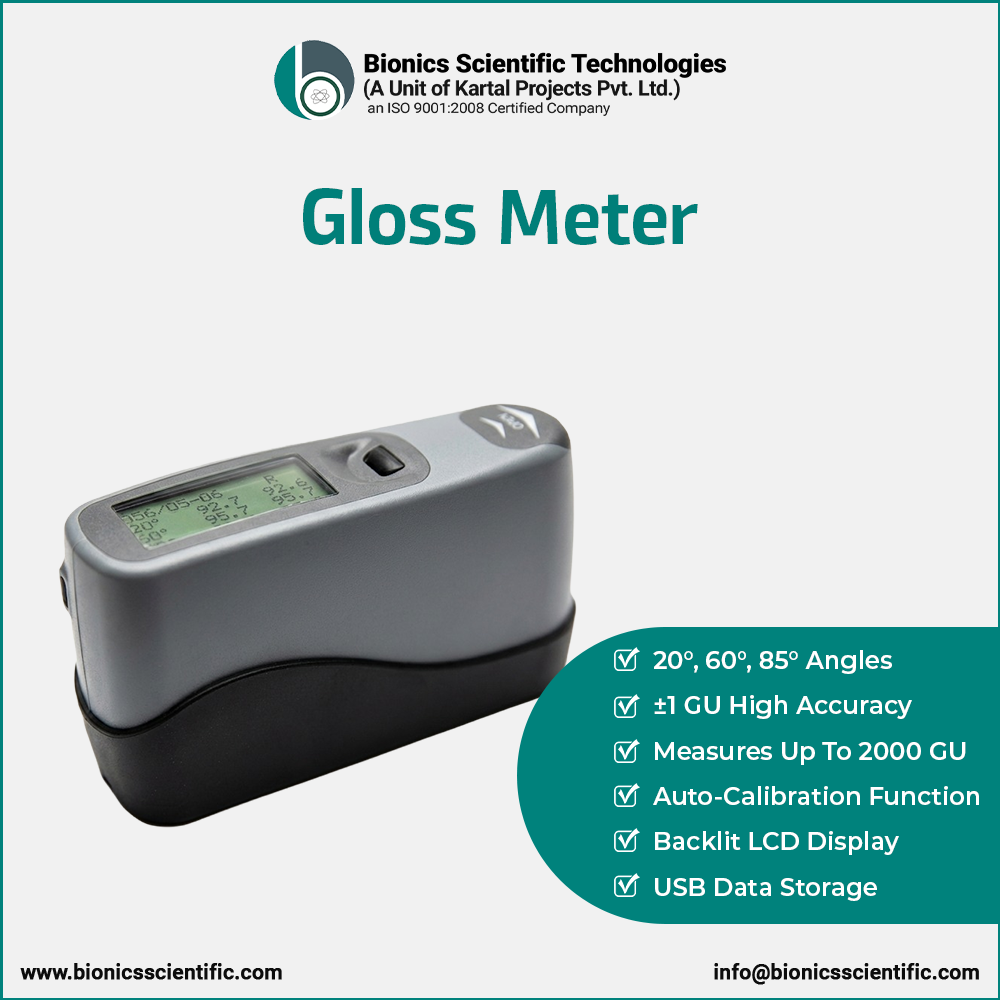
Digital Gloss Meter for Printing, Paper, Ink and Packaging
A gloss meter for printing industry is a precision instrument used to
measure the surface gloss of printed paper, printing ink, labels, cartons, coated sheets,
laminated packaging, UV-coated prints and varnished materials. The instrument displays
reflected-light measurements in Gloss Units (GU), helping printing and packaging companies
maintain consistent surface appearance across production batches.
Bionics Scientific supplies digital single-angle and multi-angle
gloss meters
for printing, paper, packaging, paint, metal, plastic and coating applications. The instrument helps
quality-control teams identify variations caused by ink formulation, paper coating,
lamination, varnishing, surface smoothness and production conditions.
The 60° measurement angle is commonly used for general and medium-gloss surfaces. The 20°
angle provides improved differentiation on high-gloss finishes, while the 85° angle is
suitable for low-gloss and matte surfaces. A multi-angle gloss meter is useful when different
printed materials and surface finishes are tested.
How Does a Printing Gloss Meter Work?
A digital gloss meter works on the principle of specular reflection. The instrument directs
a controlled beam of light onto the printed or coated surface at a defined angle. A detector
measures the amount of light reflected from the surface and converts it into a numerical
result expressed in Gloss Units.
A higher GU reading generally indicates a shinier surface, while a lower reading indicates
a matte or less reflective finish. By comparing production readings with an approved master
sample, printing and packaging manufacturers can identify gloss variation before final
dispatch.
Why Gloss Measurement Is Important in the Printing Industry
Surface gloss affects the visual appearance and perceived quality of printed products.
Differences in gloss may occur because of changes in paper coating, ink quantity, drying,
UV coating, varnish application, lamination or printing-machine settings. Visual inspection
alone may not identify small differences between batches.
A printing gloss meter provides objective and repeatable readings for incoming material
inspection, process control and final quality checking. This helps maintain uniform gloss
across labels, cartons, brochures, magazines and packaging materials.
Printing Materials That Can Be Tested
- Coated and uncoated paper
- Printing inks and ink drawdowns
- Printed labels and stickers
- Folding and pharmaceutical cartons
- UV-coated printed sheets
- Varnished brochures and magazines
- Laminated paper and packaging films tested using
digital measuring meters
- Flexible packaging materials
- Corrugated boxes and printed boards
- Commercial print samples
Which Gloss Meter Angle Should You Use?
| Measurement Angle |
Recommended Surface |
Printing Application |
| 20° |
High-gloss surfaces |
Glossy laminates, polished coatings and high-gloss UV finishes |
| 60° |
General and medium-gloss surfaces |
Printed paper, ink, labels, cartons and general packaging |
| 85° |
Low-gloss and matte surfaces |
Matte paper, matte coatings and low-gloss laminated packaging |
Gloss Meter Specifications
| Product |
Gloss Meter |
| Suitable Applications |
Printing, Paper, Packaging, Paint, Metal and Coated Surfaces |
| Accuracy |
±1 GU |
| Angle Heads |
20°, 60° and 85° |
| Resolution |
0.1 GU |
| Power Supply |
Rechargeable batteries |
| PC Compatibility |
Yes, through USB interface |
| Measurement Range |
Model dependent: up to 1000 GU or 2000 GU |
| Sensor |
V(x) Silicon Photodiode |
| Light Source |
Specially designed light source |
| Memory |
200 Readings per angle |
| Filters |
Optional |
| Accessories |
Carrying case, USB cable, Operating manual, Battery |
| Implementation of Standards |
GB/T 9754, ISO 2813, ASTM D523, ASTM C584, GB/T 8807, GB/T 9966 |
Applications of Digital Gloss Meter
- Gloss measurement of printing ink and printed paper
- Quality inspection of labels, cartons and packaging materials
- Testing of UV-coated and varnished printed surfaces
- Gloss comparison of laminated and non-laminated samples
- Batch-to-batch gloss consistency checking
- Quality control in offset, flexographic, gravure and digital printing
- Measurement of automotive paint and coated components
- Testing of metal, steel, plastic and powder-coated surfaces using
precision gloss meters
- Gloss measurement of marble, granite and ceramic tiles
- Inspection of polished wood and decorative finishes
Benefits of Gloss Measurement in Print Quality Control
- Provides objective readings in Gloss Units
- Reduces dependence on visual inspection
- Helps maintain consistent printed-product appearance
- Identifies variations in ink, coating, varnish and lamination
- Supports incoming-material and final-product inspection
- Helps reduce rejected batches and customer complaints
- Allows readings to be stored and transferred for analysis
- Provides fast results in laboratory and production environments
How to Measure the Gloss of Printed Materials
- Clean the measurement aperture and calibration tile.
- Switch on the instrument and complete calibration according to the manual.
- Select the required measurement angle: 20°, 60° or 85°.
- Place the printed sample on a flat and stable surface.
- Position the meter firmly over the test area.
- Press the measurement key and record the value in Gloss Units.
- Take readings at multiple locations for better comparison.
- Compare the readings with the approved sample or specified tolerance.
Buy Gloss Meter for Printing Industry in India
Bionics Scientific supplies digital single-angle and multi-angle gloss meters for printing,
packaging, paper, paint, metal, plastic and coating applications. Measurement range, memory,
software compatibility and supported standards may vary according to the selected model.
Contact our technical team through our
Contact Us
page to choose the right
Gloss Meter
for your printing, paper and packaging applications. Share your sample material, expected gloss range and required measurement angle for expert assistance. Our team will help you select a suitable model and provide product specifications, pricing and delivery information.
Frequently Asked Questions
A Gloss Meter for Printing Industry measures the gloss level of printed paper, labels, cartons, packaging materials, UV coatings and printing inks in Gloss Units (GU) to maintain consistent print quality.
Gloss measurement ensures consistent print appearance, coating quality, ink finish and product uniformity while reducing production variations and rejected batches.
Gloss meters are used to test coated paper, printing inks, laminated packaging, labels, cartons, painted metals, plastics, ceramics, wood finishes and other coated surfaces.
A 60° gloss meter is suitable for most applications. A 20° angle is recommended for high-gloss surfaces, while an 85° angle is ideal for matte and low-gloss materials.
Gloss Units (GU) are the standard measurement used to determine the amount of reflected light from a surface. Higher GU values indicate higher surface gloss.
Yes. Digital gloss meters accurately measure the gloss level of printed paper, printing inks, labels, brochures, magazines and packaging materials.
Digital gloss meters are widely used in printing, packaging, paper, paint, automotive, furniture, plastic, coating, ceramic and quality control laboratories.
Calibration should be performed before regular testing or according to the manufacturer's recommendations to ensure accurate and repeatable measurements.
Select a gloss meter based on the material, gloss range, measurement angle (20°, 60° or 85°), accuracy requirements and industry application.
Bionics Scientific offers reliable digital gloss meters for printing, packaging, paper, paint and industrial applications with accurate measurements, easy operation and dependable technical support.