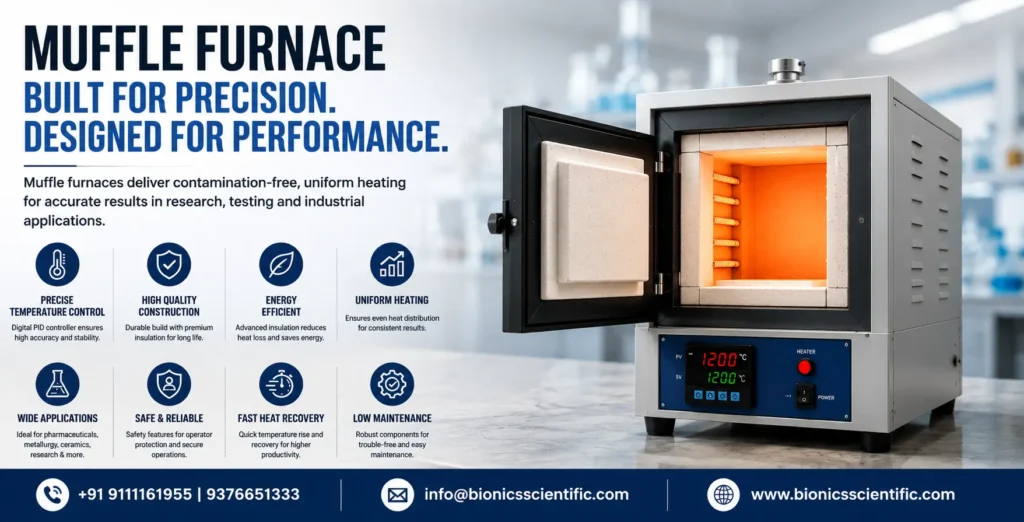
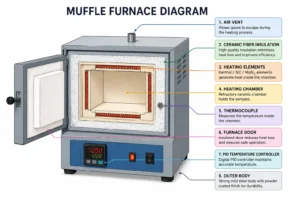
Muffle furnace schematic diagram allows the user to know about the structure and working of laboratory muffle furnaces. The components like heating chamber, heating elements, insulator, thermocouple, PID, air vent, and body can be identified by users in order to operate the instrument effectively and safely. These components are vital for proper temperature control, prevention from maintenance issues, and selection of appropriate furnaces for various purposes.
Bionics Scientific produces high-quality laboratory muffle furnaces with precision temperature control, high thermal uniformity, energy efficiency, and durability. Our products are extensively employed in pharmaceutical laboratories, research laboratories, metallurgy, ceramics, education institutions, and quality control laboratories.
What is Muffle Furnace?
The muffle furnace is an electric laboratory furnace which produces a temperature inside a thermally insulated box without coming into contact with flames and combustion gases. The contamination-free temperature produced in such furnaces assures consistent laboratory results.
The temperature range of most laboratory muffle furnaces lies between 300°C and 1200°C. The temperature of more sophisticated research muffle furnaces exceeds 1700°C.
Muffle Furnace Diagram Explanation
Heating Chamber
The heating chamber is the part used to hold the samples. The heating chamber is made of refractory ceramics that can withstand high temperatures without getting deformed. A good design of the heating chamber makes sure that there is even heat distribution.
Heating Elements
The heating elements are the parts that transform electrical energy into heat. Depending on the temperature needed, Kanthal wire, Silicon Carbide (SiC), or Molybdenum Disilicide (MoSi₂) is used. These are put around the heating chamber, which ensures that heating occurs from all sides. The chamber must not be overloaded because that makes it difficult for heat to circulate.
Ceramic Fiber Insulation
Ceramic fiber insulation prevents heat loss, increases the energy efficiency, decreases heating time, and reduces the heat of the furnace exterior.
Temperature Controller PID
The modern muffle furnace has a digital temperature controller that uses the PID principle to control the temperature in the chamber automatically. The device controls the amount of power given to the heating elements in order to maintain the exact temperature in the furnace chamber.
Thermocouple
The thermocouple measures the temperature in the chamber and feeds back information to the PID temperature controller. Proper calibration of the thermocouple is very important in order to ensure reliable laboratory results.
Furnace Door, Air Vent and Outer Body
The insulated furnace door reduces heat losses and protects the operator against high surface temperatures. The air vent allows gases to leave the chamber safely during the heating process.
How Does a Muffle Furnace Work?
Furnace works on the principle of indirect heating by electricity. After loading the sample into the furnace, the required temperature is set through the PID controller. Heat generating elements produce the heat, whereas the ceramic insulators keep it. Temperature is measured within the furnace chamber by means of a thermocouple, which enables control of power supplied. As a result, no flame or combustion gases are used for heating the samples; that is why heating is clean and precise.
Technical Specifications
| Parameter | Typical Specification |
| Temperature Range | 300°C–1200°C |
| Temperature Accuracy | ±1°C to ±2°C |
| Controller | Digital PID |
| Heating Elements | Kanthal / SiC / MoSi₂ |
| Temperature Sensor | K-Type Thermocouple |
| Chamber Material | Refractory Ceramic |
| Insulation | Ceramic Fiber |
| Power Supply | 230V AC, 50Hz |
Who Should Use a Muffle Furnace?
The laboratory muffle furnace is meant for organizations and individuals who need accurate, contaminant-free, and high-temperature heating.
Individuals who use the muffle furnace include:
- Laboratories in the pharmaceutical industry to conduct tests for ash content analysis.
- Research and Development laboratories to perform thermal analysis.
- Educational institutes for performing engineering and chemistry experiments.
- Metallurgical laboratories for tests on heat treatments.
- For sintering and firing, laboratories serve ceramic and glass manufacturers.
- Laboratories for analysis of residues and soil in the environment.
- Laboratories for industrial quality control and product testing.
Applications
Laboratory muffle furnaces find many applications in ash content determination, heat treatment, calcination, ceramics, sintering, thermal analysis, glass manufacturing, metallurgy, pharmaceuticals, environmental studies, research laboratories, universities, and industrial testing. Their capability of providing contamination-free, uniform heating makes them indispensable wherever precision at high temperature is required.
Advantages of a Laboratory Muffle Furnace
A laboratory muffle furnace is superior to conventional furnaces because of its various advantages. This type of furnace can offer uniform temperatures, clean heating, quick recovery of heat, minimal heat loss, and reliable performance in lab operations. Efficient insulation ensures less energy is used while digital PID control ensures the attainment of precise temperatures.
Safety and Maintenance
Proper functioning and regular maintenance are key factors to increase furnace lifespan and enhance the safety of operators.
Safety Guidelines
- Use heat-proof gloves and safety glasses.
- Do not use the device above its maximum operating temperature rating.
- Wait until the chamber cools down after performing high-temperature tests before you open the furnace.
- Avoid any flammable substances around the device.
- Ventilation is needed when heating gas-releasing substances.
- Switch off the power before servicing.
Maintenance Guidelines
- Cleaning up ash and other residues after each usage.
- Regular check-up of heating elements and the furnace chamber.
- Periodical calibration of the thermocouple.
- Checking the condition of door gaskets and ceramic insulating materials.
Test of PID controller and electrical connections’ integrity and accuracy.
Common Errors in Using a Muffle Furnace
The most accurate muffle furnace found in a laboratory can give erroneous data if used improperly. Here are some errors you should avoid in order to prolong equipment service and ensure the accuracy of measurements.
- Overfilling the heating area to prevent proper heat distribution.
- Opening the furnace door when the device is working at high temperatures.
- Not calibrating the thermocouple regularly and getting wrong temperature measurement
- Using the wrong type of crucible or container that cannot sustain high temperatures
- Plugging the air vent to stop proper gas discharge
Muffle Furnace vs Hot Air Oven
| Feature | Muffle Furnace | Hot Air Oven |
| Heating Method | Radiant electrical heating | Forced hot air circulation |
| Temperature Range | Up to 1200°C or higher | Up to 300°C |
| Primary Use | Ashing, calcination, heat treatment | Drying and sterilization |
| Sample Contact | No combustion gases | Heated air circulation |
| Suitable Materials | Metals, ceramics, minerals | Glassware and laboratory instruments |
In case your application involves temperatures higher than 500°C, contamination-free heating, or testing of any material, then a muffle furnace is the best option.
How to Select the Correct Muffle Furnace
The choice of a lab muffle furnace should be made according to testing requirements, specimen sizes, and the temperatures used. While buying, it is advisable to take into account the following points:
- Operating temperature according to your needs.
- Appropriate chamber size for the size of the sample.
- Heating speed and the time needed to recover the temperature.
- Digital PID temperature controller.
- Type and calibration capability of the thermocouple.
- Material of the heating element, including Kanthal, SiC and MoSi₂
- Ceramic fiber insulating materials to increase the energy efficiency
- Electrical compatibility and power consumption
- Over-temperature protection features
Availability of warranty services, spare parts and technical support
Selection of a reputable manufacturer will ensure the proper performance of the equipment, accurate temperature control, and efficient service.
Why Choose Bionics Scientific?
Bionics Scientific is one of the renowned suppliers of scientific laboratory instruments in India. The muffle furnaces that we manufacture have high-quality refractory lining along with a PID temperature controller and high-quality heating elements.
Our Advantages
- Precision-built construction
- Uniform temperature distribution
- Energy-saving ceramic insulation
- Quality heating elements
- Digital programmable controller systems
- Robust powder-coated steel body
- Customized chamber size and temperature range
- Technical support and after-sales services
If you need a furnace for pharmaceutical, metallurgical, or ceramic testing and research purposes, then we have got everything that you want.
FAQ’s
What is a muffle furnace diagram?
It is a diagram depicting all components of the muffle furnace.
What are the components of the muffle furnace?
Its components include a heating chamber, heating elements, insulation, PID controller, a thermocouple, a furnace door, air vent, and a body.
What is the use of muffle furnace?
Used in the determination of ashes, heat treatment, calcination, ceramic firing, sintering, and testing of materials.
What is the maximum temperature of the muffle furnace?
Usually, the laboratory muffle furnaces have maximum temperatures up to 1200°C, whereas certain specific models exceed 1700°C.
Why is the ceramic fiber insulation important?
Because it reduces the loss of heat and ensures efficient temperatures within the chambers.
How will PID controller improve the process?
When it controls the supply of electricity for accurate and stable temperature control
Uses of muffle furnaces?
Pharmaceutical industry, metallurgical industry, ceramics, laboratories, universities, environmental tests, and manufacturing industries.
When should you calibrate your muffle furnace?
Calibration must be performed whenever necessary depending on the laboratory quality requirements.
The maintenance that needs to be done?
Calibration of thermocouples and cleaning of heating elements, chambers, insulation, and electric components.
Conclusion
A good knowledge of the muffle furnace diagram is essential for laboratory workers to recognize different parts, use the apparatus in a safe way, and ensure accurate high-temperature operation. Every single part of the system is responsible for an efficient and uncontaminated heating process. High-quality muffle furnace from Bionics Science is a guarantee of accuracy and reliability.
High Performance Muffle Furnace
Are you on the lookout for muffle furnaces, which are high-performance and suitable for conducting tests in the laboratory environment? At Bionics Scientific, we offer muffle furnaces that provide high-performance temperature control, insulation, and sturdy construction.