Quick Answer
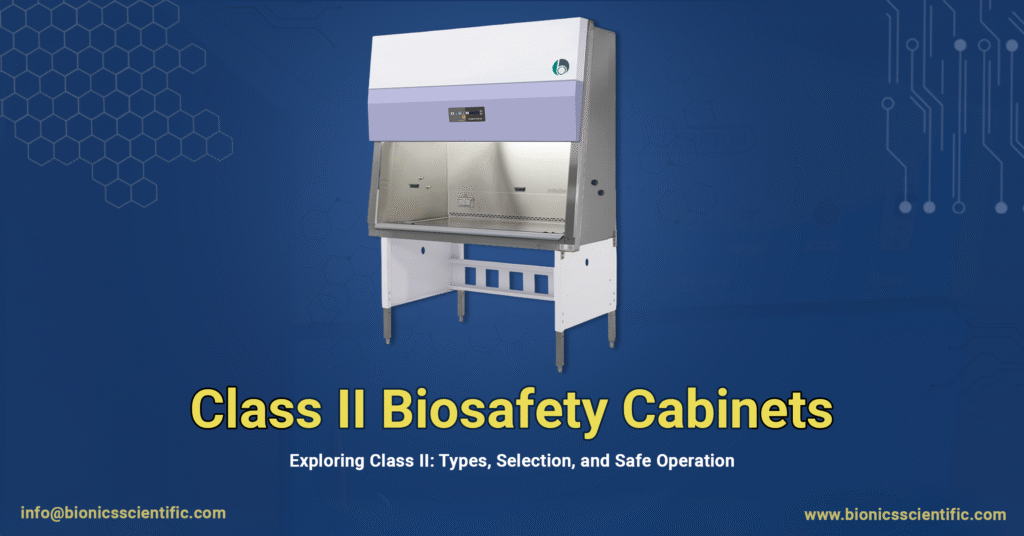
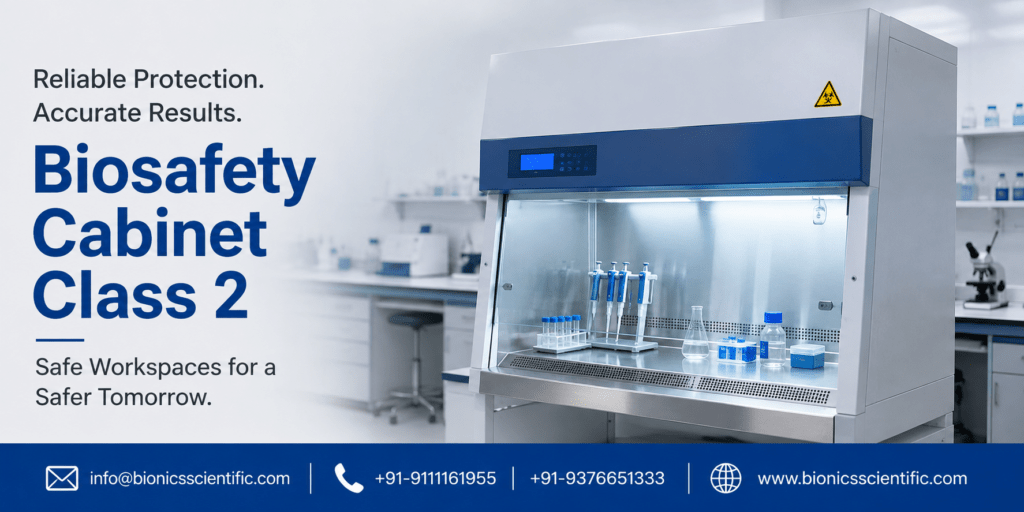
A Biosafety Cabinet Class 2 (Class II) is a ventilated, HEPA-filtered enclosure that protects the lab worker, sample, and environment simultaneously through inward, downward, and HEPA-exhaust airflow. It’s standard containment equipment for risk groups 2 and 3 biological agents in microbiology, virology, cell culture, pharma QC, and diagnostics labs.
It differs from a plain Laminar Air Flow (LAF) unit because LAF protects only the sample, and from Class I because it also protects the product with HEPA-filtered downflow. Bionics Scientific manufactures Class II Type A2 cabinets in India, with 35 years of experience and 1000+ units dispatched across India and overseas, including the Middle East, Saudi Arabia, Oman, and the USA.
What Is a Biosafety Cabinet?
A biosafety cabinet (BSC) is an enclosed, ventilated workspace built to contain aerosols from infectious or hazardous biological material. Unlike a fume hood, built for chemical vapors, a BSC is purpose-built for biological containment, and unlike an open laminar airflow bench, it protects the operator, not just the material inside.
Every Class II cabinet draws room air through the front grille, splits it, and passes a portion through a HEPA filter before recirculating it as a vertical downflow across the work surface. Remaining air is drawn down through the front grille, preventing aerosols from escaping toward the operator. Exhaust air also passes through a second HEPA filter before leaving, either into the room (Type A2) or through ductwork (Type B1/B2). This three-way protection — personnel, product, environment — separates a true biosafety cabinet from a laminar flow bench.
Biosafety Cabinet Types and Classes
Biosafety cabinets fall into three classes based on airflow design and containment level. Class I cabinets protect the operator and environment but not the sample, since air exhausts through a HEPA filter without HEPA-filtered downflow; these are largely superseded by Class II units.
Class II cabinets are the most widely installed type because they protect worker, sample, and room simultaneously. Subtypes vary by recirculation and ducting: Type A1 recirculates roughly 70% of air and may exhaust into the room but isn’t suited to volatile toxic chemicals. Type A2 is similar but with higher inflow velocity and a negative-pressure plenum—the most common subtype for microbiology and cell culture and what Bionics Scientific manufactures.
Type B1 is partially ducted; Type B2 is fully ducted with no recirculation, used where volatile chemical or radioactive hazards combine with biological risk.
Class III cabinets are gas-tight, glovebox-style enclosures for Risk Group 4 agents, reserved for BSL-4 facilities.
Biosafety Cabinet vs. Laminar Air Flow (LAF)
This distinction matters for safety. An LAF cabinet pushes filtered air across the work surface and exhausts it back into the room with no operator-protection barrier—protecting only the sample. A biosafety cabinet always includes an inward airflow barrier and HEPA filters for exhaust before release, protecting the operator too. As a rule: use a BSC, not an LAF bench, for infectious materials.
How a Class II Biosafety Cabinet Works
The blower draws room air through the front intake grille at a manufacturer-specified inflow velocity, per the data plate. This air passes beneath the work surface and up through a supply HEPA filter, forming the vertical downflow across the work area. A front air-split point directs part of this downflow, plus front-grille intake air, into the plenum and through the exhaust HEPA filter. Since both supply and exhaust air pass through HEPA filtration (typically 99.99% efficient at 0.3 microns), particulates and most microorganisms are captured before air recirculates or leaves.
Specification Table — Bionics Scientific Class II Type A2 Biosafety Cabinet
| Parameter | Specification |
| Class/Type | Class II, Type A2 |
| Construction | Powder-coated / SS 304 exterior and interior chamber |
| Filtration | HEPA supply + exhaust filter, efficiency rating on certificate |
| Airflow pattern | Inward, downward, HEPA-recirculated |
| Work surface | Perforated SS 304 removable tray |
| Viewing panel | Sloped, impact-resistant safety glass sash |
| UV germicidal lamp | Optional, factory-fitted |
| Illumination | LED, shadow-free |
| Alarm system | Airflow/sash-position audible-visual alarm |
| Available widths | 2 ft / 4 ft / 6 ft (custom on request) |
| Standards | Aligned with international BSC test standards; site validation per client SOP |
| Power supply | 220–240V, 50 Hz (export units configurable to destination voltage) |
Cabinet Temperature Behavior — Indicative Chart
Interior temperature in a Class II cabinet is a function of ambient lab conditions, blower heat load, and UV/lighting fixtures—it is not a fixed universal number and should always be verified with a calibrated thermometer at installation and during routine validation. Indicative behavior during a standard duty cycle:
| Time After Startup | Typical Work-Zone Temperature Trend |
| 0 minutes (cold start) | Approx. equal to ambient room temperature |
| 15 minutes | Gradual rise as blower motor and lighting reach operating state |
| 30 minutes | Stabilizing range; manufacturer-specified steady-state band |
| 60+ minutes (steady state) | Stable, cabinet-specific plateau — confirm against your unit’s validation report |
Because actual figures vary by cabinet model, room HVAC load, and UV/lighting configuration, Bionics Scientific provides temperature and airflow validation data specific to each dispatched unit rather than a single quoted figure.
Where Class II Biosafety Cabinets Are Used
Class II cabinets are standard in clinical microbiology, TB culture, virology, vaccine research, cell culture, pharmaceutical QC, and hospital pathology labs. Bionics Scientific’s cabinets are installed pan-India and dispatched overseas to the Middle East, Saudi Arabia, Oman, and the USA.
How to Select a Class II Type A2 Cabinet?
Consider the fitment width and take into account the sash height along with flow velocity. Demand HEPA certification along with filter certification (0.3 micron) in the form of an airflow validation report for the unit, in addition to the HEPA certification, and not just the specifications. Check out noise level, illumination, sash alarm calibration, and compatibility for electricity and ducting, and ensure that installation is a part of the delivery and not a chargeable extra at a later stage.
Know the PAO/DOP testing person for commissioning, whether annual certification facilitates NABL/GLP/ISO 17025, spare availability, and after-sales and warranty terms.
The most important aspects are HEPA filter certification, airflow validation per unit, after-sales/spares availability, and annual revalidation capacity — only these will make a difference between a genuine manufacturer and a trader. Warning signs include lack of filter certificate, lack of validation report, lack of installation in the quotation, and lack of contact name for services. Ask for a detailed and broken-down quotation with a time frame. Bionics Scientific’s Type A2 cabinets conform to this list comprehensively as standard practice.
Selection of Manufacturer
Generally, buyers look for HEPA filter certification, airflow validation, after-sales filter support, construction quality, and experience. Bionics Scientific has manufactured clean air devices for 35 years, with 1200+ units installed pan-India and overseas.
Who Trusts Bionics Scientific
Bionics Scientific Technologies (P) Ltd., a unit of Kartal Projects Pvt. Ltd., is ISO 9001:2015 certified and supplies equipment to government organizations, including DRDO, UNICEF, WHO, NSIC, MSME, and ISRO—reflecting the quality-control scrutiny its cabinets are built to withstand.
Validation & Compliance
Kartal Projects Pvt. Ltd. holds independently issued, currently valid certifications from Euroglobe Registrars (UK):
| Certification | Standard | Certificate No. | Valid Until | Scope |
| Quality Management System | ISO 9001:2015 | 184876 | 30-03-2029 | Products as per annexure |
| CE Compliance | MDD 93/42/EEC | 184877 | 30-03-2029 | Products as per annexure |
| Good Manufacturing Practices | GMP | 184878 | 30-03-2029 | Explicitly includes fume hood and biosafety cabinet |
| NSF Certification | NSF/ANSI 61 | 183884 | 08-03-2027 | Scoped to biosafety cabinet manufacture |
All four remain in active surveillance and are verifiable through the certifying body.
The Bionics Scientific Product Engineering Team has reviewed this information for technical accuracy.
Frequently Asked Questions
What is a biosafety cabinet class 2?
A HEPA-filtered, ventilated enclosure that protects the operator, sample, and environment through inward and HEPA-recirculated downward airflow—the standard for risk group 2/3 biological material.
What is the difference between LAF and a biosafety cabinet?
LAF filters air onto the work surface with no inward barrier, protecting only the sample. A biosafety cabinet adds an inward barrier and HEPA-filters exhaust, protecting the operator too.
What is the difference between Type A2 and Type B2?
Type A2 recirculates part of its filtered air and typically exhausts into the room. Type B2 is a total-exhaust, fully ducted design for volatile chemical or radioactive hazards.
Is a biosafety cabinet the same as a fume hood?
No. A fume hood extracts chemical vapor, not biological aerosols, and doesn’t HEPA-filter its exhaust like a biosafety cabinet does.
What maintenance does a Class II cabinet need?
Periodic HEPA filter integrity testing (DOP/PAO challenge), airflow velocity verification, UV lamp checks, and sash-alarm calibration — typically annually or per your quality system’s schedule.
Are Bionics Scientific’s biosafety cabinets certified and exportable?
Yes. Kartal Projects Pvt Ltd holds valid ISO 9001:2015, CE, GMP, and NSF/ANSI 61 certificates covering biosafety cabinet manufacture, and cabinets can be configured for export to the Middle East, Saudi Arabia, Oman, and the USA.
Get a Validated Biosafety Cabinet for Your Lab
Choosing the right Class II biosafety cabinet means choosing a manufacturer who backs every specification with validation data. Bionics Scientific has spent 35 years manufacturing clean-air equipment and dispatched 1200+ units across India and overseas. Talk to our team for a site-specific specification sheet, HEPA validation report, and installation support for your Class II biosafety cabinet requirement.