Quick Answer
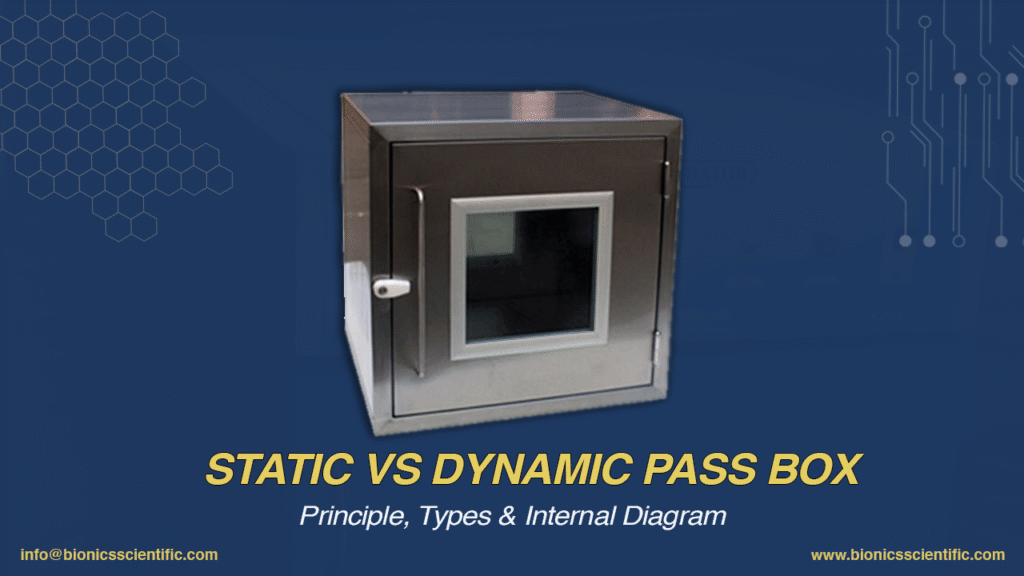
A pass box is a controlled transfer chamber built into a cleanroom or lab wall, letting materials move between two areas without personnel crossing over or breaking containment. A static pass box uses HEPA filtration with no forced airflow; a dynamic pass box adds a HEPA-filtered blower to actively flush the chamber at a defined air-change rate. Bionics Scientific manufactures both types for pharma, cleanroom, biotech, and darkroom use, with 35 years of manufacturing experience and dispatch across pan-India; the Middle East, Saudi Arabia; the US, and Oman.
What Is a Pass Box and Why It Matters
In any facility where contamination control is non-negotiable — pharma manufacturing, sterile compounding, biotech R&D, hospital pharmacies, or darkrooms — opening a cleanroom door to hand over a component defeats the point of maintaining pressure differentials and particulate control.
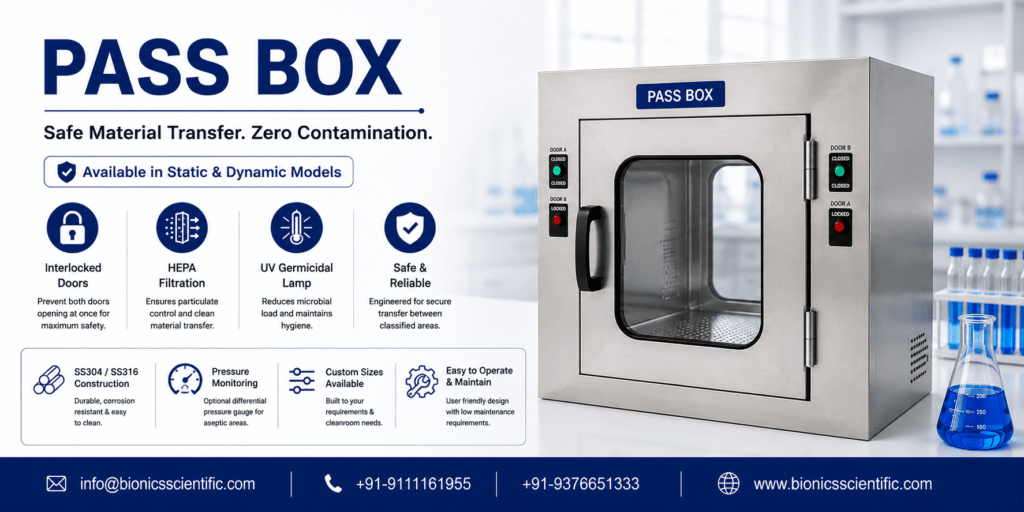
A pass box solves this by acting as an airlock for materials, not people. It’s installed flush into a partition wall with an interlocked door on each side; the interlock prevents both doors opening at once, blocking unfiltered air from entering the classified environment. Interiors are finished in powder-coated mild steel or SS304/SS316, with coved corners to eliminate particle traps.
Static Pass Box vs Dynamic Pass Box: The Difference
A static pass box has no active air handling — it relies on the HEPA filter (where fitted) and sealed, interlocked doors. It suits lower-risk transfers between similarly classified rooms, e.g., pre-cleaned components between two Grade C/D areas.
A dynamic pass box adds a HEPA-filtered blower that flushes the chamber continuously (air-change rate is manufacturer-specified, not universal). This makes it standard for higher-grade environments (Grade A/B, ISO Class 5–7), where even momentary particulate spikes matter. Dynamic units typically add a UV germicidal lamp, airflow indicators, and — in validated pharma settings — differential pressure gauges.
Bottom line: similar low-risk rooms → static. Aseptic or higher-grade transfers → dynamic.
Pass Box in Clean Room and Pharma Applications
In a clean room, this unit typically sits between a gowning area and the production floor or between staging and the classified zone. In pharma manufacturing, it’s a standard fixture between dispensing booths, granulation areas, and packing lines, with design and validation documentation reviewed under facility qualification (IQ/OQ/PQ).
Buyers should confirm interior finish (SS304 minimum, SS316 for corrosive agents), interlocking type (electromagnetic or mechanical), and whether UV/pressure monitoring is included—these are specified features, not assumed defaults.
Pass Box in Darkroom Applications
In darkroom settings, the same concept serves a different purpose: moving light-sensitive materials or undeveloped film between a darkroom and a lit workspace without exposure. These units rely on a light-trap baffle design and interlocked doors rather than HEPA filtration as the core function, though contamination control can be added where the darkroom is part of a controlled lab (e.g., forensic or radiography facilities).
Specification Table
| Parameter | Static | Dynamic |
| Air handling | Passive (no blower) | HEPA-filtered blower, continuous supply |
| Construction | Powder-coated MS / SS304 | SS304 / SS316 |
| Door interlocking | Mechanical or electromagnetic | Same, with status indicators |
| UV lamp | Optional | Standard on most GMP-grade units |
| Pressure gauge | Not standard | Recommended for aseptic areas |
| Best for | Lower-classification transfers | Grade A/B, ISO 5–7, aseptic transfers |
| Sizes | Custom; common range 600×600×600 mm–900×900×900 mm (internal) | Same range; manufacturer confirms volume for air-change calcs |
Exact air-change rate, blower capacity, and dimensions vary by model—request the manufacturer’s datasheet for the specific unit.
Operating Temperature Reference
| Zone | Typical Range |
| Ambient chamber | 18°C – 27°C (HVAC-dependent) |
| UV lamp housing | Manufacturer-rated |
| Blower motor environment | Standard indoor cleanroom ambient |
| Storage (unpowered) | 10°C – 40°C |
General reference only—confirm against the specific model’s datasheet, since material, insulation, and blower specs affect actual limits.
Bionics Scientific: Manufacturer and Supplier
Bionics Scientific has manufactured laboratory and cleanroom equipment for 35 years, with 1900+ autoclaves and allied equipment dispatched pan-India and internationally. It builds both static and dynamic configurations to customer-specified dimensions, with SS304/SS316 construction and validated interlocking systems for GMP-regulated facilities.
Bionics Scientific is a unit of Kartal Projects Pvt Ltd, whose technical file and QMS are independently assessed by Euroglobe Registrars (UK)—not a self-declared claim, but a verifiable certificate number per standard, with scheduled surveillance audits.
Certifications & Quality Compliance
| Standard | Cert. No. | Scope | Valid Until |
| ISO 9001:2015 (QMS) | 184876 | Lab, scientific & cleanroom equipment mfg. | 30-03-2029 |
| CE (MDD 93/42/EEC) | 184877 | Products as per annexure | 30-03-2029 |
| GMP | 184878 | Includes fume hood and a biosafety cabinet. | 30-03-2029 |
| NSF/ANSI 61 | 183884 | Bio-safety cabinet, lab & scientific equipment | 08-03-2027 |
All four are issued by Euroglobe Registrars (UK, est. 2007) with periodic surveillance re-verification, not one-time assessment. Certificate copies are available on request for vendor qualification.
Bionics Scientific supplies pan-India and to the Middle East, Saudi Arabia, the US, and Oman, supporting pharma, biotech, hospital, and industrial cleanroom projects.
Frequently Asked Questions
What is a pass box used for?
Transferring materials between two differently classified areas without personnel crossing over, reducing contamination risk.
What is the difference between static and dynamic pass box?
Static has no active airflow, relying on filtration and door interlocking alone. Dynamic adds a HEPA-filtered blower that actively flushes the chamber, suiting higher-classification use.
Where is a pass box in clean room typically installed?
Between gowning areas and production floors, or staging zones and classified manufacturing areas.
Why is a pass box in pharma facilities a GMP requirement?
Uncontrolled material transfer between classified zones is a recognized contamination risk that inspectors specifically assess.
What construction material is standard for pharmaceutical pass boxes?
SS304 for most GMP applications; SS316 where corrosive cleaning agents are used.
Does every pass box need a UV lamp?
No, UV lamps are standard on most dynamic, GMP-grade units but not required on static units for lower-risk transfers.
How is a pass box in darkroom different from a cleanroom pass box?
The darkroom version is primarily a light-trap, using baffled interlocking doors rather than HEPA filtration as the core function.
What sizes do manufacturers typically offer?
Custom to the facility opening, commonly 600×600×600 mm to 900×900×900 mm internal, scaled as needed.
What should buyers verify before choosing a supplier?
Stainless steel grade, interlocking type, HEPA integrity test provision, and verified certifications—e.g., Bionics Scientific’s parent, Kartal Projects, holds ISO 9001:2015 (184876), CE (184877), GMP (184878), and NSF/ANSI 61 (183884), all Euroglobe Registrars (UK)-issued with periodic audits.
Can Bionics Scientific supply outside India?
Yes—pan-India and international dispatch to the Middle East, Saudi Arabia, the US, and Oman.
Get a pass box quotation from Bionics Scientific
Whether you need a static unit for a lower-risk transfer point or a dynamic, UV-integrated unit for an aseptic suite, Bionics Scientific’s engineering team can specify the right chamber size, air-change rate, and construction grade. Contact Bionics Scientific for a technical datasheet and quotation, backed by 35 years of manufacturing experience and ISO/CE/GMP-certified production.