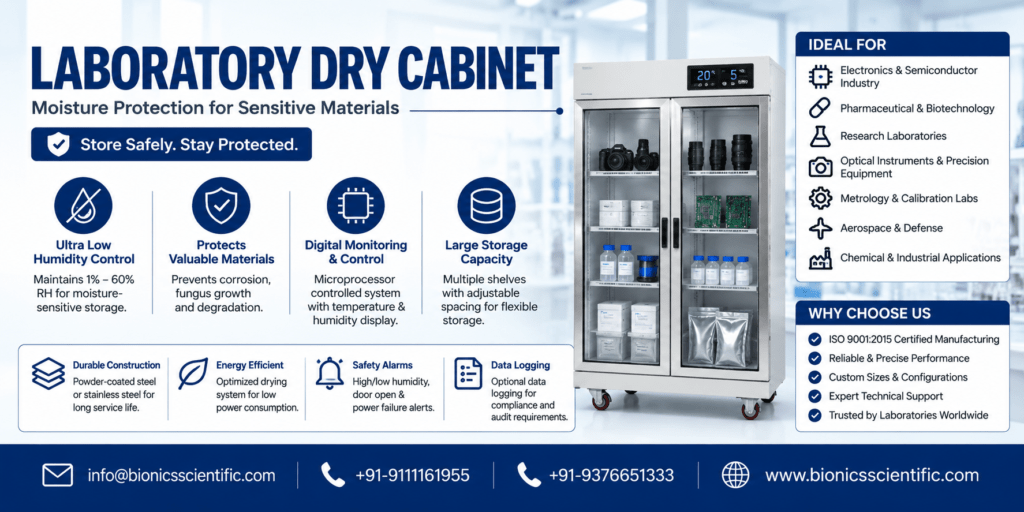
Quick Answer: A dry cabinet is a sealed storage enclosure that maintains a controlled low-humidity environment (typically 1–60% RH depending on application) to protect moisture-sensitive materials, electronic components, optical instruments, and certain reagents from oxidation, fungus growth, and degradation. Unlike a general desiccator cabinet used for small-scale sample protection, an industrial humidity-controlled cabinet is engineered for continuous, unattended humidity control across a larger chamber volume, often with digital monitoring, nitrogen purge options, and audit-trail logging. Bionics Scientific manufactures dry cabinets, dry boxes, chemical storage cabinets, and hazmat-rated enclosures for laboratory, pharmaceutical, electronics, and industrial applications, backed by 35 years of manufacturing experience and ISO 9001:2015, CE, and GMP certification.
What Is a Dry Cabinet
A dry cabinet is a humidity-controlled enclosure that holds internal air at a set relative humidity (RH) using either a desiccant wheel with an internal regeneration heater or a sealed gasketed unit with an active drying element.
A dry box is typically a compact, benchtop version of the same technology, while cabinet-format units are floor-standing and built for bulk storage.
Moisture damages materials across categories: PCBs corrode or develop whisker growth, optical lenses fog or fungus over, pharmaceutical raw materials hydrolyze or cake, and some industrial chemicals destabilize on absorbing water vapor.
A properly specified controlled storage enclosure interrupts this pathway, which is why it is used across electronics, optics, pharmaceutical QC, and metrology.
It is worth separating low-humidity storage cabinet from adjacent categories buyers often search interchangeably.
Acid storage cabinets and broader chemical storage cabinets are built primarily for chemical compatibility and containment (corrosion-resistant liners, spill trays, ducted exhaust) rather than humidity control, though some acid storage units add a drying function to limit fume-driven corrosion.
A flammable cabinet is a fire-safety enclosure rated for solvent storage under standards such as OSHA 1910.106 and does not manage humidity at all.
A desiccator cabinet usually refers to a smaller single- or double-chamber bench unit rather than bulk warehouse storage.
A hazmat cabinet is a general term for any cabinet rated for hazardous material storage, which may or may not include humidity control depending on hazard class. Buyers should confirm which function—humidity control, chemical containment, or fire rating—their application actually needs, since one cabinet is rarely optimized for all three.
How Dry Cabinets Work
Most desiccant-based dry cabinets use a rotating honeycomb desiccant wheel in the airflow path. Ambient air passes through one segment of the wheel, where moisture is adsorbed; the wheel rotates slowly so the saturated segment passes a small regeneration heater that drives moisture out through a separate exhaust duct, while dried air recirculates into the chamber. A humidity sensor feeds back to the controller, which adjusts wheel speed and heater duty cycle to hold set point. This allows continuous unattended operation without consuming nitrogen or replacing silica gel, which is why desiccant-wheel units have largely replaced simple silica-gel boxes for sustained low-RH storage.
Nitrogen-purge dry storage units are used where an inert atmosphere is required in addition to low humidity, typically when the stored material is also oxygen-sensitive rather than only moisture-sensitive.
Selecting the Right Dry Cabinet: Key Specifications
Buyers should specify a dry cabinet against the actual storage requirement rather than a generic RH range. The humidity threshold needed for PCB storage differs from that needed for pharmaceutical reference standards, and RH bands should be matched to the relevant standard (such as J-STD-033 for moisture-sensitive devices) rather than assumed universally.
| Specification | Typical Range / Feature | Application Relevance |
| Humidity control range | 1% RH – 60% RH (manufacturer-specified per model) | Lower bands for electronics/MSD storage; moderate bands for general lab reagent storage |
| Chamber volume | 50 L to 1000+ L (single or multi-door) | Determined by inventory volume and access frequency |
| Construction material | Powder-coated mild steel, stainless steel (SS304/SS316) for corrosive environments | SS recommended for acid/chemical-adjacent storage |
| Door type | Single glass door, multi-door segmented chambers | Segmented chambers reduce humidity spike on repeated access |
| Control system | Digital PID controller with data logging | Required for GMP/ISO-audited environments |
| Alarm & monitoring | High-humidity alarm, door-open alarm, USB/Ethernet data export | Needed for pharmaceutical and calibration lab compliance |
| Regeneration method | Desiccant wheel with internal heater or nitrogen purge | Wheel-type for continuous low-maintenance operation; N2 purge for inert-atmosphere needs |
| Shelving | Adjustable perforated shelves, ESD-safe shelving option | ESD shelving required for electronics/PCB storage |
| Power supply | 220–240V single phase (export models available in region-specific voltage/plug configuration) | Confirm voltage compatibility for export markets. |
Reference Humidity Chart
| Application | Recommended RH Range | Notes |
| Moisture-sensitive electronic devices (MSD) | 1% – 10% RH | Aligns with J-STD-033 low-humidity storage guidance |
| Optical instruments and lenses | 20% – 40% RH | Prevents fungus growth without over-drying lens coatings |
| Pharmaceutical raw materials/reference standards | 30% – 45% RH | Manufacturer- and product-specific; verify against material data sheet |
| General laboratory reagents and glassware | 40% – 50% RH | Standard ambient-adjacent dry storage |
| Bulk industrial component storage | 10% – 30% RH | Set per corrosion sensitivity of stored parts |
These bands are indicative starting references; the correct set point should be confirmed against the material’s storage data sheet or relevant standard rather than treated as a fixed universal rule, since materials in the same broad category can carry different sensitivity thresholds.
Where Dry Cabinets Are Used
Dry cabinets are specified across electronics manufacturing (SMT reels, moisture-sensitive IC storage), pharmaceutical and clinical laboratories (reference standards, stability samples), optics (lens assemblies, calibration instruments), metrology labs (gauge blocks sensitive to humidity-driven drift), and general industrial storage where corrosion prevention of tooling or spare parts is a maintenance priority.
Bionics Scientific: Manufacturing Background
Bionics Scientific has manufactured laboratory and scientific storage equipment for 35 years, building humidity-controlled storage units, dry boxes, chemical storage cabinets, and hazmat-rated enclosures to order for laboratory, pharmaceutical, electronics, and industrial buyers, with export-configuration voltage and documentation support for shipments across India and international markets, including the United States (USA), United Kingdom (UK), United Arab Emirates (UAE), Saudi Arabia, South Africa, Canada, Australia, Singapore, Malaysia, Philippines, Indonesia, Kenya, Nigeria, Bangladesh, Nepal, Qatar, Oman, Kuwait, Bahrain, Vietnam, Thailand, Tanzania, Ghana, Sri Lanka, and New Zealand.
| Certificate | Certificate No. | Issued | Valid To | Issuing Body |
| ISO 9001:2015 | 184876 | 31-03-2026 | 30-03-2029 | Euroglobe Registrars (UK) |
| CE (MDD 93/42/EEC) | 184877 | 31-03-2026 | 30-03-2029 | Euroglobe Registrars (UK) |
| GMP | 184878 | 31-03-2026 | 30-03-2029 | Euroglobe Registrars (UK) |
| NSF/ANSI 61 | 183884 | 09-03-2024 | 08-03-2027 | Euroglobe Registrars (UK) |
Certificates are issued to Kartal Projects Pvt Ltd, the parent company of Bionics Scientific; NSF/ANSI 61 scope is limited to biosafety cabinets and laboratory/scientific equipment manufacture and supply.
Frequently Asked Questions
What is the difference between a controlled storage cabinet and a dry box?
A dry box is a compact, benchtop unit for a few instruments; a controlled storage cabinet is a larger, floor-standing enclosure for bulk or multi-shelf storage. Both use the same desiccant or nitrogen-purge technology—the difference is chamber size and placement.
What humidity level should a dry cabinet maintain?
It depends on the material. Moisture-sensitive electronics are often stored at 1–10% RH per J-STD-033 guidance, while general lab reagents may only need 40–50% RH. Confirm the set point against the material’s storage data sheet.
Is a low-humidity storage systems the same as an acid storage cabinets?
No. A low-humidity storage systems targets humidity control; an acid storage cabinet is built for chemical compatibility, containment, and corrosion resistance against fumes. Some acid cabinets add a drying function, but the core design intent differs.
Can a dry cabinet also serve as a flammable cabinet?
No. A flammable cabinet is a fire-rated enclosure built to standards like OSHA 1910.106 and does not manage humidity. It should not be substituted for a dry cabinet or vice versa.
What is the difference between a moisture-controlled enclosure and a desiccator cabinet?
A desiccator cabinet is usually a smaller bench-level, single- or double-chamber unit for individual samples, while a moisture-controlled enclosure is a larger unit built for continuous bulk storage.
How does the desiccant wheel get regenerated?
The wheel rotates slowly; the saturated segment passes a small internal heater that drives moisture out through a dedicated exhaust duct, while the dried segment recirculates to hold the chamber at a set point.
Do dry cabinets need nitrogen gas to operate?
Standard desiccant-wheel units run continuously on ambient air with no nitrogen required. Nitrogen-purge cabinets are a separate configuration for applications needing an inert atmosphere alongside low humidity.
What documentation does a GMP-audited facility need for a storage enclosure?
Typically digital humidity data logging, calibration certificates for the sensor, and a USB/Ethernet audit trail export—confirm these are available on the specific model before purchase.
Can a humidity-controlled enclosure be classified as a hazmat cabinet?
Only if separately rated for the relevant hazard class. “Hazmat cabinet” is a general term, and a standard humidity-controlled enclosure doesn’t carry hazardous-material certification unless explicitly built for it.
What size dry cabinet suits a small electronics lab?
It depends on reel and tray inventory volume—small SMT storage is often served by 100–300 L units, while larger floors may need 500 L or multi-door configurations. Review against actual inventory before finalizing size.
Get a Dry Cabinet Built to Your Specification
Bionics Scientific manufactures dry cabinets, dry boxes, chemical storage cabinets, acid storage cabinets, and hazmat-rated enclosures configured to your required humidity band, chamber volume, and export voltage standard. Backed by 35 years of manufacturing experience and ISO 9001:2015, CE, and GMP certification, our team can provide technical data sheets, compliance documentation, and shipping support for orders across India and international markets. Contact Bionics Scientific today to request a technical quotation for your dry cabinet requirement.