A bursting strength tester is the instrument that tells you whether a carton, fabric, or paper sheet will hold under pressure before it leaves your plant. A carton that splits in a container, a fabric that rips under load, or a paper bag that fails at the filling line usually starts as a small quality gap that this test would have caught on the lab bench. If you are a QC manager, a packaging engineer, or a procurement head, this guide covers what you need to compare machines and place a confident order.
Bionics Scientific has manufactured laboratory and testing equipment for 26 years, and our testers are in daily use across paper mills, textile units, and packaging plants worldwide.
Quick Answer
- What it is: a bursting strength tester measures the pressure at which a sheet material ruptures when pushed by a rubber diaphragm.
- Where it is used: paper, corrugated board, cartons, fabrics, nonwovens, leather, and films.
- Output: Bursting pressure in kPa, psi, or kgf/cm².
- Types of machine: Manual hydraulic, motorized, and electronic bursting strength testers.
- Determinants of price: Pressure capability, display and data options, type of clamping, calibration, and after-sales service.
- Bursting strength tester consumable: Rubber diaphragm, subject to wear that affects the result of each test performed.
- Standard(s): ISO 2758, ISO 2759, ISO 13938-1, ASTM D3786, and TAPPI T403 depending on the product.
- Market: Sells to consumers in USA, UK, UAE, Saudi Arabia, Australia, Singapore, Kenya, among many other nations.
What Is a Bursting Strength Tester?
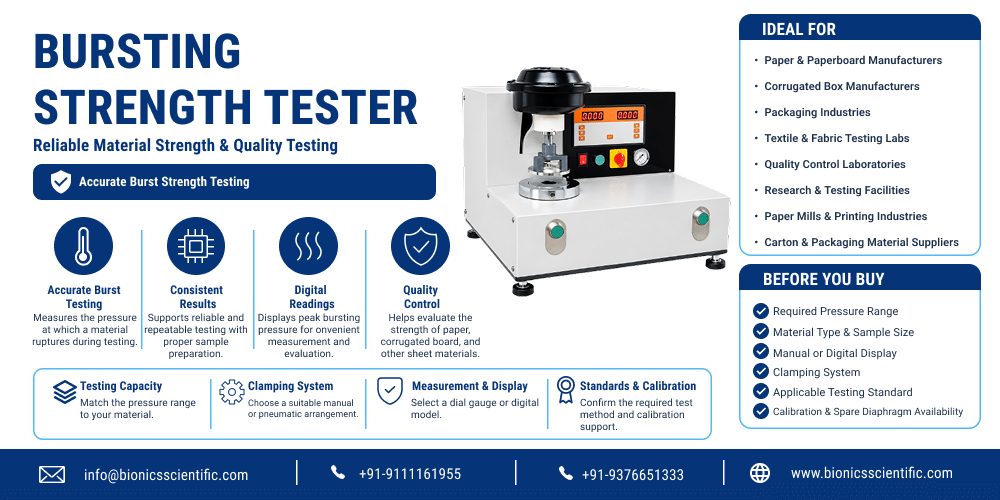
A bursting strength tester, also called a bursting strength machine, clamps a circular sample over a rubber diaphragm. Fluid, usually glycerine, is pumped beneath the diaphragm at a controlled rate. The diaphragm bulges, stretches the sample, and finally ruptures it. The highest pressure reached just before rupture is recorded as the burst pressure.
The result tells you how much multi-directional load a material can take. That matters more than people assume, because real packaging and fabrics rarely fail in a straight line. They fail when a force pushes from one side across the whole surface.
How the Test Works, Step by Step
- Condition the sample in the standard atmosphere for the required time.
- Place it flat between the upper and lower clamping rings with no wrinkles.
- Tighten the clamp so the sample cannot slip during inflation.
- Start the pump. Fluid raises the diaphragm at a fixed rate.
- The sample bursts, and the peak value is held on the gauge or digital display.
- Release pressure, reset the diaphragm, and repeat for the required number of specimens.
Most standards ask for at least ten specimens and a mean value. Skipping this step is the most common reason two labs report different numbers for the same lot.
Manual vs Digital Bursting Strength Tester
| Feature | Manual/Analog | Digital |
| Reading | Dial gauge with a peak-hold pointer | LCD or touchscreen display |
| Operator influence | Higher, as pointer reading depends on eyesight. | Low |
| Data storage | Handwritten | Memory, statistics, USB, or PC output |
| Pressure rate | Often hand-driven | Motor-driven and consistent |
| Best for | Basic in-house checks | Audited labs, export documentation |
A digital bursting strength tester removes most reading errors and gives you a mean, standard deviation, and test count at the touch of a button. For export-oriented plants supplying buyers in the UK, the UAE, or Canada, that record helps during audits.
Burst Pressure and Why the Diaphragm Matters
Burst pressure is the pressure value at rupture. Two things affect its accuracy more than anything else: calibration and the diaphragm.
The rubber diaphragm for a bursting strength tester is the part that actually touches the sample. Over time it loses elasticity, develops fatigue marks, or hardens. A tired diaphragm absorbs part of the pressure and gives you artificially different readings. Inspect it regularly, replace it on schedule, and always buy the grade specified for your machine. Using a mismatched diaphragm is one of the quietest ways to ruin otherwise good data.
Specification Table
The values below are typical ranges for our machine families. Exact figures can be tailored to your material and standard.
| Parameter | Typical Specification |
| Test materials | Paper, board, corrugated, fabric, nonwoven, leather |
| Pressure range | Low range up to 1,200 kPa, high range up to 5,500 kPa |
| Accuracy | ±1% of full scale (digital models) |
| Sample clamping | Pneumatic or hand-operated |
| Test area | Circular, per the chosen standard |
| Display | Dial gauge or digital display |
| Units | kPa, psi, kgf/cm² |
| Diaphragm | Specified rubber grade, replaceable |
| Power supply | Single phase, 220 V / 50 Hz (110 V and 60 Hz on request) |
| Compliance | ISO 2758, ISO 2759, ISO 13938-1, ASTM D3786, TAPPI T403 |
Test Temperature and Humidity Chart
Temperature does not drive the burst itself, but it changes how paper fiber and fabric behave. Moisture and heat shift the result, so samples are conditioned first. Use the reference below.
| Material | Conditioning Temperature | Relative Humidity | Typical Minimum Conditioning |
| Paper and board | 23 ± 1°C | 50 ± 2% | Until weight is stable |
| Corrugated board | 23 ± 1°C | 50 ± 2% | At least 24 hours |
| Textile fabrics | 20 ± 2°C | 65 ± 4% | At least 24 hours |
| Nonwovens | 20 ± 2°C | 65 ± 4% | At least 24 hours |
| Leather | 23 ± 2°C | 50 ± 5% | At least 48 hours |
Always confirm the figures against the standard you are working to, since regional variants exist.
Bursting Strength Tester Price: What Decides the Quote
Buyers searching for bursting strength tester price usually find a wide spread. Here is why:
- Pressure range: a machine for tissue and light paper costs less than one for heavy board or industrial fabric.
- Digital features: memory, statistics, and printer or PC output add to cost.
- Clamping system: pneumatic clamping costs more than a hand screw but improves repeatability.
- Build and calibration: a traceable calibration certificate takes time and adds value.
- Freight and duty: these vary for Gulf, African, and Southeast Asian destinations.
Do not compare quotes on the headline figure alone. Compare range, accuracy, diaphragm supply, and warranty. A cheaper unit with no spare diaphragms often costs more by year two.
Buyer Checklist: 15 Points Before You Order
- Material you will test most often.
- Standard your customer or auditor expects.
- Required pressure range with some headroom.
- Analogue or digital display.
- Clamping type and sample size.
- Pressure rate control.
- Diaphragm grade, spare stock, and replacement cost.
- Calibration certificate and recalibration support.
- Data output and report format.
- Power supply compatibility for your country.
- Build quality of the pump and fluid system.
- Operator training and manual clarity.
- Warranty terms.
- Spare parts lead time to your location.
- Manufacturer track record, not just a trader’s catalogue.
Why Buyers Choose Bionics Scientific
We design, build, and calibrate our machines ourselves, so there is no middleman between your question and the person who can answer it. After 26 years in manufacturing, our engineers know how a tester behaves in a humid Kenyan warehouse as well as in an air-conditioned lab in Singapore.
We supply buyers in the United States, United Kingdom, United Arab Emirates, Saudi Arabia, South Africa, Canada, Australia, Singapore, Malaysia, the Philippines, Indonesia, Kenya, Bangladesh, Nepal, Qatar, Oman, Kuwait, Bahrain, Vietnam, Thailand, Tanzania, Ghana, Sri Lanka, and New Zealand. Export packing, documentation, and spare diaphragm kits are handled by our team. You can explore our bursting strength tester range or pair it with our coefficient of friction tester, which many packaging labs run alongside burst tests. Standards bodies such as ASTM International publish the full test methods if you want to read them in detail.
Frequently Asked Questions
What is a bursting strength tester?
It measures the pressure a sheet material withstands before rupturing under diaphragm pressure.
Which materials can be tested?
Paper, board, corrugated sheets, fabrics, nonwovens, leather, and some films.
What is burst pressure?
It is the peak pressure recorded at the moment the sample ruptures.
How often should you change the diaphragm?
Whenever it cracks, becomes hard or gives out inconsistent readings. The heavy users change it once a month.
Is a digital bursting strength tester worth the money?
Certainly, especially if you require data storage, averaging, and reporting for auditing.
What factors determine the bursting strength tester cost?
Pressure range, clamping type, digital options, calibration, and delivery.
How many samples should I test?
Most standards ask for ten specimens, then a mean value.
Does humidity change the result?
Yes. Paper and fabric absorb moisture, so conditioning is required before testing.
How often does the machine need calibration?
Once a year is common. Do it sooner after heavy use or any shock.
Do you ship to my country?
Yes. We export to the USA, UK, UAE, Saudi Arabia, Africa, Southeast Asia, and beyond.
Get a Quote From Bionics Scientific
Tell us your material, pressure range, and destination country, and our team will suggest the right model with a clear quotation. Reach us through our contact today, and get a bursting strength tester built for your lab, your standard, and your budget.