
Quick Answer
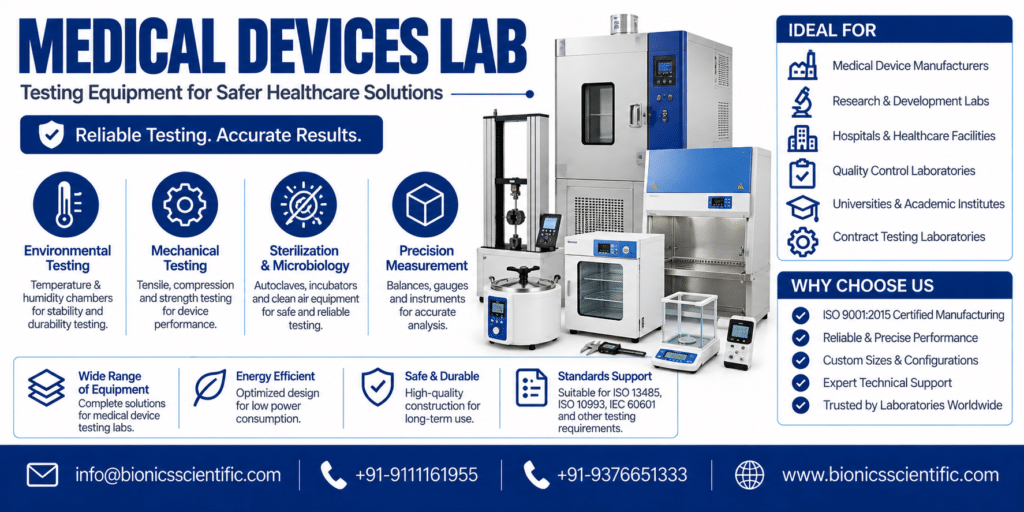
A medical devices lab is a controlled testing environment where the safety, performance, durability, materials, and packaging of medical devices get checked against defined criteria. What equipment shows up depends on the testing stage—environmental chambers, mechanical test rigs, precision instruments, sterilization gear, microbiology setups, and packaging integrity testers are common, though rarely all present at once.
A lab built to test surgical instruments won’t look like one built around implantables or electronics—the equipment follows the device, not the other way around. Planning starts with a few basics: what the device is used for, which test method applies, what the samples look like, how much accuracy the work demands, and what documentation needs to come out at the end.
What Is a Medical Devices Lab?
At its core, a medical devices lab runs controlled testing and measurement on devices, components, materials, or packaging. That work can happen inside a manufacturer, a contract testing house, a hospital, a university, or an independent lab, and the output might feed R&D, design verification, quality control, process validation, or packaging assessment. The rhythm is similar across all of these: prepare a sample, condition it if needed, test it under controlled conditions, measure, check against a criterion, and document. The equipment a lab buys should come out of that actual workflow, not a generic checklist.
Who Uses a Medical Devices Lab
- Manufacturers—development, design verification, quality control, release testing
- QA/QC teams—checking materials, components, dimensions, packaging
- R&D groups—testing prototypes and design changes before production
- Contract testing labs—filling gaps for manufacturers without in-house capability
- Hospitals and biomedical engineering teams—selected verification checks
- Universities and research institutions—research, prototyping, teaching
Core Equipment Used in a Medical Devices Lab
Temperature-humidity chambers, stability chambers, and accelerated aging units evaluate a device or its packaging under climatic exposure. Worth checking: achievable range, uniformity, recovery time after the door opens, capacity, and data logging.
On the mechanical side, universal testing machines, tensile testers, and compression testers examine strength, deformation, and other properties. Load range, accuracy, speed, fixtures, and sample geometry all need to match the specified method.
Where a lab does microbiological work, autoclaves, incubators, biosafety cabinets, and laminar airflow units come into play, though what’s needed depends on the procedures run.
Precision measurement rounds things out: balances, dimensional gauges, thermometers, and pressure instruments support inspection, where accuracy, repeatability, and traceable calibration matter.
Packaging and contamination control involve particle counters and monitoring instruments wherever a controlled environment is required. For sterile barrier packaging, seal-strength and integrity testers confirm the barrier holds up.
Medical Device Testing Process
- Define the requirement—test method, characteristic, acceptance criteria
- Prepare samples—identification, quantity, geometry
- Condition samples—expose to required conditions
- Perform testing—run equipment per the approved procedure
- Record data—measurements, equipment identity, calibration status
- Evaluate results—check against acceptance criteria
- Maintain records—retain documentation per the quality system
None of this holds together unless the method, equipment, and records behind it are all under control—that’s what makes a result usable.
Standards Relevant to Medical Device Testing
Which standards apply comes down to the device, intended use, materials, risk, and target market. ISO 13485 lays out quality-management expectations; ISO 10993 covers biological evaluation; ISO 14971 handles risk management; IEC 60601 covers medical electrical equipment; IEC 62366 addresses usability. Pin down the relevant standard before shopping for equipment—owning something referenced in a standard doesn’t automatically mean compliance.
Here’s a more natural rewrite of that table—same structure, same meaning, less clipped/listy phrasing:
| Specification / Parameter | What to Check | Why It Matters |
| Temperature range | The minimum and maximum the application actually needs | Makes sure the chamber can cover the test window |
| Humidity range | Required RH span and how tightly it’s controlled | Influences conditioning and aging results |
| Uniformity | How even conditions stay across the working space | Keeps every sample exposed to roughly the same thing |
| Load capacity | Maximum force and the range you’ll realistically use | Decides whether the mechanical test can even be run |
| Accuracy and resolution | Stated accuracy alongside repeatability | Determines how much the readings can be trusted |
| Working capacity | Sample size, quantity, and chamber or fixture volume | Prevents a mismatch between equipment and actual workload |
| Data logging | How data is stored, exported, and traced | Backs up proper documentation of what was done |
| Calibration | Certificate availability and traceability | Keeps confidence in the measurements over time |
| Fixtures | Whether they suit the sample’s geometry | Makes sure the test setup is actually correct |
| Utilities | Power, water, air supply, ventilation, space | Shapes what installation will require |
Buyer Comparison: What to Evaluate Across Equipment Options
| Factor | What to Evaluate |
| Application suitability | Test method and design match |
| Specification matching | Practical range, not headline maximum |
| Capacity | Size and volume vs. real workload |
| Operating conditions | Utilities and space needed |
| Control and data | Manual vs. programmable, logging |
| Documentation | Certificates, IQ/OQ/PQ where required |
| Calibration and maintenance | Interval, traceability, service reach |
| Customization | Fixtures or software adaptability |
| Installation and training | Support and training offered |
| Total ownership | Service turnaround, cost, equipment life |
How to Select Equipment
The test method comes first—standard, sample geometry, operating range, acceptance criteria—before requesting quotations. Weigh usable working range over headline maximum capacity, and check data/traceability needs, calibration documentation, and whether IQ/OQ/PQ paperwork applies. Facility readiness deserves a check too—power, space, ventilation, utilities—alongside long-term support: maintenance, spares, and training.
When talking to suppliers, share the device/sample type, applicable standard, sample dimensions and quantity, required range and accuracy, fixtures needed, data requirements, and site utilities upfront—that makes it more likely a supplier proposes something that fits.
Cost and Total Ownership
What’s on the initial quotation rarely tells the whole story. Fixtures, installation, calibration, utilities, maintenance, spare parts, and training add up over time, and a cheaper upfront price can cost more once maintenance or downtime pile on.
Buyer Checklist
- Applicable test standard and method
- Device type and intended application
- Sample size, geometry, and quantity
- Required operating range, accuracy, repeatability
- Equipment capacity, fixtures, accessories
- Calibration and traceability
- Data logging and documentation
- Facility utilities and safety features
- Installation, training, and service support
- Warranty terms and delivery schedule
- Total cost of ownership
- Qualification or validation requirements, where applicable
Bionics Scientific for Medical Devices Lab Equipment
Bionics Scientific has spent more than 35 years manufacturing scientific and laboratory equipment, supplying customers across India and international markets. For a team setting up or expanding a medical devices lab, the sensible starting point is the actual application, not a standard equipment list—and Bionics Scientific can support that conversation around requirements, operating conditions, sample characteristics, capacity, and documentation where relevant. Whatever configuration gets chosen should still be checked against the relevant test method, facility conditions, and product documentation before purchase.
Equipment Requirements for Your Medical Device Laboratory?
Planning to develop a new laboratory or improve your existing testing facilities? Let us know the type of device, testing requirements, sample details, and the operating conditions needed, and our team will assist you in discussing an appropriate equipment setup for your application.
Contact Bionics Scientific to discuss your equipment requirements for your medical devices lab.
Frequently Asked Questions
What equipment is commonly used in a medical devices lab?
Environmental chambers, mechanical testing machines, precision instruments, sterilization/microbiology equipment, and packaging testers, depending on the device and program.
Do all medical device labs require a cleanroom?
Always consider the device type, the process used, and the requirements of contamination control.
Which standards apply to the testing of medical devices?
Some examples include ISO 13485, ISO 10993, ISO 14971, IEC 60601, etc. Again, the standard applicable will depend on the particular test and the type of the device under test.
Why is it important to calibrate lab instruments for medical devices?
This is important to ensure that the measurements taken are still accurate and traceable to a certain reference at specified intervals.
What are the things to consider when purchasing an environmental chamber?
Things to consider include the temperature/humidity range, temperature/humidity uniformity, working volume, control accuracy, recovery characteristics, and calibration.
What mechanical testing equipment may be required?
Tensile, compression, force, or deformation systems, selected by load capacity, accuracy, speed, and available fixtures.
Is accelerated aging used for medical devices?
It can be, for certain device or packaging evaluations, with parameters set by the applicable test protocol.
What documentation should buyers request?
Specifications, manuals, calibration certificates, and qualification or validation records where applicable.
How should lab equipment capacity be determined?
By sample dimensions, quantity, and expected workload—not by the maximum figure on a datasheet.
What should I consider before purchasing medical device lab equipment?
Test method, device characteristics, operating range, accuracy, calibration, utilities, documentation, and total cost of ownership.
Conclusion
There’s no single equipment list that defines a medical devices lab. What a facility needs depends on the device, intended use, test method, sample characteristics, applicable standards, and workflow. The order that works best: define testing requirements first, then compare equipment on technical suitability, usable range, accuracy, capacity, calibration, documentation, installation, service, and total ownership cost—not price tags or maximum specifications alone.