Quick Answer
Searching for a “list of clean room manufacturers in India” usually means one of two things: you’re building a new pharma or medical device facility and don’t know where to start, or you got three quotes that vary by 40% and can’t tell why. The honest answer is that price gaps that large almost always come down to specification differences—air change rate, filter coverage, and whether validation paperwork is included—not vendor markup. Bionics Scientific has spent 35 years building scientific and lab equipment, including HEPA-filtered clean room systems for pharmaceutical and medical device lines, and this guide walks through what separates a compliant clean room from a room that just looks like one.
The Question Nobody Asks Until It’s Too Late
Most clean room procurement conversations start with square footage and end with a purchase order. What gets skipped in between is the one question that actually determines whether the room passes an audit: what is this room’s ISO class supposed to be, and does the design achieve it under real operating conditions—not on the day the AHU is switched on for commissioning, but six months later with people, equipment heat, and door traffic in the mix?
A partition wall system and a ceiling grid do not make a clean room. What makes it a clean room is whether particle counts stay inside classification limits while the room is actually being used. That’s a mechanical engineering problem, not a construction one, and it’s why the manufacturer you pick matters more than the panels they sell you.
What’s Actually Inside a Clean Room Build
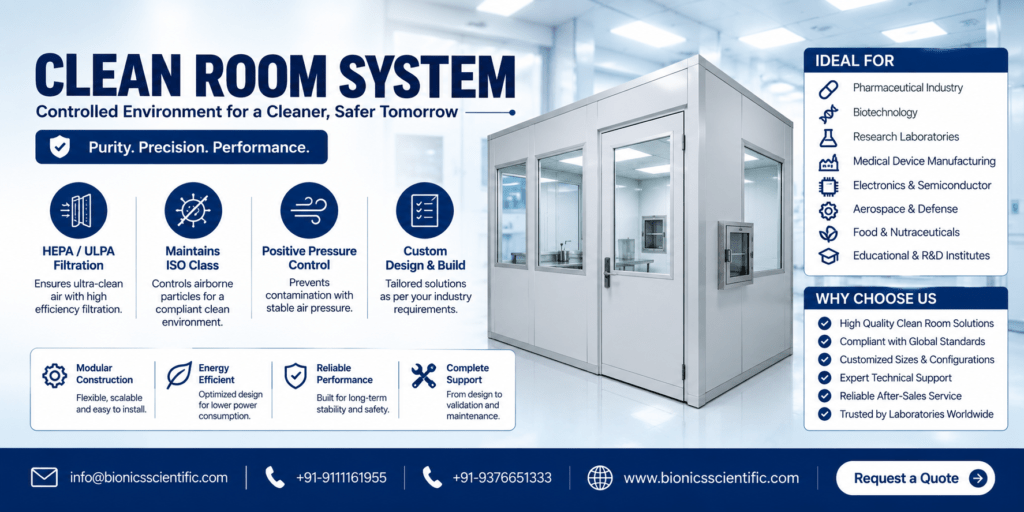
Strip away the marketing language, and a clean room comes down to a handful of interacting systems:
- Sandwich panels (usually PUF-core, GI-clad) that don’t shed particles and can be wiped down without degrading
- An air handling unit sized specifically to your room’s required air changes per hour—not a stock unit resized after the fact
- HEPA or ULPA filters positioned where your process actually generates particles, not just spread evenly across the ceiling
- Pass boxes and airlocks that stop people and materials from dragging contamination in
- Pressure cascades between rooms, so air moves from cleaner to dirtier spaces, never the reverse
- Coved flooring with no exposed corners, because corners are where dust and microbes settle and never get cleaned out
Some vendors sell pieces of this—a HEPA unit here, a passbox there. Others handle the whole system, including the documentation your quality team will need later. That second category is what most people actually mean when they search “cleanroom solutions,” even if they don’t phrase it that way.
Clean Room Requirements for Medical Device Manufacturing, Specifically
Medical device facilities get lumped into general pharma clean room guidance, which causes problems, because device manufacturing has its own risk profile:
- Classification tied to the actual process step, not the whole facility. Assembly and packaging often run at ISO 7 or 8. Anything involving implantable components or critical sterile operations can require ISO 5 at the point of exposure—not the entire room.
- Documentation aligned to ISO 13485, meaning your DQ, IQ, OQ, and PQ protocols need to exist as real, reviewable documents handed over at project close, not produced after the fact when an auditor asks.
- Materials that survive your sterilization method. A device line running ethylene oxide sterilization puts different stress on wall panels and seals than one running gamma or autoclave-based terminal sterilization. The room has to be built for what happens downstream of it.
- Static discharge control where electronic components or certain polymers are handled—this gets missed constantly because it’s not a pharma concern, so pharma-background vendors sometimes leave it out entirely.
- Sampling points designed into the layout, not retrofitted. If your environmental monitoring plan requires particle counts at specific locations, those need to be planned into the ceiling and wall design before installation, not drilled in afterward.
A vendor whose main experience is tablet manufacturing plants will often propose a design that technically works but wasn’t built with any of this in mind. It’s worth asking directly whether they’ve delivered a medical device facility before, not just a pharma one.
How a HEPA Clean Room Actually Holds Its Classification
The filter rating—usually 99.97% efficiency at 0.3 microns—gets all the attention, but it’s the least interesting part of the system. What actually keeps a room at its ISO class is the combination of air change rate, filter coverage across the ceiling, and directional airflow that pushes particles toward returns instead of letting them recirculate near the work surface.
This is also where the “HEPA clean room” search term hides a lot of variation. A gowning room running at ISO 8 and an aseptic filling line at ISO 5 both use HEPA filtration, but the filling line might have 80-100% ceiling coverage and 400+ air changes per hour, while the gowning room runs a fraction of that. Same filter technology, completely different engineering behind it.
Specification Reference: ISO Classification
| ISO Class | Older FS 209E Name | Particle Limit (≥0.5 µm/m³) | Air Changes/Hour (typical range) | Where You’ll See It |
| ISO 5 | Class 100 | 3,520 | 240–480 | Sterile filling lines, critical device assembly |
| ISO 6 | Class 1,000 | 35,200 | 150–240 | Injectable component preparation |
| ISO 7 | Class 10,000 | 352,000 | 60–90 | Device assembly, sterile packaging |
| ISO 8 | Class 100,000 | 3,520,000 | 5–48 | Gowning rooms, general packaging areas |
Air change figures shift depending on room occupancy, equipment heat load, and layout—treat the ranges above as a starting point for discussion with your manufacturer, not a spec to lock in before a design review.
Temperature and Humidity: What Different Rooms Actually Run At
| Facility Type | Temperature Range | Relative Humidity |
| Pharmaceutical production cleanroom | 20°C – 24°C | 45% – 55% |
| Medical device assembly cleanroom | 20°C – 22°C | 40% – 60% |
| ISO 5 sterile filling zone | 20°C – 22°C | 35% – 45% |
| Electronics/semiconductor clean room | 21°C ± 1°C | 40% ± 5% |
These are process-driven set points, not fixed rules—a manufacturer should confirm the actual target with your quality or process team during design qualification rather than defaulting to a generic number.
Questions Worth Asking Every Name on Your Shortlist
Before comparing quotes line by line, ask each vendor for:
- A reference project in your specific industry—medical device—is not interchangeable with general pharma here
- A sample DQ/IQ/OQ/PQ package from a past project, so you can see what “documentation included” actually looks like from them
- Their filter testing method post-installation (DOP or PAO testing, specifically, not just “we test the filters”)
- AMC terms for filter replacement and AHU servicing—this is where ongoing cost surprises usually come from
- Export compliance experience if the facility will eventually supply regulated markets
Where Bionics Scientific Fits
Thirty-five years of manufacturing scientific and laboratory equipment—autoclaves, sterilizers, and controlled environment systems—dispatched pan-India and to export markets including the USA, UK, UAE, Saudi Arabia, South Africa, Canada, Australia, Singapore, Malaysia, the Philippines, Indonesia, Kenya, Nigeria, Bangladesh, Nepal, Qatar, Oman, Kuwait, Bahrain, Vietnam, Thailand, Tanzania, Ghana, Sri Lanka, and New Zealand means we’ve run into most of the design problems above more than once. Our clean room systems are built around the classification your process actually needs and the documentation your compliance team will actually be asked for, rather than a standard panel package resized to fit your floor plan.
If you’re comparing quotes right now and the specs don’t line up cleanly between vendors, that’s usually the sign to get a design review before signing anything. Reach out to Bionics Scientific for a classification review and a quote built around your actual process, not a template.
People Ask About This
What’s included in a clean room quote?
Panels, AHU, HEPA filters, pass boxes, lighting, flooring, and validation docs.
Is a HEPA clean room different from a normal one?
Not in filter type—the difference is filter coverage.
What ISO class does a medical device room need?
ISO 7/8 for assembly; ISO 5 for critical/implantable steps.
How long does installation take?
A few weeks to a few months.
Do manufacturers provide validation documents?
Yes—DQ, IQ, OQ, and PQ at project close.
What air change rate is needed?
About 20 to 400+ ACH, depending on ISO class.
Can panels handle humid climates?
Yes, with the right core, gaskets, and vapor barrier.
Cleanroom solutions vs. a HEPA unit—what’s the difference?
A solution is the full system; a HEPA unit is one part of it.
Can Indian manufacturers supply export markets?
Yes, if built to ISO 14644-1—confirm local approvals separately.
How do I compare vendor pricing?
Match ISO class and ACH first, then compare price.