Quick Answer
Double distilled water has been through the distillation cycle twice, not once. That second pass strips out the residual dissolved gases, ionic traces, and organic carryover that a single distillation run tends to leave behind. It’s produced on a water distillation unit or, where trace-metal purity matters most, an all glass distillation apparatus—the “all glass” part matters because it keeps metal out of the water-contact path entirely. Conductivity on properly produced double distilled water usually sits below 2 µS/cm, with resistivity in the 1–5 megohm-cm range. Labs reach for it when single-distilled or deionized water simply isn’t clean enough—pharmaceutical formulation, electrochemistry, trace analysis, cell culture work.
What Double Distillation Actually Does
Run water through a still once, and you get rid of most dissolved salts, heavy metals, and suspended particulate. That’s single distillation, and for a lot of lab work it’s fine. But it doesn’t touch everything. Dissolved CO₂ still gets absorbed back in. Some organics share a boiling point close enough to water’s that they ride along in the vapor. And if the still itself has metal parts in the water path, you can pick up trace ions from the equipment instead of the feed water.
A second distillation pass — ideally through a glass distillation unit rather than a metal-bodied one — knocks most of that down further. This is why pharmacopoeial monographs, electrochemical reference work, and injectable-grade manufacturing specify double distilled water rather than settling for a single pass: the purity floor is measurably lower.
How a Water Distillation Unit Works
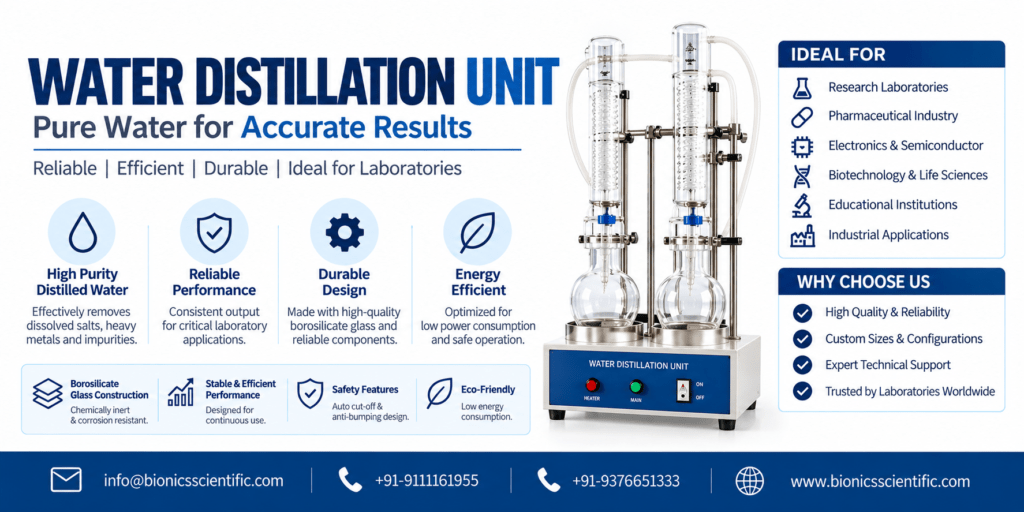
The principle isn’t complicated. Feed water goes into a boiling chamber—borosilicate glass in most lab-grade units, sometimes stainless steel in larger industrial ones—and a heating element, usually an immersion coil or a silica sheath heater, brings it to boiling point. As it vaporizes, the dissolved minerals and non-volatile impurities stay behind in the chamber. Only the vapor moves on.
That vapor travels through a condenser (coil-type or Liebig-type, cooled by circulating water) and comes back out as liquid on the other side—your distillate. For double-distilled water, this distillate becomes the feed for a second, identical run, ideally on a dedicated glass unit so no metal component gets reintroduced into the water at this stage.
Bionics Scientific builds these units with borosilicate 3.3 glass columns, automatic water-level cutoff, and anti-bumping design—the last of which matters more than it sounds, since bumping (violent, irregular boiling) can carry liquid droplets straight into the distillate and quietly ruin an otherwise clean batch. It’s a common weak point in cheaper stills.
Glass Distillation Unit vs. All Glass Distillation Apparatus
These two terms get used almost interchangeably, but they’re not quite the same thing.
A glass distillation unit has a glass boiling chamber and glass condenser, but fittings, supports, or the heater housing outside the direct water path may still be metal or PTFE.
An all glass distillation apparatus goes further—every wetted surface, from the boiler through the vapor path to the collection point, is glass. Nothing in the flow touches metal. This is the specification you want when even trace metal leaching would compromise results, such as ICP-MS sample prep or electrochemical reference solutions where a few parts per billion of contamination can throw off a reading.
Which one you need comes down to how sensitive your application is to trace metals, not just how much water you need per hour. Worth confirming the wetted-surface material against your actual use case before ordering rather than assuming “glass” means the same thing across every model.
Where Double Distilled Water Gets Used
Pharmaceutical injectable and ophthalmic formulation. Trace metal and analytical chemistry. Electrochemistry and battery research, where ion contamination skews measurements. Semiconductor rinsing. Cell culture media prep. Calibrating pH and conductivity meters, where even minor contamination throws off the baseline. Basically anywhere the water itself can’t be allowed to introduce variables into the result.
Specification Table
| Parameter | Typical Value |
| Distillation stages | 2 (double distillation) |
| Output conductivity | Below 2 µS/cm |
| Resistivity | 1–5 megohm-cm |
| Wetted material | Borosilicate 3.3 glass (all-glass models) |
| Heating type | Immersion coil / silica sheath heater |
| Condenser type | Coil or Liebig-type, water-cooled |
| Output capacity | 2 L/hr to 20+ L/hr, model-dependent |
| Feed water requirement | Pre-treated, single-distilled, or RO water |
| Storage vessel | Borosilicate glass or PP carboy (metal-free) |
| Power supply | 220V/50Hz single-phase standard; 3-phase on high-capacity units |
Exact capacity and heater wattage vary by model—check the specific unit’s datasheet before planning installation around a particular throughput.
Temperature Chart: Distillation Stages
| Stage | Approximate Temperature |
| Feed water heating begins. | Ambient up to 60°C |
| Vapor generation (boiling point, sea level) | 100°C |
| Vapor transit through the condenser. | Drops from 100°C along condenser length |
| Condensate collection | 25–40°C, depending on cooling water flow |
| Second distillation boiling point | 100°C, re-boiled from single-distilled feed |
These numbers shift with altitude and ambient conditions—treat them as reference points for the process, not fixed thresholds; every unit will hit exactly.
Why Manufacturers and Buyers Choose Bionics Scientific
Bionics Scientific has been manufacturing laboratory and scientific equipment for 35 years now, with water distillation units, glass distillation units, and all-glass distillation apparatus going out across India and to international buyers—the United States, United Kingdom, United Arab Emirates, Saudi Arabia, South Africa, Canada, Australia, Singapore, Malaysia, the Philippines, Indonesia, Kenya, Nigeria, Bangladesh, Nepal, Qatar, Oman, Kuwait, Bahrain, Vietnam, Thailand, Tanzania, Ghana, Sri Lanka, and New Zealand. Manufacturing runs under ISO 9001:2015 and CE-compliant processes, which gives buyers something concrete to check rather than a marketing claim to take at face value.
Frequently Asked Questions
What is double-distilled water actually used for?
Mostly where water purity directly affects the result—pharmaceutical injectable formulation, analytical and trace chemistry, electrochemistry, and cell culture media, all situations where single distillation or deionization doesn’t get you clean enough.
How is it different from regular distilled water?
One boil-condense cycle versus two. The second pass on double-distilled water strips out more of the dissolved ions, gases, and organics that survive the first round.
What exactly is a water distillation unit?
A water distillation unit is equipment that separates water from its dissolved impurities by using controlled boiling and condensation; the impurities remain in the boiling chamber while the purified vapor moves on to condense into distillate.
Glass distillation unit or all glass distillation apparatus—what’s the actual difference? The “all glass” version has zero metal anywhere in the water-contact path. A standard glass unit can still have metal fittings outside that path. Matters most when you can’t tolerate any trace-metal leaching at all.
Why does glass matter more than metal here?
Borosilicate 3.3 glass doesn’t leach ions into the water the way metal components can, which is exactly why it’s the standard for trace analysis and pharmaceutical-grade output.
What conductivity should double distilled water have?
Under 2 µS/cm is typical, though the actual number depends on your feed water quality and how well-maintained the equipment is.
Is double-distilled water the same as water for injection?
No—WF has its own pharmacopoeial standard, which includes additional validated steps beyond distillation. Double distillation is part of that broader process, not a substitute for full WFI qualification.
How much output can I expect per hour?
Depends heavily on the model—benchtop units run around 2 liters/hour, while higher-capacity systems push past 20 liters/hour.
Does it need to be stored any differently?
Yes. Metal containers are out—borosilicate glass or polypropylene keeps it from picking up contamination after you’ve already gone through the trouble of purifying it.
Someone mentioned a “center fuse” in a distillation unit—is that a real part?
That’s a regional mispronunciation of “immersion heater” or “sheath heater.” The correct term is immersion coil or silica sheath heater.
Get a Quote
Need a water distillation unit, glass distillation unit, or all glass distillation apparatus that holds up under real lab or pharmaceutical demands? Bionics Scientific has 35 years of manufacturing behind it, ISO 9001:2015 and CE-compliant processes, and equipment already running in facilities across two dozen countries. Reach out to talk through your capacity, wetted material, and compliance needs.