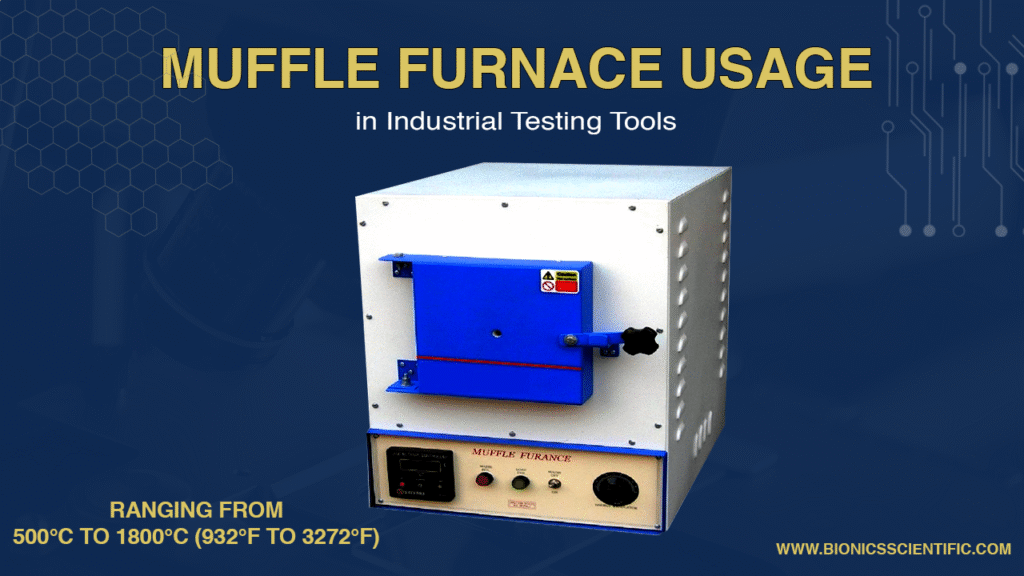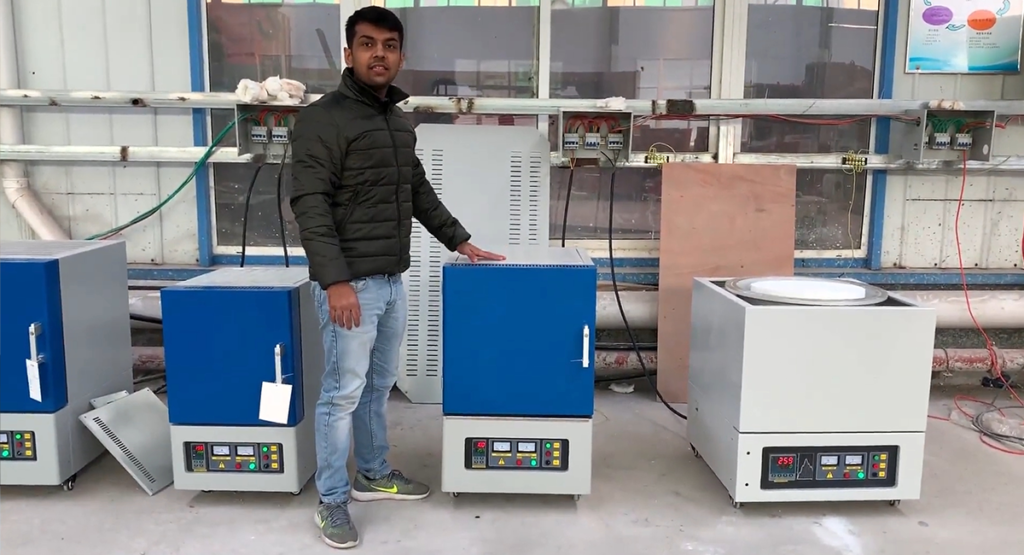
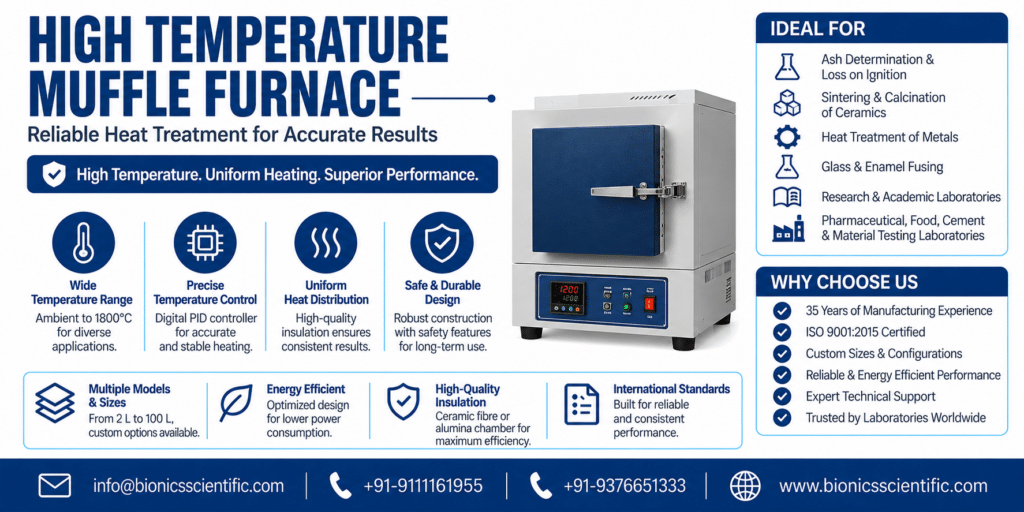
A high temperature muffle furnace is an electrically heated chamber that keeps your sample away from flame and combustion gases while holding a precise, uniform temperature, usually between 1000°C and 1800°C. Labs use it for ashing, sintering, annealing, heat treatment, and material testing. At Bionics Scientific, we have built these furnaces for 35 years, and this guide covers what buyers actually ask us before ordering.
Quick Answer
- What it is: An insulated electric furnace with a sealed inner chamber (the muffle) that isolates the sample from the heating elements.
- Temperature range: 1000°C to 1800°C, depending on the heating element.
- Common uses include ash content, loss on ignition, calcination, sintering, ceramic firing, glass work, and metal heat treatment.
- Heating element: Kanthal coil to 1200°C, silicon carbide to 1400°C, and molybdenum disilicide to 1800°C.
- Price in India: Depends on chamber volume, maximum temperature, and controller. Small 1100°C units cost far less than 1700°C programmable models.
- HSN code: Generally classified under 8514 (industrial or laboratory electric furnaces and ovens). Confirm the exact sub-code with your tax advisor.
- Who makes it: Bionics Scientific, a manufacturer with 35 years of experience, supplying 24 countries.
What Is a High Temperature Muffle Furnace?
The word “muffle” refers to the inner chamber that separates your sample from the heat source. In Spanish and Portuguese-speaking markets, buyers search for it as a mufla, and the principle is identical. Because the sample never touches a flame or element, results stay free of contamination, which matters in pharmaceutical, food, cement, metallurgy, and academic labs.
“High temperature” generally means anything above 1200°C. Below that, a standard muffle furnace handles most routine ashing. Above it, the heating technology, insulation, and controller all change, and so does the price.
Muffle Furnace Temperature Range and Heating Elements
The muffle furnace temperature range is decided mainly by the heating element. This is the first thing to settle before you compare quotes.
| Heating Element | Max Temperature | Typical Use |
| Kanthal (FeCrAl) heating coil | 1100–1200°C | Ashing, LOI, routine heat treatment |
| Silicon carbide (SiC) rods | 1400°C | Ceramics, glass, sintering |
| Molybdenum disilicide (MoSi₂) | 1600–1800°C | Advanced ceramics, zirconia, research |
A heating coil for a muffle furnace is wound from Kanthal wire and embedded in grooves in the ceramic insulation. It is economical and easy to replace, but it has a ceiling near 1200°C. If your process needs more, a coil furnace will fail early, so choose the element for the highest temperature you will ever use, not the average one.
Temperature Chart: Maximum and Recommended Working Temperature
| Furnace Type | Heating Element | Maximum Temperature | Recommended Continuous Use | Best For |
| Standard muffle furnace | Kanthal (FeCrAl) coil | 1200°C | Up to 1100°C | Ashing, loss on ignition, routine heat treatment |
| High temperature muffle furnace | Silicon carbide (SiC) rods | 1400°C | Up to 1300°C | Ceramics, glass, sintering |
| High temperature muffle furnace | MoSi2 (molybdenum disilicide) | 1600°C | Up to 1500°C | Advanced ceramics, research, powder sintering |
| Ultra-high-temperature muffle furnace | MoSi2 (molybdenum disilicide) | 1800°C | Up to 1700°C | Zirconia, specialized materials research |
The recommended continuous working temperature is usually 100°C below the maximum. Running a 1200°C furnace at 1200°C every day shortens element life.
Technical Specifications
| Parameter | Specification |
| Temperature range | Ambient to 1800°C (model dependent) |
| Heating elements | Kanthal / SiC / MoSi₂ |
| Chamber material | High-purity ceramic fibre or alumina |
| Chamber volume | 2 L to 100 L, custom sizes available |
| Temperature accuracy | ±1°C to ±5°C |
| Uniformity | ±5°C to ±10°C in the working zone |
| Controller | PID digital, programmable multi-segment |
| Thermocouple | K-type (to 1200°C), S/R-type (above 1300°C) |
| Outer body | Powder-coated mild steel or stainless steel |
| Safety | Over-temperature cut-off, door interlock |
| Power supply | Single or three-phase, 50/60 Hz |
| Optional | Data logging, gas inlet, exhaust port, vertical or horizontal layout |
What Is a Muffle Furnace Used For?
Buyers searching for what a muffle furnace is used for usually have one of these jobs in mind:
- Ash determination in food, feed, coal, pharmaceuticals, and polymers.
- Loss on ignition testing of cement, soil, and minerals.
- Sintering and calcination of powders and ceramics.
- Annealing and hardening of small metal parts.
- Glass and enamel fusing.
- Gravimetric analysis, where a residue must be burned to constant weight.
If your work is mostly ashing below 1000°C, you probably do not need a high-temperature model. Telling you this honestly is part of how we have kept customers for decades.
Horizontal, Vertical, and Ceramic Muffle Designs
A vertical muffle furnace loads from the top. It suits tall crucibles, long samples, and processes where heat rising evenly around a vertical sample improves uniformity. A horizontal front-loading furnace is easier for trays and routine batch work.
The ceramic muffle itself is a separate liner, often alumina, that protects elements from fumes and spills. In high temperature furnaces, a good ceramic muffle resists thermal shock and extends element life. Ask any supplier what the muffle is made of and its purity, because this is where cheap furnaces cut corners.
Choosing the Right Crucible for a Muffle Furnace
The crucible for muffle furnace use must survive your peak temperature and not react with your sample.
- Porcelain: Economical, suitable to roughly 1100–1200°C.
- Alumina: Good to about 1700°C, chemically stable, and ideal for sintering.
- Silica (quartz): Handles thermal shock but is unsuitable with alkalis.
- Platinum: For analytical work needing zero contamination, at high cost.
Always dry crucibles, handle them with long tongs, and let the furnace cool below 200°C before opening the door.
Muffle Furnace Price in India: What Drives the Cost
Search results for “muffle furnace price in India” and “muffle furnace price” often show a single number, which is misleading. Real pricing depends on:
- Maximum temperature: MoSi₂ elements cost much more than Kanthal.
- Chamber size: Volume affects insulation, element count, and power.
- Controller: A basic single-setpoint unit versus a multi-step programmable controller.
- Build quality: Fiber density, shell thickness, thermocouple grade.
- Customization: Gas ports, vertical loading, data logging.
Taxes add to the cost. The muffle furnace HSN code commonly used is 8514, and GST applies on top of the ex-works price. Ask for a written quotation that lists the element type, insulation, controller, and warranty so you can compare like with like.
What Buyers Really Think About Before Ordering
After 35 years of manufacturing, the questions buyers raise are consistent:
- Will it reach and hold my real working temperature?
- How long will the elements last?
- Is the chamber uniform, or are there cold spots?
- How safe is it for my technicians?
- Can I get spares and service quickly?
- Does it ship and clear customs smoothly?
- Is the price clear, with no hidden extras?
We build and quote around these seven points, not around a brochure.
Global Supply From Bionics Scientific
Bionics Scientific exports high-temperature muffle furnaces to the United States (USA), the United Kingdom (UK), the United Arab Emirates (UAE), Saudi Arabia, South Africa, Canada, Australia, Singapore, Malaysia, the Philippines, Indonesia, Kenya, Bangladesh, Nepal, Qatar, Oman, Kuwait, Bahrain, Vietnam, Thailand, Tanzania, Ghana, Sri Lanka, and New Zealand. We configure voltage, frequency, and documentation to match each destination, so the furnace arrives ready to commission.
Frequently Asked Questions
What is a high temperature muffle furnace?
It is an electric furnace that heats samples above 1200°C inside an isolated chamber, keeping them free from flame and combustion by-products.
What is the temperature range of the muffle furnace?
Standard models reach 1100–1200°C, while high-temperature versions reach 1400°C, 1600°C, and up to 1800°C.
What is a muffle furnace used for?
It is used for ashing, loss on ignition, sintering, calcination, annealing, ceramic firing, and gravimetric analysis.
How much does a muffle furnace cost in India?
Cost depends on temperature, volume, and controller. A small 1100°C unit costs far less than a programmable 1700°C model. Request a quote with your exact needs.
What is the HSN code for a muffle furnace?
Electric laboratory furnaces generally fall under HSN heading 8514. Verify the full sub-code and GST rate with your accountant.
Which crucible should I use?
Use porcelain up to about 1100°C, alumina up to about 1700°C, and platinum when zero contamination is required.
When should I choose a vertical muffle furnace?
Choose vertical loading for tall crucibles, long samples, or when top-down access improves uniformity.
How long do heating elements last?
With correct use, Kanthal coils last several years. Running at the maximum temperature daily shortens life, so keep a safety margin.
Can the furnace be customized?
Yes. Chamber size, controller, gas inlet, exhaust, vertical layout, and voltage can be tailored.
Does Bionics Scientific export internationally?
Yes. We supply 24 countries across Asia, Africa, the Middle East, Europe, North America, and Oceania.
Request a Quote Today
Tell us your maximum temperature, sample size, and country, and our engineers will recommend the right element, chamber, and controller within one working day. Contact Bionics Scientific now offers a free technical consultation and a written quotation. With 35 years of manufacturing behind every furnace, you buy with confidence.