What Is a BOD Incubator?
The BOD incubator is a type of incubator used in laboratories to maintain controlled temperatures that may be 20°C for the biological oxygen demand tests. The difference between a typical incubator and the BOD incubator is that the BOD incubator is equipped with heating and cooling systems to provide temperatures lower or higher than the room temperature.
As the slightest deviation from the optimal temperature in the biological oxygen demand test will alter the microbial activity and measurements of dissolved oxygen, stability of the temperature, airflow, insulation, and sensors are crucial factors.
In the present guide, you will find the BOD incubator diagram, major components, working principles, and differences between the BOD incubator and a typical laboratory incubator.
Bionics Scientific Technologies builds these chambers for pharma labs, microbiology departments, water-testing facilities, and environmental monitoring teams. Depending on the model, capacity runs from 68 to 425 liters, the working range spans 5°C to 60°C, and uniformity holds at ±0.5°C around the 20°C mark.
BOD Incubator at a Glance
Purpose: Maintains controlled temperature for BOD and other laboratory applications
Typical BOD temperature: Around 20°C
Temperature control: Heating + refrigeration
Control system: PID digital controller
Air circulation: Forced circulation
Common applications: Water testing, wastewater analysis, microbiology and environmental testing
Key advantage: Stable temperature control, including operation below room temperature
Need one for your lab?
Get in touch for current specs and pricing. [Request a Quote]
Diagram of BOD Incubator
How can you comprehend the machine within a few moments? Just have a look at the diagram below. This diagram depicts all important components of the BOD incubator such as chamber, refrigeration system, heater, fan, temperature sensor, PID controller, insulation, and safety thermostat.
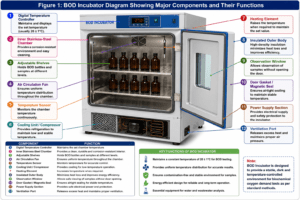
Look at any labeled diagram of one of these units, and you’ll spot the same recurring pieces: an inner chamber, a refrigeration circuit, a heater, a fan for circulating air, a temperature sensor, a PID controller, a toughened glass panel for viewing, a locking door, a safety thermostat, and an insulated shell wrapping the whole thing.
Different brands arrange these slightly differently, but the underlying heating-cooling-circulation logic stays the same across nearly all models.
BOD Incubator Parts: What Does Each Component Do?
The main BOD incubator parts work together to maintain a stable environment for long-duration testing.
Temperature-control components
- Refrigeration system: Lowers chamber temperature when cooling is required.
- Heating element: Raises the temperature when additional heat is needed.
- Temperature sensor: Continuously measures chamber temperature.
- PID controller: Uses sensor feedback to maintain the selected set point.
Air-management components
- Circulation fan: Distributes conditioned air throughout the chamber.
- PUF insulation: Reduces heat transfer between the chamber and surrounding environment.
User and safety components
- Glass window: Allows samples to be viewed without opening the door.
- Safety thermostat: Provides over-temperature protection.
- Lock and handle: Keeps the chamber securely closed during operation.
Breaking Down the Parts
|
Part |
What It Does |
|
Inner Chamber |
Where BOD bottles, samples and culture media actually sit |
|
Outer Cabinet |
Gives the unit rigidity and shields the internals |
|
Removable Shelves |
Repositioned freely depending on sample load |
|
Refrigeration Unit |
Pulls temperature down below room level |
|
Heating Element |
Pushes temperature up to the target point |
|
Circulation Fan |
Keeps air moving so every shelf reads the same temperature |
|
Temperature Sensor |
Feeds live readings back to the controller |
|
PID Controller |
Balances heating against cooling automatically |
|
Glass Window |
Lets a technician glance at samples without breaking the seal |
|
Safety Thermostat |
Cuts in if temperature climbs past a safe limit |
|
Lock & Handle |
Keeps the door sealed while testing is underway |
|
Power Unit |
Runs every electrical component in the system |
The Logic Behind BOD Testing
Here’s the underlying science: microbes living in water eat away at organic waste, and doing so uses up dissolved oxygen. A BOD incubator‘s entire purpose is to hold that environment rock-steady—typically at 20°C—so nothing external interferes with how much oxygen the microbes actually consume.
Walking through the process:
- Load the samples—BOD bottles go into the chamber.
- Lock in the temperature — refrigeration and heating work together continuously to hold the set point.
- Move the air—internal fans make sure no shelf runs hotter or colder than another.
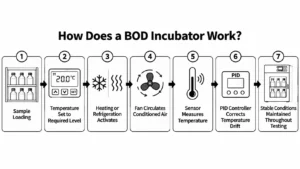
- Watch it digitally — the PID controller tracks conditions in real time and catches any drift.
- Let it run—over five days, microbial activity eats into the dissolved oxygen level as organic matter breaks down.
How the reading is taken:
A dissolved-oxygen measurement is logged at the very start, then again once the five days are up. Whatever oxygen disappeared in that window is the BOD value — a direct stand-in for how polluted the sample actually is.
Why any of this matters:
A high BOD number signals heavy organic pollution and oxygen-starved conditions for anything living in that water—which is precisely why treatment plants, regulators, and industrial dischargers rely on this test. Watching BOD numbers shift over time also tells a lab whether its treatment process is genuinely cutting pollution before water goes back into the environment.
Build Quality: What’s Inside the Walls
The cabinet itself is double-walled, with dense PUF insulation packed between the layers to keep outside temperature from ever touching the sample chamber.
- Inside: SS 304 stainless steel — chosen for how well it resists corrosion over years of use
- Outside: either powder-coated mild steel or stainless steel
- Heating and cooling: engineered to work as one coordinated system, not two separate ones
- Airflow: fan-driven, so uniformity holds across every shelf position
- Control: a PID loop constantly correcting for drift
- Shelving: adjustable to fit whatever sample volumes come through
Get any one of these wrong — especially insulation or airflow — and the whole point of the chamber (long-term stability) is compromised.
Where These Chambers Actually Get Used
- Pharma labs running stability trials under fixed conditions
- Microbiology departments growing bacterial cultures
- Water treatment plants running BOD tests as a matter of routine
- Wastewater labs checking organic pollution levels
- Food and dairy testing for microbial quality checks
- Environmental researchers studying pollution and aquatic health
- Culture growth studies needing tightly held low temperatures
None of these applications work if the chamber can’t hold temperature evenly over multiple days—which is precisely why insulation and airflow engineering matter as much as the compressor and heater themselves.
How This Differs From a Regular Incubator
| Aspect |
Standard Incubator |
BOD Incubator |
|
Main purpose |
Cell culture, general microbiology |
Oxygen-demand testing in water |
|
Temperature |
Adjustable, usually 25°C–37°C |
20°C for BOD testing |
|
Typical use |
Wide range of bio/chem work |
Specifically water-quality testing |
|
Airflow |
Not always included |
Standard feature |
Related Incubator Types Worth Knowing
- CO₂ incubators — built around cell culture, with humidity and CO₂ control
- Shaking incubators — add motion for liquid cultures
- Refrigerated incubators — for below-ambient storage, often enzymes or seed work
Specs at a Glance
The BOD incubator diagram and technical specifications together help users understand the equipment’s design and performance.
|
Spec |
Value |
|
Temperature range |
5°C–60°C |
|
Accuracy |
±0.5°C |
|
Uniformity |
±0.5°C @ 20°C |
|
Controller |
PID digital |
|
Chamber material |
SS 304 stainless steel |
|
Insulation |
PUF |
|
Cooling |
Compressor-based |
|
Airflow |
Forced circulation |
|
Capacity |
Approximately 68 to 425 litres. |
Rough Pricing (India)
|
Capacity |
Range |
Approx. Price |
|
100L |
5°C–60°C |
₹45,000–₹65,000 |
|
200L |
5°C–60°C |
₹70,000–₹110,000 |
|
300L |
5°C–60°C |
₹120,000–₹180,000 |
Common Questions
What’s a BOD incubator actually for?
Water testing, microbiology, pharma research, and environmental monitoring.
What temperatures can it handle?
Anywhere from 5°C to 60°C, depending on the test.
How tight is the temperature control?
Within ±0.5°C, thanks to PID controllers and precise sensors.
What sizes exist?
BOD incubator capacities vary by manufacturer and model. The models discussed here range from approximately 68 to 425 litres.
What’s it made of?
304-grade stainless steel inside; powder-coated steel or stainless steel outside.
Can it go below room temperature?
Yes, the refrigeration system handles that.
What safety measures are built in?
Alarms, over-temperature cutoffs, and a lockable door.
What should I check before buying one?
Temperature range, chamber size, build quality, airflow design, and support after purchase.
How do I maintain one properly?
Clean it regularly, calibrate on schedule, and follow the manual’s maintenance checks.
What does the diagram actually tell you?
It maps out where the cooling, heating, sensing, and airflow systems sit inside the unit.
Conclusion
A BOD incubator is not only about temperature controlled cabinet. The refrigeration system, the heating system, air flow, insulation, monitoring and controlling system all work in tandem to ensure the maintenance of stable conditions over extended testing. When considering BOD tests, choosing appropriate capacity and temperature control setup is very important.
When comparing different units, consider temperature stability, uniformity, capacity, construction, refrigeration efficiency, service, and applications in addition to cost factors.
In need of BOD incubators? Feel free to contact Bionics Scientific Technologies for specification, cost and configurations.
Ready to Choose One?
Reach out to Bionics Scientific Technologies for pricing, specs, custom builds, and delivery across India.
📧 info@bionicsscientific.com | 📞 +91 9111161955, 9376651333 | [Get a Quote] | WhatsApp our technical team for instant pricing.