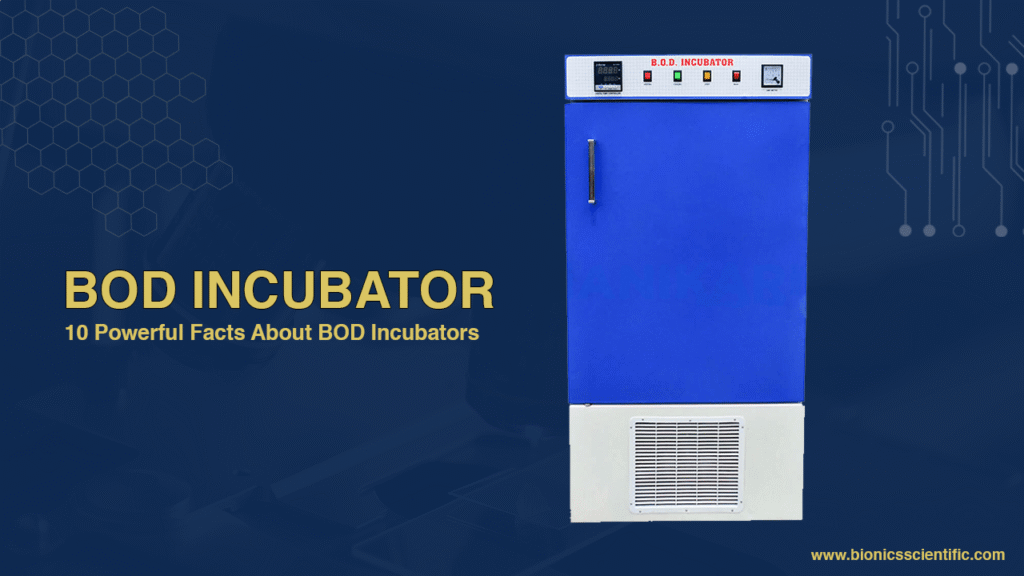
The BOD incubator and the CO₂ incubator have their distinct uses in the laboratory setting. The former is ideal for use with water samples and low-temperature incubation. The latter, on the other hand, is intended for the culture of cells and tissues where a certain level of temperature, humidity, and CO₂ concentration is required. In choosing one of the two, the most important factors to consider include the sample and temperature requirements.
Quick Answer
|
Requirement |
Best Choice |
|
BOD testing |
BOD Incubator |
|
Water/wastewater testing |
BOD Incubator |
|
Low-temperature incubation |
BOD Incubator |
|
Environmental testing |
BOD Incubator |
|
Cell culture |
CO₂ Incubator |
|
Tissue culture |
CO₂ Incubator |
|
Controlled CO₂ environment |
CO₂ Incubator |
|
High-humidity cell culture |
CO₂ Incubator |
Understanding these differences is important to avoid inaccurate results, contamination risks, and unnecessary investment. In this guide, we compare BOD and CO₂ incubators based on temperature control, applications, working principles, and laboratory usage.
Quick Comparison Between BOD Vs CO₂ Incubator
| Parameter | BOD Incubator | CO₂ Incubator |
|---|---|---|
| Main Purpose | BOD testing & microbial incubation | Cell & tissue culture |
| Temperature | Low temperature applications | 37°C controlled environment |
| CO₂ Control | Not available | Available |
| Humidity | Basic | High humidity |
| Used In | Environmental labs | Pharma & biotech labs |
| Cost | Lower | Higher |
Table of Contents
- BOD Incubator vs CO₂ Incubator: Quick Comparison
- What Is a BOD Incubator?
- What Is a CO₂ Incubator?
- BOD vs CO₂ Incubator: Key Differences
- Applications of BOD Incubators
- Applications of CO₂ Incubators
- Which Incubator Should You Choose?
- Factors to Consider Before Buying
- Frequently Asked Questions
- Choosing the Right Laboratory Incubator
BOD Incubator vs CO₂ Incubator: Key Differences Explained
What Is a BOD Incubator?
BOD Incubator, also known as Biochemical Oxygen Demand Incubator also known as Biochemical Oxygen Demand Incubator, is mainly designed to maintain a low-temperature environment, usually between 5°C and 60°C, with higher stability. A BOD (Biochemical Oxygen Demand) incubator is a specialized laboratory equipment used in measuring the amount of oxygen consumed by microorganisms in water or wastewater samples. The BOD test is a widely used method to determine the level of water pollution and the effectiveness of treatment processes.
A BOD incubator creates a controlled environment to support microbial activity during biochemical oxygen demand (BOD) testing. It maintains a steady temperature of 20°C, the standard required for accurate BOD analysis. The chamber is dark and sealed to block external light and air, ensuring that microorganisms rely solely on the oxygen present in the water sample.
The BOD test begins by measuring the sample’s initial dissolved oxygen (DO) level. The sample is then placed inside the incubator for five days. After incubation, the final DO level is recorded. The difference between the initial and final readings represents the BOD value, indicating how much oxygen the microorganisms consumed during that period.
BOD incubators often include an internal power socket, which allows users to operate devices like magnetic stirrers or sensors within the chamber. This feature supports continuous monitoring or controlled agitation without compromising the incubator’s sealed environment.
How Does a BOD Incubator Work?
The incubator maintains a consistent internal temperature throughout the chamber. Samples are placed inside, and the controlled environment allows the required incubation period to be maintained with minimal temperature fluctuation.
Main Features:
- Temperature control (typically 20°C ± 1°C for BOD tests)
- Ideal for long-duration incubations (up to 5 days or more)
- Designed to support aerobic biological tests
Common Applications:
- Water treatment: BOD tests are used to measure the effectiveness of water treatment processes, such as the removal of pollutants from wastewater.
- Environmental monitoring: BOD tests are used to measure the level of water pollution in rivers, lakes, and other bodies of water.
- Industrial monitoring: BOD tests are used to measure the impact of industrial processes on water quality.
- Research: BOD tests are used in research to study the growth and metabolism of microorganisms in water and wastewater samples.
What Is a CO₂ Incubator?
The objective of CO₂ incubators is the creation of a controlled physiological environment for the cultivation of cells and tissues.
CO₂ incubators are special chambers where controlled environmental conditions can be achieved to cultivate living materials. While incubators serve multiple industries—including poultry and pharmaceutical development—CO₂ incubators are specifically used in life science and laboratory settings for cell culture applications.
These incubators regulate key parameters such as temperature, humidity, CO₂ concentration, and oxygen levels. Among these, controlling CO₂ is essential for maintaining the pH balance of the culture medium. The incubators often use CO₂ sensors to ensure that the gas concentration remains stable throughout the incubation period.
Maintaining a sterile and tightly regulated environment allows technicians and researchers to optimize cell growth, reduce contamination risks, and ensure the reproducibility of experimental results.
How Does a CO₂ Incubator Work?
The system continuously monitors and regulates temperature and CO₂ concentration. A humidified environment helps minimize evaporation from culture vessels, while controlled CO₂ supports the required culture conditions.
Main Features:
- Precise CO₂ control with sensors (IR or thermal conductivity)
- Humidified environment with temperature around 37°C
- HEPA filtration for contamination control
Common Applications:
- Cell culture (including stem cells and cancer cells)
- IVF procedures and embryo incubation
- Pharmaceutical testing
- Tissue engineering and regenerative medicine
|
Feature |
BOD Incubator |
CO₂ Incubator |
|
Primary purpose |
BOD and environmental testing |
Cell and tissue culture |
|
Main applications |
Water testing, microbiology |
Biotechnology, cell culture |
|
Temperature |
Suitable for low-temperature applications |
Commonly used at physiological temperatures |
|
CO₂ control |
Generally not required |
Essential for many cell-culture applications |
|
Humidity |
Application dependent |
High humidity commonly maintained |
|
Sample type |
Environmental/microbial samples |
Cells and tissue cultures |
|
Gas regulation |
Usually not required |
CO₂ regulation required |
|
Sterility requirements |
Application dependent |
Generally high |
|
Typical users |
Environmental laboratories |
Research, biotech and pharmaceutical labs |
|
Cost |
Generally lower |
Generally higher |
|
Best suited for |
Environmental testing |
Cell/tissue culture |
When to Use a BOD Incubator and When to Use a CO₂ Incubator
- Choose a BOD incubator if your work involves environmental testing, water analysis, bacterial culturing, or seed germination at low temperatures.
- Go for a CO₂ incubator if you’re working with sensitive cell cultures, tissue samples, or medical research requiring a CO₂-enriched and humidified environment.
- A BOD incubator is suitable for laboratories performing environmental analysis, microbial studies, water testing, and seed germination where lower temperature stability is important.
A CO₂ incubator is ideal for pharmaceutical laboratories, biotechnology research, IVF applications, and tissue culture processes requiring controlled CO₂ concentration, humidity, and sterile incubation conditions.
Frequently Asked Questions
What is the key difference between a BOD incubator and a CO₂ incubator?
A BOD incubator is mostly used for BOD test, environment test and low temperature incubation whereas a CO₂ incubator is mainly used for cell culture in which CO₂ level, temperature and humidity are to be controlled.
Can I use a BOD incubator for cell culture?
A normal BOD incubator cannot provide the controlled CO₂ and humidity conditions needed for most of the cell culture applications.
Can I use a CO₂ incubator for BOD testing?
CO₂ incubator is specially designed for cell culture not for BOD test so it’s better to get a BOD incubator.
Which incubator should be used for water test?
A BOD incubator is usually used for BOD and water/wastewater test applications.
Which incubator should be used for cell culture?
A CO₂ incubator should be used for applications related to mammalian cell culture.
Choosing the Right Laboratory Incubator
Whether you need a high-precision BOD incubator for wastewater testing or an advanced CO₂ incubator for cell culture, Bionics Scientific offers a wide range of reliable, ISO & CE-certified lab incubators designed for Indian labs and international standards.