Quick Answer
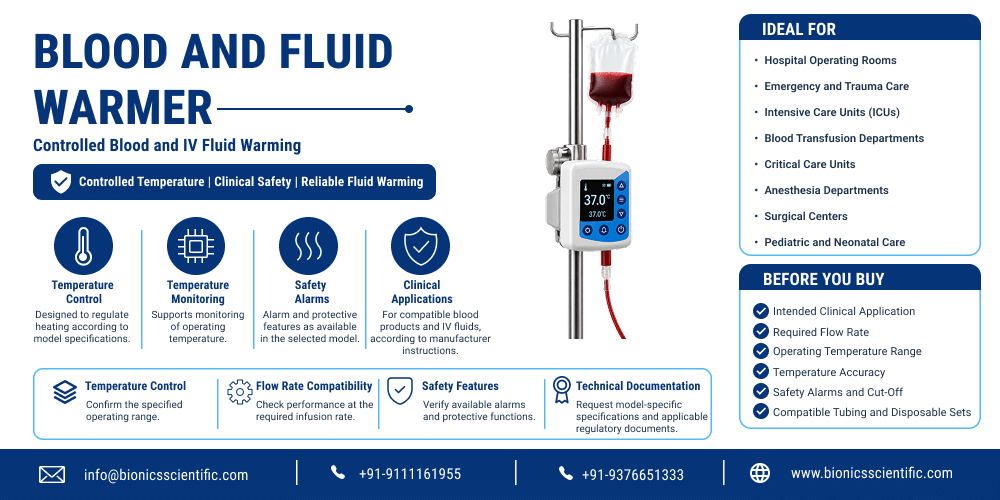
A blood and fluid warmer heats blood, blood products, and IV solutions to about 37°C while they travel from the bag to the patient. Nurses and anesthetists reach for one when large amounts of cold fluid are going in fast, since that is the situation where body temperature slips.
You will see three names used for this equipment:
- Blood transfusion warmer, when the fluid is a blood component
- IV fluid warmer, when the fluid is saline or another IV solution
- Medical fluid warmer, a general name for both
In many cases it is one device doing both jobs. The instructions for use tell you which fluids your model is cleared for, which disposable set goes with it, and what flow range it supports.
Why Cold Fluids Cause Trouble
Blood banks keep red cells cold, usually around 1°C to 6°C. One unit of cold blood is rarely a problem. Several units in a short stretch, say in a long operation or after a serious accident, can pull the core temperature down. Hospital transfusion guidelines connect this with hypothermia and irregular heartbeat, and newborns are the most vulnerable.
Too much heat does damage as well. Red cells suffer when overheated, and AABB guidance sets 42°C as the ceiling for warmed blood products. The same guidance expects a warmer to display its temperature and warn staff when something fails. The Shared Health Manitoba blood warming guidelines show how one hospital system puts this into practice.
If your blood bank stores units in a laboratory refrigerator, the warmer is the step that takes them from storage temperature to something the patient can safely receive.
How It Works
Fluid leaves the bag and runs through a disposable set, either a length of tubing or a flat cassette, that touches a heated surface. A sensor reports the temperature to a controller. The controller turns heat up or down to stay close to the target, and an alarm sounds if the reading leaves its allowed range.
Flow rate is what makes this tricky. Fast flow leaves little time to transfer heat, so the fluid may come out cooler than intended. Slow flow, or a bag that is nearly empty, lets the same heat push the temperature higher. This is why sensor position and control software matter more than how powerful the heater is. A well-designed unit keeps the outlet steady whether the infusion is slow or fast.
Types of Blood and Fluid Warmers
Most warmers can be sorted by how they heat and by who they are made for.
Dry-heat warmers use a heated plate or sleeve. They are usually compact and clip onto an IV pole. Water-based warmers circulate warm water around the fluid path and are often picked for even heat transfer.
On the patient side, standard models cover everyday infusion, high-flow models are designed for rapid transfusion, and pediatric models use smaller sets for low volumes.
A common question is whether a blood warmer and an IV fluid warmer are really different. Usually they are not. Makers often describe a single device for blood, blood products, and IV solutions, and the real differences between models are the set, the flow range, and the temperature limit set by the maker. Platelets are normally not warmed, so check your blood bank policy.
Where Warmers Are Used
- Major surgery with heavy blood or fluid loss
- Trauma care and emergency resuscitation
- Intensive care units
- Pediatric and neonatal transfusion, including exchange transfusion
- Any case where the team wants to protect the patient’s temperature during infusion
Advantages
- Helps keep the patient’s temperature steady during infusion
- Shows staff a live temperature reading and sounds an alarm when needed
- Uses single-patient disposable sets, so the fluid path is not shared between patients
- Can be mounted on an IV pole or placed at the bedside in a few seconds
- Works with both blood products and IV solutions on models rated for both
Blood and Fluid Warmer Specifications
Specifications differ by model and intended use. Contact Bionics Scientific to confirm available features and technical details before you buy.
| Parameter | What to Check |
| Heating method | Dry heat or water-based |
| Temperature control | Operating range and settings |
| Accuracy | Documented temperature accuracy |
| Flow rate | Supported flow range |
| Warm-up time | Time to reach operating temperature |
| Safety features | Temperature alarms and protective cut-off |
| Display | Temperature readings and status |
| Accessories | Compatible tubing and disposable sets |
| Power supply | Voltage and frequency |
| Maintenance | Cleaning and servicing requirements |
| Documentation | Technical specifications and applicable certifications |
Confirm model-specific specifications, accessories, and documentation with Bionics Scientific before ordering.
Temperature Reference
Treat this as a general guide. The manufacturer’s instructions for use decide the final setting.
| Fluid | Typical Target at Outlet | Upper Limit |
| Packed red blood cells | About 37°C | As per manufacturer instructions, AABB guidance is 42°C for blood products. |
| Crystalloid IV solutions | About 37°C | As per manufacturer instructions |
| Platelets | Do not warm. | Follow your blood bank policy. |
A warmer supports clinical care and never replaces it. Follow your hospital protocol and the device manual.
Buying Guide: 15 Points to Check
Hospitals and operating theaters should look at:
- Outlet temperature accuracy
- A clear, visible temperature display
- Over-temperature and malfunction alarms
- Maximum flow rate for their usual cases
- Time needed before the unit is ready
Laboratories and biomedical teams should look at:
- Calibration method and certificate
- Cleaning instructions and surface material
- Weight and pole clamp design
- Manual, test report, and warranty terms
- Availability of disposable sets
Distributors and procurement teams should look at:
- Power supply for the destination country
- Regulatory requirements in their market
- Yearly cost of disposable sets
- Service and support response time
- Total cost, including shipping and duty
About Bionics Scientific
Bionics Scientific has 35 years of experience manufacturing laboratory equipment in India. Tell us your flow rate, temperature range, and set type, and our team will help you pick a suitable model and share its datasheet so you can check it against your hospital protocol before ordering.
Where We Receive Enquiries From
Our inquiries come from the United States (USA), the United Kingdom (UK), the United Arab Emirates (UAE), Saudi Arabia, South Africa, Canada, Australia, Singapore, Malaysia, Philippines, Indonesia, Kenya, Bangladesh, Nepal, Qatar, Oman, Kuwait, Bahrain, Vietnam, Thailand, Tanzania, Ghana, Sri Lanka, and New Zealand. We confirm delivery options, voltage, and plug type on the quotation for your country.
Frequently Asked Questions
What is a blood and fluid warmer?
A device that warms blood, blood products, and IV solutions to about 37°C before infusion.
Is a blood transfusion warmer different from an IV fluid warmer?
Often it is the same device. The manual lists the fluids each model supports.
What temperature should warmed blood reach?
About 37°C at the outlet, within the maker’s limit. AABB guidance caps blood products at 42°C.
What flow rate can a warmer handle?
It depends on the model and set. Check the maximum flow rate on the datasheet.
How long does it take to heat up?
It varies by model. The datasheet states the warm-up time.
Which safety alarms should it have?
A visible temperature display and alarms for over-temperature and malfunction.
How often does it need calibration?
Follow the manual and your biomedical team’s schedule.
What maintenance does it need?
Clean it as per policy, inspect cords and sensors, and use a fresh disposable set as directed.
How much does a blood and fluid warmer cost?
Price depends on model, flow range, and set type. Send your requirement for a quotation.
How do I request a quotation?
Share your product model, required flow rate, temperature range, and delivery country.
Get Your Quotation Today
Send the Bionics Scientific team your product model, required flow rate, temperature range, and delivery country. Request a quote now and we will reply with the datasheet, pricing, and lead time.