A laminar flow cabinet is one of the most widely used clean-air workstations in modern laboratories, yet it is also one of the most misunderstood. Many buyers confuse it with a safety cabinet or a flammable safety cabinet, and the wrong choice can put samples, staff, and budgets at risk. This guide explains how a laminar flow cabinet works, what to check before you buy, and how Bionics Scientific helps laboratories worldwide choose with confidence.
Quick Answer
- Laminar flow cabinet: a clean-air workstation. HEPA-filtered air moves in one steady direction across the work area, protecting your sample from airborne particles.
- Safety cabinet: a broader term. A biosafety cabinet protects the operator and the sample; a laminar flow cabinet protects only the sample.
- Flammable safety cabinet: a double-walled storage cabinet for solvents and fuels. It does not filter air and is not a workstation.
- Best for: tissue culture media prep, pharmaceutical filling, electronics assembly, and microbiology plating of non-hazardous material.
- Not for: pathogens, cytotoxic drugs, or volatile solvents.
Why This Guide Exists
Buyers often tell us the same thing: the three terms above get mixed up in quotations. A procurement team asks for a “safety cabinet,” receives a clean bench, and discovers it cannot protect the person using it. This guide explains the differences from a manufacturer’s point of view. Bionics Scientific has built laboratory equipment for 26 years, and the questions below come from real purchase conversations.
What Is a Laminar Flow Cabinet?
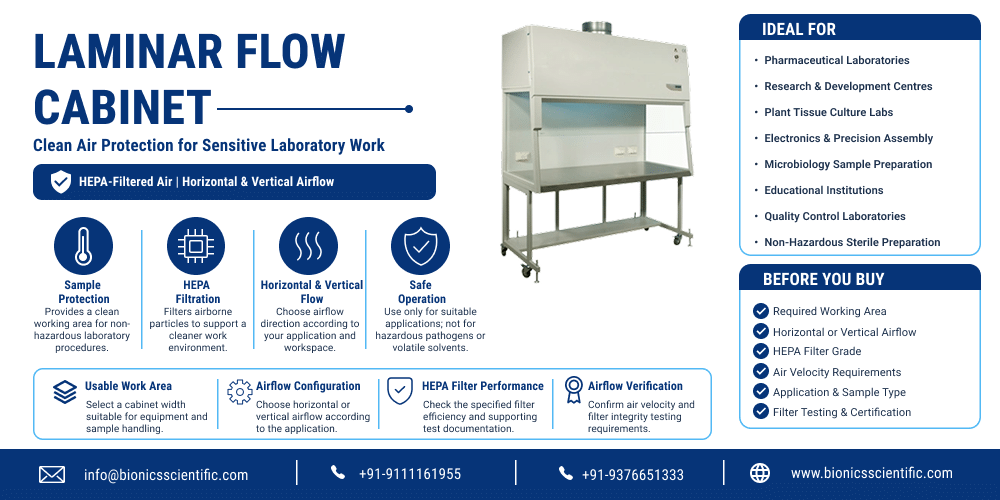
A laminar flow cabinet, also called a laminar air flow (LAF) workstation or clean bench, pulls room air through a pre-filter, pushes it through a HEPA filter, and delivers it across the work surface in parallel streams. “Laminar” means the layers of air travel smoothly without turbulence, sweeping particles away from your sample.
A HEPA filter captures at least 99.97% of particles at 0.3 microns. An H14-grade filter reaches 99.995% at its most penetrating particle size. The result is an ISO Class 5 environment at the work zone when the cabinet is installed and tested correctly.
Horizontal vs Vertical Airflow
Horizontal flow: air travels from the back wall toward the operator. It suits electronics, tissue culture media, and general sterile prep. Particles generated by the work are carried toward the user, so avoid anything hazardous.
Vertical flow: air descends from the top onto the work surface and exits through a front grille. The air stays away from the operator’s face, which makes this layout better for pharmaceutical dispensing and bulky equipment.
Our team usually recommends horizontal units for clean assembly and sample prep and vertical units where the work involves powders or heavier handling. For a detailed model range, see our laminar air flow cabinet page.
Laminar Flow Cabinet vs Safety Cabinet vs Flammable Safety Cabinet
| Feature | Laminar Flow Cabinet | Biological Safety Cabinet | Flammable Safety Cabinet |
| Primary purpose | Protect the product. | Protect operator, product, environment | Store flammable liquids. |
| Air handling | HEPA-filtered clean air | HEPA supply and exhaust | Passive vents, no filtration |
| Suitable for pathogens | No | Yes. | No |
| Suitable for solvents | No | No (unless specifically designed) | Yes, storage only. |
| Typical standard reference | ISO 14644-1 | EN 12469 / NSF 49 | NFPA 30 / EN 14470-1 |
The safest rule: if the material can harm a person, you need a biosafety cabinet. If the material can ignite, you need a flammable safety cabinet for storage and a chemical fume hood for handling. A laminar flow cabinet recirculates air through the work zone, so solvent vapor could build up around lamps and motors. Never use volatile solvents inside one.
Specification Table
The values below show a typical Bionics Scientific range. Exact figures vary by model and are confirmed at quotation.
| Parameter | Specification |
| Airflow type | Horizontal or vertical |
| Air cleanliness | ISO Class 5 at work zone |
| Final filter | HEPA, 99.97% at 0.3 µm (H14 on request) |
| Pre-filter | Washable synthetic, G4 grade |
| Air velocity | 0.45 m/s ± 20% |
| Work area sizes | 2 ft, 3 ft, 4 ft, 5 ft, 6 ft widths |
| Work surface | SS 304 |
| Body | Powder-coated MS or full SS 304 |
| Lighting | LED, above 750 lux at work surface |
| Noise level | Below 65 dB(A) |
| Controls | Digital airflow display, filter-life alert |
| Optional | UV lamp, gas tap, sash window, pressure gauge |
| Power supply | 220–240 V, 50/60 Hz, single phase |
Temperature and Environment Chart
A laminar flow cabinet does not heat or cool air. It moves the room air through filters. Room conditions and heat from the blower and lights still affect your results, so plan for these ranges.
| Condition | Recommended Range | Why It Matters |
| Room temperature | 18–25°C | Keeps motor load stable and operator comfortable |
| Rise inside work zone. | 2–4°C above room | Heat from blower and lighting |
| Relative humidity | 30–60% RH | Above 60% risks microbial growth on filters. |
| Storage before installation | 5–40°C | Protects filter media and electronics |
Typical work-zone temperature when the room is held at 22°C:
| Running Time | Work-Zone Temperature | Rise Above Room Temperature |
| Cabinet off (room air) | 22°C | 0°C |
| After 30 minutes | 24°C | +2°C |
| After 2 hours | 25°C | +3°C |
If your work involves temperature-sensitive reagents, keep them in a laboratory incubator or refrigerator until needed, and bring only what you will use onto the bench.
What Buyers Should Check Before Ordering
- Process fit. Describe the material. If it is hazardous or flammable, a laminar flow cabinet is the wrong tool.
- Work size. Choose a width that leaves at least 15 cm of clear space from the sides. Crowding disrupts the airflow.
- Filter grade and access. Ask how the HEPA filter is replaced and whether a filter-life indicator is included.
- Airflow verification. Request a test certificate covering velocity, filter integrity, and particle count.
- Local power and voltage. Gulf, South Asian, and North American voltages differ. State your supply at the enquiry stage.
- After-sales support. Check spare availability and service response in your country.
- Lifetime cost. Compare filter replacement interval and power draw, not only the purchase price.
Where Laminar Flow Cabinets Are Used
- Pharmaceutical and nutraceutical labs: sterile sampling, media filling and sterility prep.
- Plant tissue culture: media pouring and explant transfer.
- Electronics and optics: assembly of particle-sensitive components.
- Food and beverage QC: plating of non-pathogenic samples.
- Hospitals and research institutes: reagent preparation and slide handling.
Teams working with reactive gases or moisture-sensitive materials often pair a clean bench with a glove box for the steps that need an inert atmosphere.
Maintenance and Validation
Run the blower for 15 to 20 minutes before work starts. Wipe the work surface with 70% isopropyl alcohol before and after every session, moving from the back of the cabinet toward the front. Clean the pre-filter monthly and test airflow velocity every six months. Have a qualified technician run an integrity test on the HEPA filter once a year, or sooner if the display warns of a blockage. Keep a logbook of each test so audits are simple.
Supplying Laboratories Worldwide
Bionics Scientific ships laminar flow cabinets to laboratories in the United States (USA), United Kingdom (UK), United Arab Emirates (UAE), Saudi Arabia, South Africa, Canada, Australia, Singapore, Malaysia, Philippines, Indonesia, Kenya, Bangladesh, Nepal, Qatar, Oman, Kuwait, Bahrain, Vietnam, Thailand, Tanzania, Ghana, Sri Lanka, and New Zealand. Units are export-packed and supplied with a test report, manual, and spares list. Voltage and plug configuration are matched to the destination country.
Why Bionics Scientific
We have 26 years of manufacturing experience in laboratory equipment. Every cabinet is tested for airflow velocity and filter leaks before dispatch, and our engineers will tell you plainly when a laminar flow cabinet is not the right choice for your process. That honesty is deliberate: a wrong purchase costs your lab more than a delayed one.
Frequently Asked Questions
What is a laminar flow cabinet used for?
It provides a particle-free work area for non-hazardous sterile tasks such as media preparation, pharmaceutical filling, and electronics assembly.
Is a laminar flow cabinet the same as a safety cabinet?
No. A laminar flow cabinet protects the sample. A biosafety cabinet also protects the operator and the surrounding room.
Can I use a laminar flow cabinet for flammable solvents?
No. Recirculated air can concentrate vapor near electrical parts. Use a chemical fume hood for handling and a flammable safety cabinet for storage.
What does a flammable safety cabinet do?
It is a double-walled, fire-resistant storage unit that limits heat transfer to stored liquids and contains spills. It has no airflow system for work.
What is the standard air velocity?
About 0.45 m/s with a tolerance of ±20% across the work zone.
How often should the HEPA filter be replaced?
Typically every three to five years, depending on usage, room dust, and pre-filter care. Replace it when the integrity test fails or airflow cannot be restored.
Horizontal or vertical: which is better?
Horizontal suits electronics and general sterile prep. Vertical suits dispense and keep air away from the operator’s face.
Does it need a UV lamp?
It is optional. UV can reduce surface contamination but does not replace wiping with disinfectant, and it must be off while people work.
What room conditions are best? Hold the room at 18–25°C and 30–60% RH, away from doors and air vents that disturb airflow.
Do you ship to my country?
Yes. We supply to the 24 countries listed above and can arrange export documentation, voltage matching, and installation guidance.
Get a Quote Today
Not sure which cabinet fits your process? Share your application, work size, and country with our engineers, and we will recommend the right model within one working day. Contact Bionics Scientific now to request a quotation or technical datasheet.