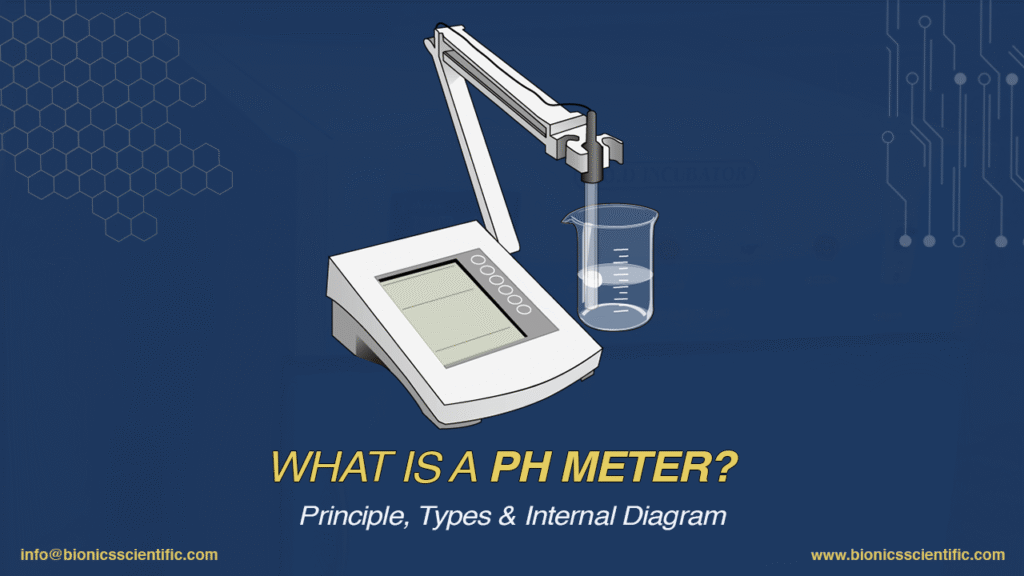
A pH meter measures the acidity or alkalinity of a solution by measuring the voltage between a pH-sensitive glass electrode and a reference electrode. After calibration with standard buffer solutions, the meter converts this voltage into a pH reading. This guide explains its working principle, labelled components, calibration procedure, types, and applications.
What Does pH Mean?
pH describes how acidic or alkaline a solution is. It is defined as the negative base-10 logarithm of hydrogen ion activity: pH = −log₁₀ a(H⁺). “Potential of hydrogen” is a commonly used explanatory phrase.
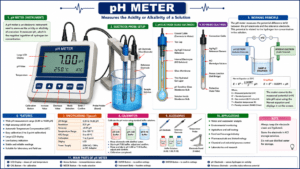
The pH scale shows how acidic or alkaline a solution is (0-14):
- pH < 7: Acidic
- pH = 7: Neutral
- pH > 7: Basic (Alkaline)
These categories apply to many dilute aqueous solutions at 25°C. Neutral pH changes with temperature, and pH values can fall outside the familiar 0–14 range.
Working Principle of a pH Meter
A conventional pH meter works on the principle of potentiometry. It measures the electrical potential difference between a pH-sensitive glass electrode and a reference electrode immersed in the sample solution.
Hydrogen ion activity in the sample affects the potential across the hydrated glass membrane, while the reference electrode provides a stable comparison potential. The meter uses calibration data to convert this voltage difference into a pH reading. Many pH probes combine the glass and reference electrodes in a single body.
Nernst Equation and Calculation Example
The relationship between electrode voltage and pH follows the Nernst equation. At a fixed temperature, the ideal response can be expressed as:
E = K − S × pH
Here, E is the measured voltage, K represents the constant potentials of the electrode system, and S is the temperature-dependent slope. At 25°C, the ideal slope is approximately 59.16 mV per pH unit.
For example, a change from pH 7 to pH 4 represents a difference of three pH units:
Voltage-change magnitude = 3 × 59.16 = 177.48 mV
This is a theoretical example, not a guaranteed reading or accuracy specification. Calibration determines the actual electrode offset and slope.
pH Meter Construction
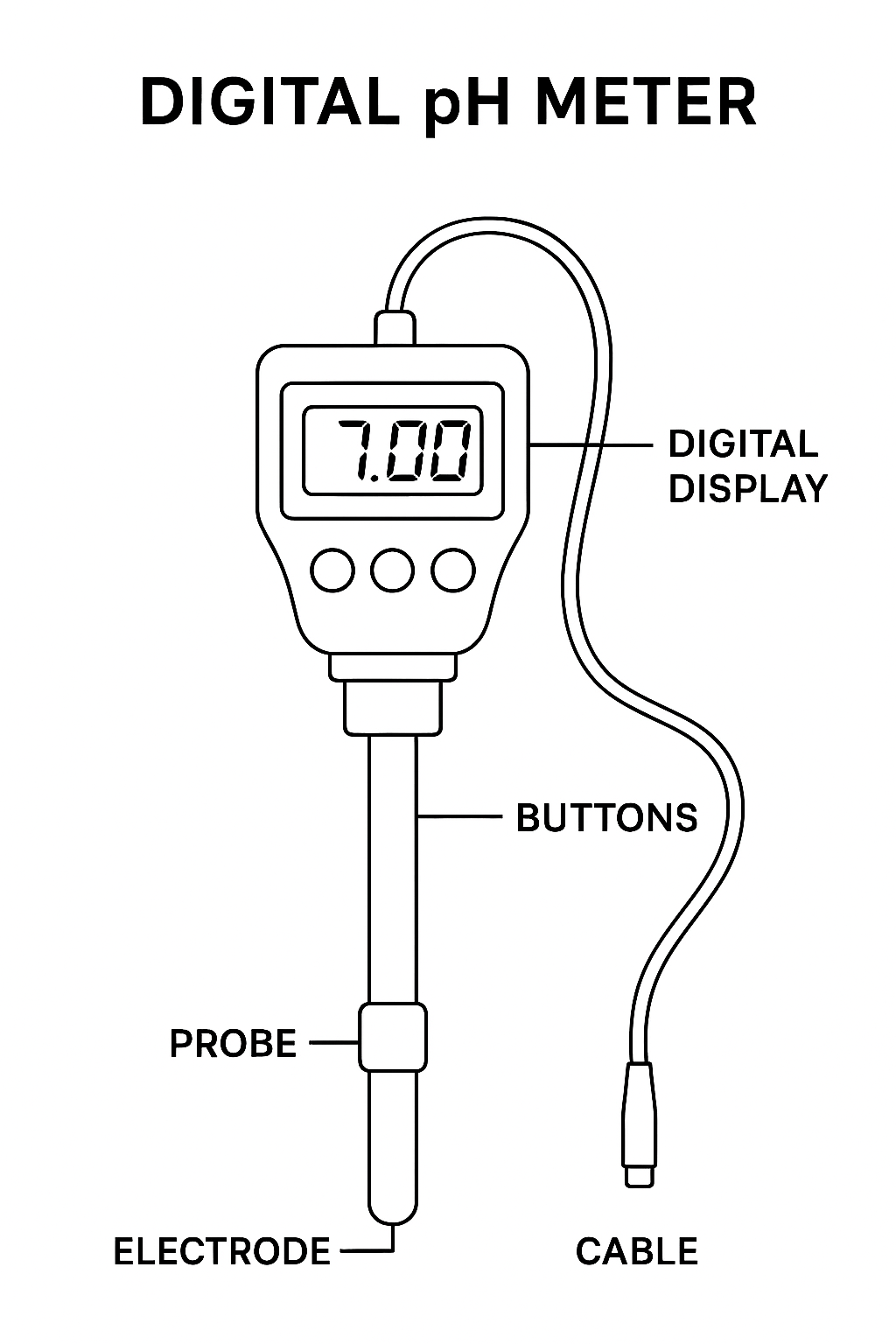
A conventional pH meter includes a glass measuring electrode, a reference electrode, high-impedance measuring electronics, a display, and calibration controls. Many instruments use a combination probe that contains both electrodes in one body. A temperature sensor may be separate or integrated into the probe.
| Component | Function |
| Glass electrode | Develops a potential related to hydrogen ion activity in the sample. |
| Reference electrode and junction | Provide a stable reference potential and electrical contact with the sample. |
| Temperature sensor, where fitted | Measures temperature for compensation of the electrode’s temperature-dependent slope. |
| Measuring electronics | Measure the electrode voltage and convert it into pH using calibration data. |
| Display and calibration controls | Show readings and allow calibration with standard buffers. |
Types of pH Meters
Different types of pH meters are available to suit various testing requirements. Some models are designed for laboratory use, while others are better suited for field testing, industrial monitoring, or routine measurements.
- Digital pH meter—Provides accurate digital readouts, often with automatic calibration and temperature compensation. Commonly used in laboratories, industries, and field testing.
- Portable pH Meter—A compact, battery-operated device suitable for on-site testing in agriculture, wastewater management, etc.
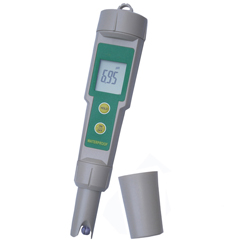
- Pen-type pH Meter—Lightweight and small, ideal for aquariums, swimming pools, and quick sampling.
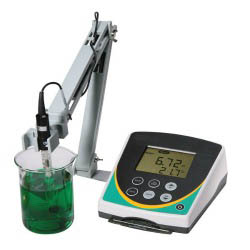
- Benchtop pH meter—A high-precision instrument primarily used in research laboratories and quality control departments.
- pH Transmitters—Industrial-grade devices that continuously measure and transmit pH values to control systems.
pH Meter Price in India
pH meter prices in India depend on the selected model, electrode, and included accessories. When comparing quotations, check whether the temperature probe, calibration buffers, and storage solution are included. Contact Bionics Scientific with your application and required quantity for current pricing.
Choosing the right pH meter
| Type | Typical Use | What to Check Before Buying |
| Pen-type pH meter | Quick spot measurements | Specified accuracy, calibration method, and electrode replacement options |
| Portable pH meter | Field sampling and on-site testing | Electrode suitability, temperature measurement, protection rating, and battery operation |
| Benchtop pH meter | Routine laboratory testing and research | Specified accuracy, calibration options, electrode compatibility, and data-recording requirements |
| Inline pH system | Continuous process monitoring | Process temperature, installation requirements, cleaning, and transmitter compatibility |
Select a pH meter by its specified performance and electrode suitability, rather than assuming accuracy from its size or format. Display resolution is not the same as measurement accuracy.
pH Scale Indicators:
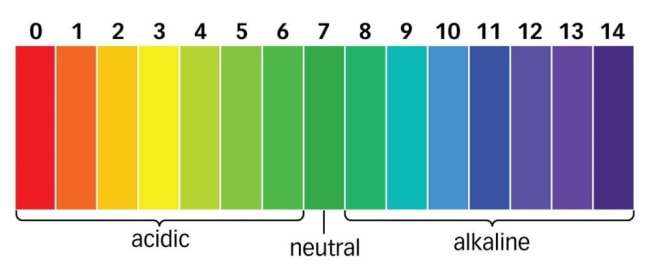
Source: https://www.epa.gov/goldkingmine/what-ph
Bionics Scientific pH Meters
Uses and Applications of a pH Meter
The uses of a pH meter include laboratory testing, water-quality monitoring, agriculture, food processing, pharmaceutical testing, and industrial quality control.
- Science & Research—Provide aid to scientists for test reactions, study chemicals, and even develop new medicines.
- Farming & Gardening—analyze if soil is too acidic or basic and help plants grow healthier.
- Food & drinks—Used to keep yogurt tangy, cheese tasty, and beer or wine just right.
- Water and Wastewater Treatment—pH measurement helps monitor acid-base conditions and treatment processes. It is one water-quality parameter; a pH reading alone does not establish drinking-water safety or regulatory compliance.
- Pharmaceutical & Laboratory Testing—pH measurement is used in laboratory testing, formulation processes, quality control, and research where accurate acidity or alkalinity measurements are required.
- Industry—Factories use it to make soaps, cosmetics, paper, and other products with the right balance.
| Component | Function |
| Glass Electrode | Detects hydrogen ions |
| Reference Electrode | Provides stable reference |
| Temperature Sensor | Compensates temperature changes |
| Amplifier | Strengthens electrical signal |
| Display Unit | Shows pH value |
Components Shown in pH Meter Diagram
The diagram of a pH meter highlights the key components responsible for measuring the acidity or alkalinity of a solution. The glass electrode is the sensing element that responds to hydrogen ions present in the sample, while the reference electrode provides a stable comparison point for measurement. Modern instruments may also include a temperature sensor to improve accuracy when testing samples at different temperatures. The electrical signal generated by the electrodes is amplified and processed by the instrument before the final pH value is displayed on the screen. Understanding these components makes it easier to interpret how a pH meter works and why accurate calibration is important for reliable results.
pH Meter Calibration Procedure
Calibration establishes the relationship between electrode voltage and known pH values. Follow the instrument instructions and use fresh buffers recognized by your meter.
- Inspect the electrode for damage and condition it according to the manufacturer’s instructions.
- Pour the required buffers into separate clean containers. For two-point calibration, choose buffers that bracket the expected sample pH where possible.
- Rinse the electrode with distilled or deionised water. Do not rub the sensitive glass bulb.
- Immerse the sensing bulb and reference junction in the first buffer. Follow the meter’s specified calibration sequence, wait for a stable reading, and confirm the calibration point.
- Rinse between buffers and repeat for the remaining calibration points. Use the buffer’s assigned pH value at the calibration temperature.
- Confirm that calibration meets the instrument or laboratory acceptance criteria. Never pour used buffer back into its original bottle.
Calibration frequency depends on the required accuracy, electrode condition, measurement method, and laboratory procedure. Recalibrate when verification checks show unacceptable drift.
How to Measure pH After Calibration
- Rinse the electrode with distilled or deionised water before placing it in the sample.
- Immerse the sensing bulb and reference junction without exceeding the probe’s recommended immersion depth.
- Keep the glass bulb clear of the container walls and bottom. Mix the sample gently and consistently.
- Wait for the pH reading and sample temperature to stabilize.
- Record the pH value together with the sample temperature.
- Rinse the electrode between samples. After testing, store it according to the manufacturer’s instructions.
For soil, viscous foods, and other difficult samples, use an appropriate electrode and follow a defined sample-preparation method.
pH Meter vs. pH Paper
Both pH meters and pH paper are used to measure the acidity or alkalinity of a solution. However, a pH meter provides more accurate and reliable results, making it the preferred choice for laboratories, industries, and research applications. For laboratory and industrial applications, a pH meter is generally preferred because it provides more accurate and repeatable measurements than pH paper.
| Feature | pH Meter | pH Paper |
| Accuracy | High | Moderate |
| Reading Method | Digital Display | Color Comparison |
| Cost | Higher | Lower |
| Applications | Laboratory & Industrial Testing | Basic Testing |
| Reliability | More Reliable | Less Precise |
A pH meter is ideal when precise measurements are required, while pH paper is suitable for quick and approximate testing.
Advantages of pH Meters
One of the biggest advantages of a pH meter is that it gives results quickly without requiring complicated calculations or color comparisons. Unlike litmus paper, which can only provide an approximate indication, a pH meter displays a precise value that is easier to interpret. This makes it a practical choice for laboratories, water treatment facilities, food processing units, and agricultural testing.
Another benefit is consistency. When properly calibrated, the instrument can provide repeatable readings, helping users monitor changes in pH with greater confidence. Many modern models also include features such as digital displays and temperature compensation, making routine testing simpler and more convenient. Whether testing water, soil, chemicals, or food products, a pH meter offers a dependable way to assess acidity and alkalinity with minimal effort.
Limitations of pH Meter
Reliable pH measurement depends on calibration, electrode condition, sample suitability, and temperature handling. A dirty, damaged, or dehydrated electrode may give slow or unstable readings. Use an electrode suitable for the sample and follow the manufacturer’s cleaning instructions.
Rinse the electrode between measurements and store a conventional glass pH electrode in the manufacturer-recommended storage solution. Do not store it in distilled or deionised water. Automatic temperature compensation adjusts for temperature-related changes in electrode response; it does not generally convert the sample’s actual pH to its value at 25°C. Record the sample temperature with the pH result.
Looking for the Right pH Meter for Your Application?
Need help selecting a pH meter? Share your sample type, expected pH range, sample temperature, required accuracy, testing location, and quantity. Contact Bionics Scientific to discuss a suitable meter and electrode combination and request current pricing.
Conclusion
A pH meter has become an essential tool wherever accurate testing is required. Whether it is used in a laboratory, water treatment plant, food processing unit, or agricultural field, it helps users quickly determine the acidity or alkalinity of a sample. By understanding its working principle, key components, calibration process, and practical applications, users can make better use of the instrument and achieve more dependable measurements in their day-to-day testing activities.
Frequently Asked Questions (FAQs)
What is a pH meter?
A pH meter is an electronic instrument used to measure the acidity or alkalinity of liquids with high accuracy.
How does this instrument measure pH?
It measures the electrical potential difference between a glass electrode and a reference electrode and converts it into a pH value.
What are the main components of a pH measuring instrument?
The main components include a glass electrode, reference electrode, display unit, temperature sensor, and calibration controls.
Why is calibration important before testing?
Calibration helps ensure accurate and reliable readings by comparing the device with standard buffer solutions.
What is the normal pH range that can be measured?
Most laboratory instruments can measure pH values from 0 to 14, covering acidic, neutral, and alkaline solutions.
Where is this device commonly used?
It is widely used in laboratories, water treatment facilities, pharmaceutical manufacturing, agriculture, food processing, and environmental testing.
How often should the instrument be calibrated?
Calibration frequency depends on the measurement method, required accuracy, electrode condition, and laboratory procedure. Follow the instrument instructions and recalibrate when verification checks show unacceptable drift.
What is the difference between a digital instrument and pH paper?
A digital instrument provides precise numerical readings, whereas pH paper offers approximate values based on color changes.