Salt Spray Test Chamber Manufacturer in India
ASTM B117 Salt Spray Corrosion Test Chamber
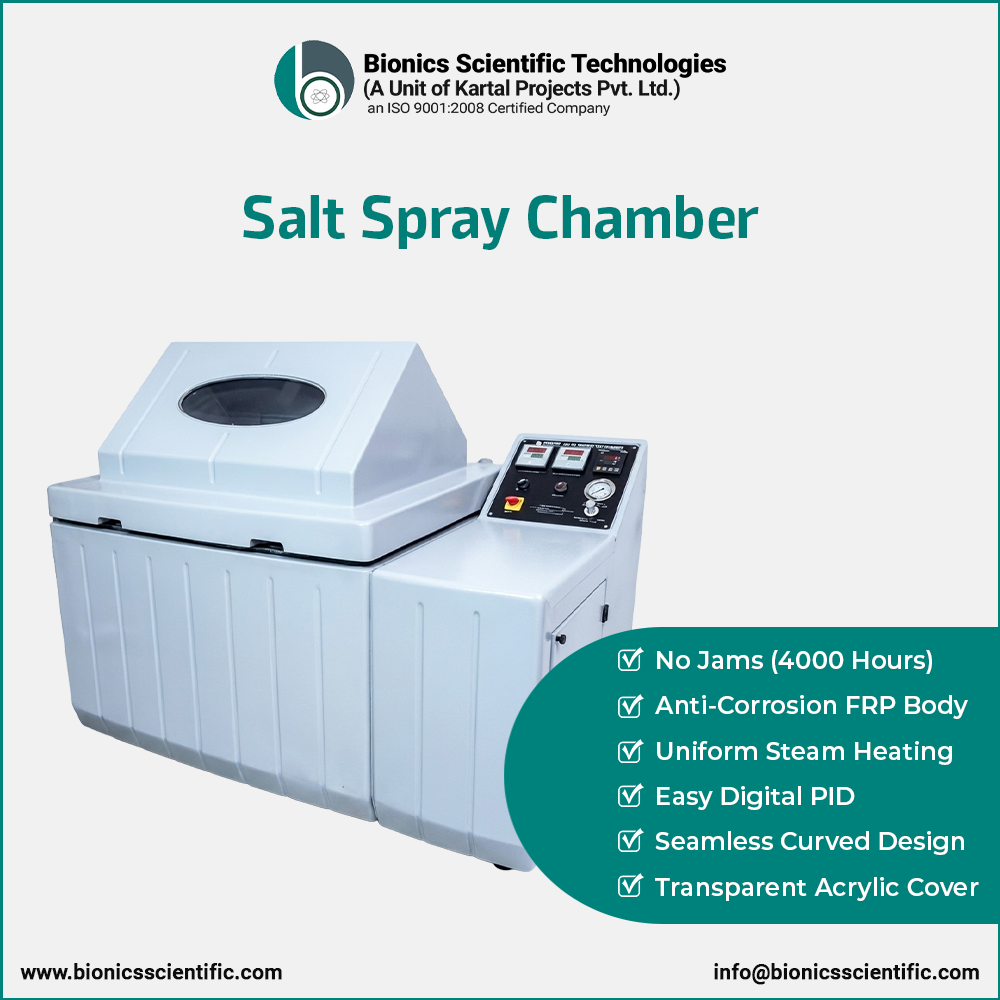
Bionics Scientific manufactures Salt Spray Test Chambers for accelerated corrosion testing of metals, coatings, plated components and finished products. Designed for laboratory and industrial quality-control applications, the chambers can be configured for Neutral Salt Spray (NSS), Acetic Acid Salt Spray (AASS), Copper-Accelerated Acetic Acid Salt Spray (CASS) and cyclic corrosion testing requirements.
Standard Bionics Scientific models are available in 108, 270, 480 and 980 litre chamber capacities, with customized configurations available according to specimen size, test method, control requirements and application. The range uses corrosion-resistant FRP construction, digital PID control and optional PLC/touch-screen control as specified in the technical configuration below.
Quick selection: For a quotation, share your required test standard, specimen dimensions, test method (NSS/AASS/CASS/CCT), chamber capacity, control preference, quantity and delivery location.
Get Salt Spray Chamber Price & Specifications
What Is a Salt Spray Test Chamber?
A salt spray test chamber, also called a salt fog chamber or corrosion test chamber, creates a controlled corrosive atmosphere to compare the corrosion resistance of metallic materials, protective coatings, plated parts and surface-treated products. It is widely used in quality control, product development and comparative corrosion testing. For related environmental testing, you can also explore our Humidity Temperature Test Chamber.
Salt Spray Test Standards: ASTM B117 and ISO 9227
ASTM B117 is the standard practice for operating salt spray (fog) apparatus. It defines the apparatus, procedure and conditions required to create and maintain a controlled salt spray environment. ASTM also notes that the practice itself does not prescribe the exposure period for a specific product or how results should be interpreted.
ISO 9227 specifies apparatus, reagents and procedures for Neutral Salt Spray (NSS), Acetic Acid Salt Spray (AASS) and Copper-Accelerated Acetic Acid Salt Spray (CASS) tests. The applicable product or customer specification should determine the required exposure duration and acceptance criteria.
How Does a Salt Spray Test Chamber Work?
A prepared salt solution is atomized through a corrosion-resistant nozzle to create a fine fog inside the test chamber. Specimens are exposed under controlled chamber temperature, air pressure, solution chemistry and fog collection conditions according to the selected test method. After the specified exposure period, the specimens are evaluated using the acceptance criteria defined by the applicable product specification or test plan.
Types of Salt Spray and Corrosion Tests
Neutral Salt Spray Test (NSS)
NSS uses a neutral salt solution and is one of the most common methods for comparative corrosion testing of metallic materials and protective coatings.
Acetic Acid Salt Spray Test (AASS)
AASS uses an acidified salt solution for applications where the applicable standard or product specification requires acidic salt-fog exposure.
Copper-Accelerated Acetic Acid Salt Spray Test (CASS)
CASS uses a copper-accelerated acidic salt solution and is applied where a more aggressive corrosion environment is specified for suitable coated or plated materials.
Cyclic Corrosion Testing (CCT)
Cyclic corrosion testing alternates environmental stages such as salt spray, humidity and drying according to a programmed test cycle. For humidity-based environmental testing, see our Refrigerated Humidity Chamber. Confirm the exact cycle, temperature range and optional hardware required for your intended CCT method before ordering.
How to Choose a Salt Spray Test Chamber
The right chamber should be selected from the test requirement first, not only from price or nominal capacity. Before requesting a model, confirm the applicable standard, test method, specimen dimensions, number of samples per batch, exposure duration, chamber construction, control system and site utilities.
| Selection Factor | What to Confirm Before Ordering |
|---|---|
| Test Method | NSS, AASS, CASS or required cyclic corrosion sequence |
| Specimen Size & Quantity | Maximum specimen dimensions, rack arrangement and samples per batch |
| Chamber Capacity | 108 L, 270 L, 480 L, 980 L or customized capacity |
| Control System | PID control or optional PLC/touch-screen configuration |
| Utilities | Electrical supply, compressed air, drainage and water requirements |
| Documentation | Calibration certificate and any project-specific documentation required before dispatch |
Applications and Industries
Salt spray test chambers are used for accelerated corrosion evaluation in automotive components, aerospace parts, marine hardware, railway equipment, electrical and electronics products, paints and coatings, electroplating, metal finishing, fasteners, general engineering and research laboratories.
Key Features & Benefits of Salt Spray Test Chamber
| Seamless curved design for maximum service life | Double walled anti-corrosion FRP construction |
| See-through acrylic cover optimizes test observation | Digital PID controller for easy operation |
| Corrosion-resistant glass nozzle for fine fog generation | Controlled heating system for stable chamber conditions |
| Dual Over temperature protection | Automatic restart after power interruption (where configured) |
Salt Spray Test Chamber Construction & Control
Capacity: Standard models are available in 108 litres, 270 litres, 480 litres and 980 litres. Higher or customized capacities can be considered according to the application and specimen requirements.
Chamber Construction: Double-walled corrosion-resistant FRP construction is used to protect the chamber from the corrosive test environment. The chamber is insulated with high-density ceramic wool.
Control: Standard configurations use PID control for chamber and humidifier functions. Optional PLC-based control with a graphical touch-screen interface is available where required.
Lid: FRP/acrylic lid construction with a viewing window allows observation of specimens without unnecessarily disturbing the test. Pneumatic operation is provided according to the selected configuration.
Spray System: A corrosion-resistant glass nozzle and non-metallic atomizer generate the salt fog. Optional flow-control components are available for applications requiring additional control of solution delivery.
Solution System: A corrosion-resistant solution storage arrangement is provided for the salt solution. Exact configuration depends on chamber capacity and selected options.
Salt Spray Test Procedure: General Workflow
- Confirm the applicable standard or customer test specification.
- Prepare the required test solution and verify the relevant chemistry parameters.
- Arrange specimens so that they do not interfere with fog exposure or one another.
- Set chamber temperature, air pressure, spray/fog parameters and test duration according to the selected method.
- Run the exposure while monitoring the chamber conditions required by the test plan.
- At the end of exposure, evaluate the specimens using the acceptance criteria defined by the applicable product specification.
Important: ASTM B117 and ISO 9227 define salt-spray test environments and procedures, but the appropriate exposure time and pass/fail criteria should come from the relevant product, material, customer or industry specification.
Technical Specifications
class="table-responsive">| Model | BST-SSC108 | BST-SSC270 | BST-SSC480 | BST-SSC980 |
|---|---|---|---|---|
| Capacity | 108 Liters | 270 Liters | 480 Liters | 980 Liters |
| Brine tank capacity | 15 Liters | 25 Liters | 40 Liters | 50 Liters |
| Test Types | NSS + CASS + ISO 9227 Testing | |||
| Objective of Salt Spray Chamber | Neutral Salt Solution Test, Acetic Acid Solution
Test, Cyclic Corrosion Test (CCT), Seawater Acidified Test (SWAAT) or Cupric Acid (CASS), Salt MIST Treatment |
|||
| Temperature Range | 35°C to 55°C | |||
| Temperature Fluctuations | ≤ ± 0.5°C | |||
| Temperature Uniformity | ≤ ± 2°C | |||
| Temperature Precision | ± 1°C | |||
| Test Chamber Temperature | Salt Spray Method (NSS AASS) 35°C ±1°C Corrosion-resistant Testing Method(CASS) 50°C ±1°C |
|||
| Saturated air Barrel Temperature | Salt Spray Method (NSS AASS) 47°C ±1°C Corrosion-resistant Testing Method(CASS) 63°C ±1°C |
|||
| Brine Temperature | 35°C ±1°C, 50°C ±1°C | |||
| Spray Quantity | 1.0 to 2.0 ml / 80cm2 / hr | |||
| Air pressure | 1.00 ± 0.01kgf/cm2 | |||
| pH Control Range | Salt Spray Method (NSS AASS) 6.5 to 7.2 Corrosion-resistant Testing Method (CASS) 3.0 to 3.2 |
|||
| Nozzle | Glass Nozzle (Made in Germany) | |||
| Timer | 0 to 9999 (H. M. S.) | |||
| Construction | Double walled corrosion resistant FRP | |||
| Internal Chamber | Corrosion Resistant FRP | |||
| Insulation | High density ceramic wool | |||
| Lid Cover | Acrylic Sheet / PVC w/ Pneumatic Operation | |||
| Display | LCD Display w/ Backlit | |||
| Control Panel | Basic PID Controller OR LCD Touch Screen Interface, PLC Based Control Panel |
|||
| Atomizer | Glass /Acrylic (non-reactive to salt solution) | |||
| Air Regulator | Precise regulator w/ gauge ranging from 0 - 30 psi | |||
| Drainage | Solution and water drain out tap | |||
| Caster Wheel | Revolving Type (Optional) | |||
| Power Supply | 220 / 230 / 240 Volts | |||
Optional Accessories
| Lucite Atomizer | Flow Control system | Peristaltic pump and flow meter for salt mist fall rate control |
| pH meter (Table Top or Pen Type) | Humidity Indicator - Hand held or panel mounted | Air Compressor |
| Water de-ionizer | Chamber Illumination | Touch Screen control console |
| Refrigeration Module / Attachment - for below ambient testing | Revolving Caster Wheels | Calibration Certificate |
Common Salt Spray Test Chamber Applications
| Automotive Components | Paints & Protective Coatings | Electroplated Parts |
| Marine Hardware | Aerospace Components | Railway Components |
| Electrical & Electronics | Fasteners & Hardware | General Engineering |
Related Environmental Test Chambers
For broader environmental testing requirements, explore our Test Chambers, Humidity Temperature Test Chamber, Refrigerated Humidity Chamber and Sand and Dust Test Chamber.
Why Choose Bionics Scientific for Salt Spray Test Chambers?
Bionics Scientific offers standard and customized salt spray test chamber configurations for laboratory, quality-control and industrial corrosion testing applications. Buyers can select from multiple chamber capacities, PID or optional PLC-based controls and optional accessories according to the required test method and project specification.
- Standard capacities: 108 L, 270 L, 480 L and 980 L
- Configurations for NSS, AASS, CASS and cyclic corrosion requirements
- Corrosion-resistant FRP chamber construction
- PID control with optional PLC/touch-screen configuration
- Optional accessories including flow-control components, pH meter, air compressor, water de-ionizer and calibration certificate
Installation, Calibration & Technical Support
Installation, commissioning, operator training, calibration, preventive maintenance and AMC support may be provided according to the agreed project scope and location. Include any required calibration, documentation, installation and training requirements in the quotation request so they can be confirmed before ordering.
Frequently Asked Questions About Salt Spray Test Chambers
What is a salt spray test chamber used for?
A salt spray test chamber creates a controlled salt-fog environment for comparative corrosion testing of metals, coatings, plated parts and surface-treated products. It is commonly used in quality control, product development and corrosion-resistance evaluation.
Which test methods can this chamber support?
Depending on the selected configuration, Bionics Scientific chambers can be specified for Neutral Salt Spray (NSS), Acetic Acid Salt Spray (AASS), Copper-Accelerated Acetic Acid Salt Spray (CASS) and cyclic corrosion testing requirements. Confirm the exact test method and cycle before ordering.
What is the difference between ASTM B117 and ISO 9227?
ASTM B117 describes the apparatus, procedure and conditions for operating a salt spray (fog) environment. ISO 9227 specifies methods including NSS, AASS and CASS. Neither standard by itself determines the correct exposure duration or pass/fail criteria for every product; those should be taken from the applicable product or customer specification.
What chamber capacities are available?
Standard Bionics Scientific models are available in 108 L, 270 L, 480 L and 980 L capacities. Customized capacities can be discussed when specimen dimensions or batch size require a different chamber volume.
How do I choose the correct salt spray chamber size?
Choose capacity according to the maximum specimen dimensions, number of samples per batch, required rack arrangement and applicable test method. Share these details with the quotation request so the chamber size can be matched to the intended workload.
What information should I send for a quotation?
Share the test standard, test method, specimen dimensions, number of specimens, preferred chamber capacity, control system requirement, optional accessories, electrical supply, delivery location and any calibration or documentation requirements.
Does the salt spray test predict exact outdoor service life?
No. Salt spray testing provides controlled comparative corrosion-resistance information. ASTM B117 cautions that direct prediction or extrapolation to natural-environment performance is not always reliable without appropriate supporting long-term exposure data.
Are PLC and touch-screen controls available?
Yes, PLC-based control with a graphical touch-screen interface is listed as an optional configuration. Standard configurations use PID control. Confirm the required automation and data-recording functions before ordering.
Are installation and calibration services available?
Installation, commissioning, operator training, calibration, preventive maintenance and AMC support can be discussed as part of the project scope. Availability should be confirmed for the installation location at the quotation stage.
Request a Salt Spray Test Chamber Quote
Need help selecting the right salt spray test chamber? Send your test standard, specimen size, required test method, chamber capacity, control preference and delivery location to Bionics Scientific for model selection, technical specifications and quotation.
Related Products