
Quick Answer
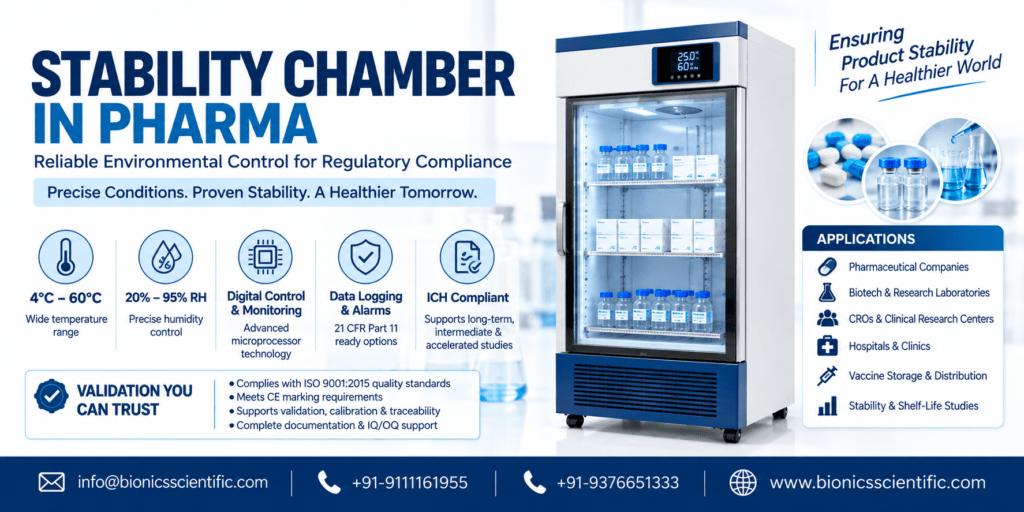
A stability chamber in pharma holds temperature and humidity at fixed, controlled levels so drug formulations, APIs, and packaging can be tested for how they hold up over time, following the ICH Q1A(R2) guideline. It’s also called a temperature chamber. Most units run between 4°C and 60°C, with humidity from 20% to 95% RH, logging conditions continuously so the data can be submitted with a drug application. Bionics Scientific has built this kind of equipment for 35 years and supplies stability chambers to pharmaceutical, biotech, and CRO facilities in India and abroad.
What Is a Stability Chamber in Pharma?
A stability chamber is a sealed enclosure built to hold a specific temperature and humidity for months or years while a product is checked periodically for degradation. This isn’t cosmetic—regulators like the USFDA, EMA, and CDSCO require this data before approving a submission, under conditions set by ICH Q1A(R2).
What separates a pharma-grade chamber from a regular incubator is tolerance: it typically needs to hold within ±2°C and ±5% RH, consistently across the whole interior, not just near the sensor. One bad reading can invalidate months of data—which is why airflow, sensor placement, and humidity method matter more here than in most lab equipment.
Why Stability Testing Cannot Be Skipped
The world is divided into four ICH climatic zones (I–IVb) by ambient temperature and humidity. A tablet stored in Lagos degrades differently than one in Reykjavik, so a stability chamber recreates those conditions in-house instead of shipping product to every region.
This data determines:
- The shelf life on the label
- Storage instructions, like “store below 25°C”
- Packaging choices—blister vs. bottle, desiccant needs
- Whether a formulation change requires re-filing
Skipping or under-documenting this step is a common cause of regulatory query letters and rejections.
Climatic Zones and Testing Conditions
A stability chamber in pharma can be configured according to the temperature and humidity conditions required for specific stability testing protocols.
| ICH Zone | Definition | Long-Term Condition | Intermediate | Accelerated |
| Zone I | Temperate | 21°C / 45% RH | — | 40°C / 75% RH |
| Zone II | Mediterranean/subtropical | 25°C / 60% RH | 30°C / 65% RH | 40°C / 75% RH |
| Zone III | Hot, dry | 30°C / 35% RH | — | 40°C / 75% RH |
| Zone IVa | Hot, humid | 30°C / 65% RH | — | 40°C / 75% RH |
| Zone IVb | Hot, very humid | 30°C / 75% RH | — | 40°C / 75% RH |
Most chambers are set to one condition at a time. Facilities running full submission programs typically run several chambers in parallel—long-term, intermediate, accelerated—rather than cycling one unit through all three.
Specification Table
| Parameter | Typical Range | Notes |
| Temperature range | 4°C to 60°C | Varies by model; walk-in units may go beyond |
| Humidity range | 20% to 95% RH | Non-condensing |
| Temperature uniformity | ±2°C | Confirmed via mapping study |
| Humidity uniformity | ±5% RH | Checked during IQ/OQ |
| Construction | SS 304/316 interior, PUF insulation | Holds up over long test durations |
| Humidification | Steam or ultrasonic | Steam gives tighter RH control. |
| Data logging | Continuous, 21 CFR Part 11-ready options | Needed for audit trail |
| Alarms | Visual and audible, high/low temp/RH | Many models include battery backup |
| Chamber sizes | Tabletop, reach-in, walk-in | Depends on sample throughput |
| Compliance | ICH Q1A(R2), WHO, Schedule M | Confirm against model documentation. |
What Sets Bionics Scientific Stability Chambers Apart
Bionics Scientific has spent 35 years manufacturing scientific and laboratory equipment, dispatched across India and overseas. Its scope—ovens, incubators, environmental chambers, autoclaves, and related equipment—is certified under ISO 9001:2015 and CE marked under the Medical Devices Directive, with GMP-compliant manufacturing, audited by Euroglobe Registrars (UK) with scheduled surveillance checks.
For a buyer, that means the documentation can stand up to an audit, the company has history to support spares and servicing, and the equipment is built around the same framework—ICH, WHO, and Schedule M—most pharma facilities already operate under.
Certifications on Record
| Certification | Certifying Body | Certificate No. | Issued | Valid Until | Scope (per annexure) |
| ISO 9001:2015 | Euroglobe Registrars, UK | 184876 | 31-03-2026 | 30-03-2029 | Laboratory, scientific & machinery equipment per annexure (includes autoclaves, chambers, refrigerators, and ovens) |
| CE Marking (MDD 93/42/EEC) | Euroglobe Registrars, UK | 184877 | 31-03-2026 | 30-03-2029 | Technical file assessed for products per annexure |
| GMP | Euroglobe Registrars, UK | 184878 | 31-03-2026 | 30-03-2029 | Laboratory, scientific & machinery equipment per annexure |
| NSF/ANSI 61 | Euroglobe Registrars, UK | 183884 | 09-03-2024 | 08-03-2027 | Bio-safety cabinets, laboratory & scientific equipment |
All four sit under Kartal Projects Private Limited, Bionics Scientific’s parent entity, each with surveillance audits scheduled before expiry and verifiable through Euroglobe Registrars. Worth noting: the annexures cover the broader equipment range rather than naming “stability chamber” specifically, and NSF/ANSI 61 is scoped to biosafety cabinets. For a particular model, confirm which annexure it falls under.
Applications Across the Pharmaceutical Value Chain
A stability chamber in pharma supports multiple applications across pharmaceutical manufacturing, quality control, research, and regulatory testing.
- Drug substance and API stability studies for regulatory filings
- Finished formulation testing—tablets, capsules, injectables, ophthalmics
- Packaging qualification—whether a blister or bottle protects the product through its shelf life
- Photostability studies, paired with a light-exposure chamber under ICH Q1B
- CRO and third-party labs running multi-client stability programs
- Biotech and vaccine developers validating cold-chain-adjacent formulations
Selection Criteria: What to Check Before Buying
- Match chamber volume to actual sample load.
- Ask for real uniformity mapping data, not just spec-sheet numbers.
- Check door-opening recovery time.
- Confirm calibration and validation support (IQ/OQ/PQ documentation).
- Look at data integrity features—audit trails, access controls, backup power.
- Check the after-sales network for local spares and calibration support.
Global Reach
Bionics Scientific supplies stability chambers and related equipment across the United States (USA), United Kingdom (UK), United Arab Emirates (UAE), Saudi Arabia, South Africa, Canada, Australia, Singapore, Malaysia, Philippines, Indonesia, Kenya, Nigeria, Bangladesh, Nepal, Qatar, Oman, Kuwait, Bahrain, Vietnam, Thailand, Tanzania, Ghana, Sri Lanka, and New Zealand, alongside its pan-India base.
Frequently Asked Questions
What is a stability chamber used for in pharma?
Exposing drug substances, formulations, or packaged products to set conditions over time, generating the degradation data regulators use to set shelf life and storage instructions.
What’s the difference between a stability chamber and a temperature chamber?
Temperature chamber” is the broader term for any equipment controlling temperature.
A stability chamber also controls humidity tightly for the long, regulated durations ICH protocols require.
What temperature and humidity does a stability chamber maintain?
It depends on the protocol—a long-term Zone II study runs at 25°C/60% RH, while accelerated runs at 40°C/75% RH. Check exact setpoints against your ICH zone and manufacturer specs.
How long does a stability study run?
Long-term studies usually run 12–36 months; accelerated studies are typically 6 months, depending on the guideline and product.
What does ICH Q1A(R2) cover?
The ICH guideline governing stability testing for new drug substances and products—climatic zones, testing frequency, and data presentation.
Can one chamber run multiple stability protocols?
Not really—a chamber is generally locked to one condition, so simultaneous long-term, intermediate, and accelerated studies need separate chambers.
How big should a stability chamber be for a small laboratory?
It’s about sample volume and testing frequency, not lab size. QC labs typically use tabletop or reach-in units; CRO-scale volume calls for a walk-in chamber. Manufacturers can help size it against your monthly testing load.
Do stability chambers need calibration?
Yes—sensors drift over time and need periodic calibration, plus IQ/OQ/PQ validation and a uniformity mapping study before regulatory use.
What certifications should a stability chamber manufacturer have?
ISO 9001:2015, CE marking where applicable, and GMP-aligned manufacturing backed by independent surveillance audits.
Does Bionics Scientific export stability chambers outside India?
Yes—alongside its pan-India base, it supplies stability chambers and related equipment across the Middle East, Africa, and Southeast Asia.
Get a Quote for Your Facility
Setting up a QC lab, scaling stability testing, or replacing an old chamber? Bionics Scientific’s engineering team can help size the right configuration for your protocol and facility layout—reach out for a spec sheet, calibration documentation, and a quote built around your testing volume.