Quick Answer
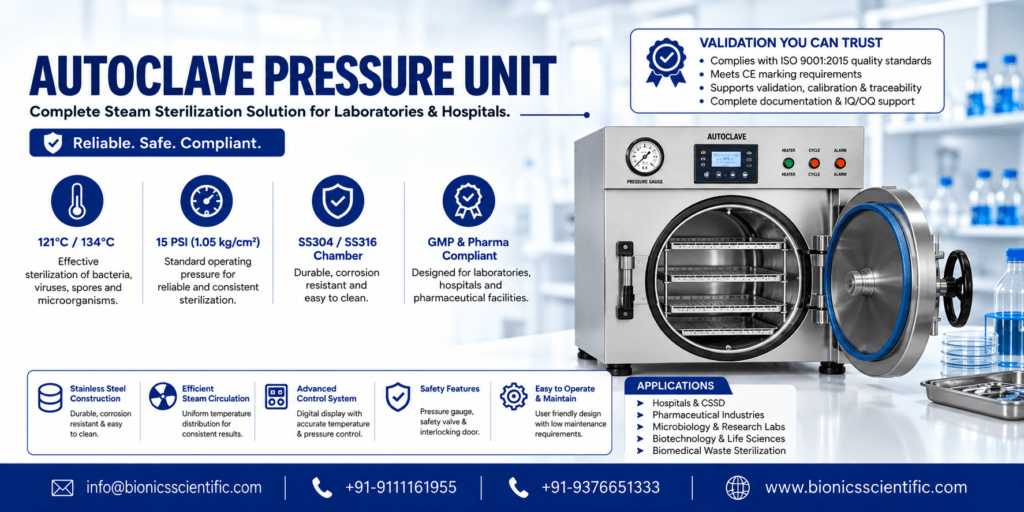
An autoclave pressure unit is the pressurized steam sterilization equipment used to destroy bacteria, viruses, spores, and other microorganisms on laboratory glassware, surgical instruments, culture media, and biomedical waste. Items are exposed to saturated steam at a set pressure—typically around 15 psi (1.05 kg/cm²)—and a temperature of 121°C or 134°C, held for a fixed duration. If you’re evaluating a sterile machine for purchase, chamber capacity, gauge accuracy, safety interlocks, and after-sales support matter as much as the headline pressure rating. Bionics Scientific has been building vertical and horizontal autoclaves for 35 years, supplying labs and hospitals across India as well as buyers in the USA, UK, UAE, Saudi Arabia, and Southeast Asia.
What Does “Autoclave Pressure Unit” Actually Mean?
This phrase gets used two different ways, and it’s worth untangling them before anything else. Sometimes it refers literally to the unit of pressure shown on the autoclave’s gauge—psi, bar, or kg/cm². Other times, especially in tender documents and institutional purchase orders, “autoclave pressure unit” is just shorthand for the whole machine: chamber, pressure vessel, heating element, gauge, safety valve, control panel, the works.
In practice, when a hospital or pharma company writes this into a procurement request, they mean the complete system. Nobody’s ordering a gauge on its own. What they do need to check is that the pressure rating quoted matches the manufacturer’s actual datasheet for that model—general industry figures floating around online aren’t a substitute for the number on the spec sheet of the unit you’re buying.
How Steam Sterilization Equipment Actually Works
The physics here isn’t complicated, even if the engineering behind a good autoclave is. Pressurized steam holds far more thermal energy than dry heat at the same temperature, and it gets into porous loads—fabric wraps, tubing, packaged instruments—in a way dry heat never manages. Once air is pushed out of the chamber and replaced with steam under pressure, water’s boiling point climbs well past 100°C. That’s what lets the chamber reach temperatures capable of killing bacterial spores, not just the easier-to-kill vegetative cells.
A full cycle runs through four stages. First, air has to go—either by gravity displacement or, in the better pre-vacuum machines, an actual vacuum pump, since any trapped air pocket is a spot steam never reaches. Next comes pressure build-up, as steam is admitted until the chamber hits its rated pressure and matching temperature. Then there’s the hold: the load sits at sterilizing temperature for a set stretch, often 15 to 20 minutes at 121°C, shorter at 134°C, though the real number depends on what’s inside and the validated cycle for that load. Finally, pressure is released gradually, and for wrapped or porous items, a drying phase clears residual moisture before anyone opens the door.
Vertical or Horizontal—Which One Do You Actually Need?
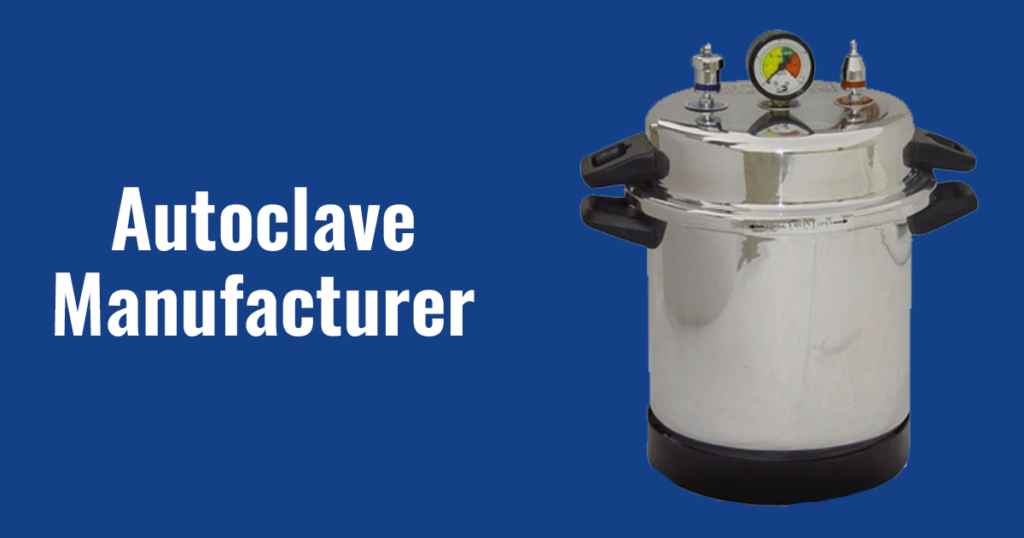
Two configurations dominate the market, and the choice usually comes down to space and workflow rather than performance. Vertical autoclaves open from the top. They fit smaller labs where floor space is tight, and they’re the go-to for glassware, culture media, and small instrument sets.
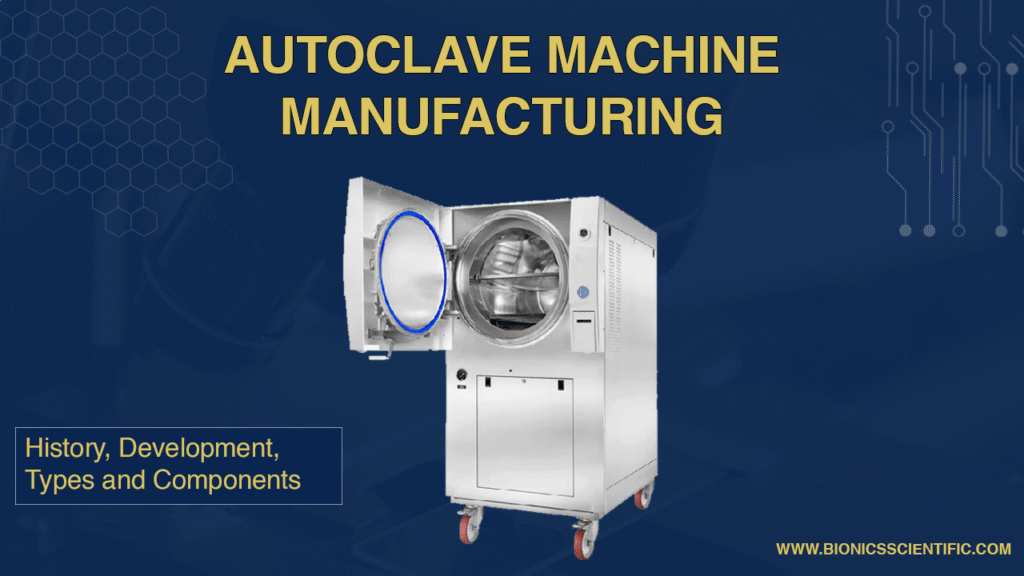
Horizontal units open from the front, more like a large oven, and they’re built for volume—hospital CSSDs, pharmaceutical production lines, anywhere trolleys of bulk items need to go in and out. Within either category, you will also find differences in cycle type (gravity displacement versus pre-vacuum), chamber material—usually SS316 or SS304 stainless steel for corrosion resistance—and whether heating comes from an electric immersion element or an external steam line.
Specification Table: Reference Parameters
| Parameter | Typical Range / Value | Notes |
| Operating pressure | 15–20 psi (1.05–1.4 kg/cm²) | Confirm against the manufacturer’s datasheet for the specific model |
| Sterilizing temperature | 121°C or 134°C | Chosen based on load type and validated cycle |
| Chamber material | SS316 / SS304 stainless steel | Withstands repeated steam exposure without corroding |
| Chamber orientation | Vertical or horizontal | Driven by facility layout and load volume |
| Heating method | Electric immersion heater or external steam | Varies by model |
| Safety fittings | Safety valve, pressure gauge, interlocking door | Standard on certified equipment |
| Cycle type | Gravity displacement or pre-vacuum | Pre-vacuum handles porous loads better. |
| Typical hold time | 15–20 minutes at 121°C | Depends on load; follow the validated cycle. |
Treat these as reference points, not guarantees—every manufacturer publishes its own datasheet, and that’s the document to check before buying.
Temperature and Pressure Reference Chart
| Sterilization Temperature | Approx. Corresponding Pressure | Typical Minimum Hold Time |
| 115°C | ~10 psi | 30 minutes |
| 121°C | ~15 psi | 15–20 minutes |
| 126°C | ~18–20 psi | 10–12 minutes |
| 134°C | ~30 psi | 3–5 minutes |
Altitude, chamber design, and how densely a load is packed all shift these numbers in practice, so validated settings for your specific machine and load should always take priority over a general reference table like this one.
Why the Manufacturer Behind the Machine Matters
An autoclave is a pressure vessel running at high temperature—this isn’t the kind of equipment where cutting corners on the supplier pays off. Bionics Scientific has spent 35 years manufacturing lab and hospital equipment and has shipped both vertical and horizontal autoclaves to buyers across India and overseas. The company’s manufacturing scope carries ISO 9001:2015 certification and CE marking under the Medical Device Directive, both issued by Euroglobe Registrars (UK), along with GMP certification for the facility itself.
A few things worth checking before signing a purchase order: whether the certifications quoted are real and verifiable (ask for the certificate number and scope, not just a logo on a brochure), whether the supplier has actually exported to markets with strict regulatory requirements, whether spares and service are available after the sale, and whether the unit meets the pressure vessel safety rules in whatever country it’s headed to.
Where Autoclaves Actually Get Used
Steam sterilization shows up anywhere biological contamination has to be eliminated before something gets reused or thrown away. Hospitals and CSSDs run autoclaves constantly for surgical instruments, linens, and reusable devices. Pharmaceutical manufacturers use them on containers and closures and sometimes on in-process equipment. Microbiology labs sterilize culture media, glassware, and pipette tips this way as a matter of course. And biomedical waste—infectious waste that can’t just go in a regular bin—typically has to be autoclaved before disposal under most local regulations.
Where Bionics Scientific Ships
Bionics Scientific supplies autoclave pressure units and related steam sterilization equipment across India and internationally—including the United States, United Kingdom, United Arab Emirates, Saudi Arabia, South Africa, Canada, Australia, Singapore, Malaysia, the Philippines, Indonesia, Kenya, Nigeria, Bangladesh, Nepal, Qatar, Oman, Kuwait, Bahrain, Vietnam, Thailand, Tanzania, Ghana, Sri Lanka, and New Zealand. Export paperwork, certification packages, and installation support are handled for international buyers setting up hospital, laboratory, or pharmaceutical facilities.
Frequently Asked Questions
What is the actual difference between an “autoclave” and a “sterile machine”?
Sterile machine” is the loose, catch-all term people use for any sterilization equipment. “Autoclave” specifically means one that uses pressurized steam. So every autoclave qualifies as a sterile machine, but plenty of sterile machines—dry heat ovens, ethylene oxide chambers, UV or radiation units—aren’t autoclaves at all.
What pressure does this equipment run at?
Most standard cycles sit around 15 psi, roughly 1.05 kg/cm². That said, it varies by manufacturer and cycle type, so the model’s own datasheet is the final word, not a general figure.
What temperature is needed to actually sterilize something?
121°C covers most standard cycles. 134°C is used for shorter, hotter cycles depending on the load—neither number is universal, and the right choice depends on what’s being sterilized.
How long does one cycle take, from start to finish?
The hold time at 121°C is usually 15–20 minutes, but that excludes heating up and cooling down, which can add a fair bit more. Total cycle time depends heavily on load type.
Vertical or horizontal—what’s the key difference?
Vertical units load from the top and suit smaller labs where space is limited. Horizontal ones load from the front like an oven and handle bulk loading better, which is why hospitals lean toward them.
Can biomedical waste go through an autoclave?
Yes—it’s one of the standard methods for decontaminating infectious waste before disposal, though the exact requirements depend on local biomedical waste rules.
What’s the chamber usually made of?
Stainless steel, most often SS316 or SS304, because it holds up under repeated steam exposure without corroding the way lesser metals would.
Which certifications should a buyer actually look for?
ISO 9001 for quality management, CE marking if the equipment is headed to a regulated market, and GMP certification for the manufacturing facility itself. Ask for certificate numbers, not just claims.
Does altitude change how sterilization works?
It does—water boils at a lower temperature at higher altitudes, so cycle settings sometimes need adjusting to hit the same validated sterilizing conditions. Worth flagging to the manufacturer if you’re at elevation.
Is pre-vacuum genuinely better than gravity displacement?
For porous or tightly wrapped loads, yes—pre-vacuum clears air out more thoroughly, so steam reaches everywhere it needs to. For general lab work with simpler loads, gravity displacement still does the job fine.
Get in Touch with Bionics Scientific
Bionics Scientific has been manufacturing vertical and horizontal autoclave pressure units for 35 years, backed by ISO 9001:2015, CE, and GMP certification, and an export record covering more than two dozen countries. Setting up a hospital CSSD, a pharmaceutical line, or a research lab—our technical team can help you land on the right chamber capacity, cycle type, and configuration for what you actually need. Get in touch for a spec sheet, certification documents, or a quote tailored to your facility.