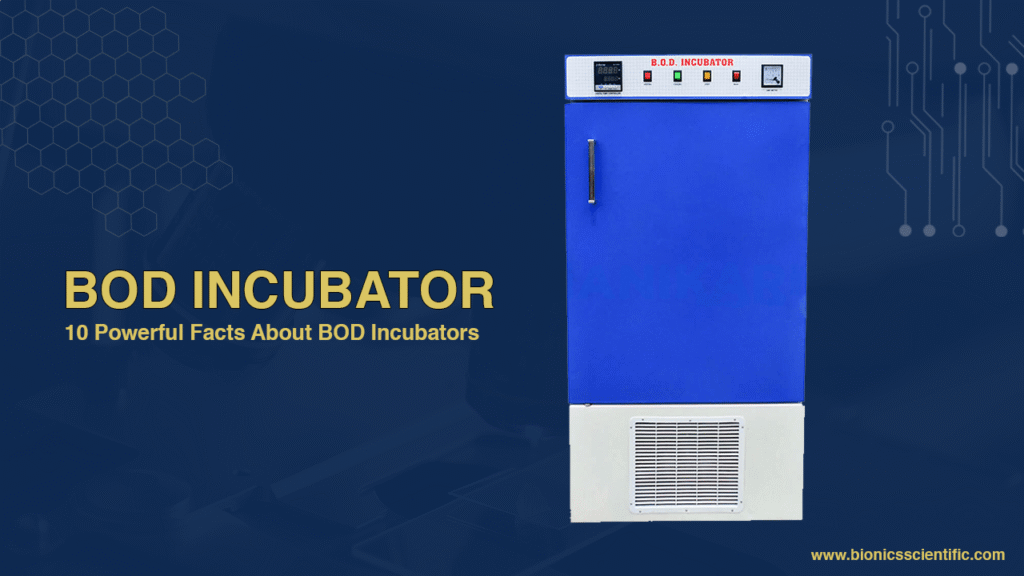
BOD Incubator Diagram: Working Principle, Parts, Construction and Uses
BOD incubators are widely used in pharmaceutical laboratories, microbiology testing, water analysis, wastewater treatment plants and research facilities where precise low-temperature control is required. These incubators help maintain stable conditions for BOD testing, microbial culture growth and sample stability.
At Bionics Scientific Technologies, we manufacture BOD incubators for laboratory and industrial applications with different capacities and reliable temperature control. These systems are suitable for pharmaceutical testing, microbiology research, environmental analysis and quality control laboratories.
A BOD incubator diagram helps laboratory professionals understand the construction, internal components, and working mechanism of the equipment. The diagram typically identifies parts such as the inner chamber, refrigeration system, heater, air circulation fan, temperature sensor, PID controller, and insulated cabinet.
Need a BOD Incubator for Laboratory Testing?
Get the latest BOD incubator price, specifications and expert guidance for pharmaceutical, microbiology and environmental testing applications.
What Is a BOD Incubator?
During routine testing, I’ve often seen people underestimate how much room temperature can fluctuate over a few days. On paper the laboratory may seem stable, but once equipment starts running, doors open frequently, or weather changes outside, conditions can shift more than expected. For certain samples, that becomes a problem.
In many labs I’ve worked with, long-duration water testing is one of the main reasons these chambers stay occupied. Samples may remain inside for several days, sometimes longer, and technicians generally don’t want environmental changes influencing microbial activity during that period. Most of the attention goes to maintaining a steady temperature rather than constantly checking the samples themselves.
One thing that usually causes confusion is assuming it works like a regular incubator. It doesn’t. The ability to cool as well as heat makes a noticeable difference, especially during summer months when ambient laboratory temperatures are already high. Temperature drift can become noticeable if equipment isn’t performing properly, so routine monitoring is part of normal laboratory practice.
In our lab, the same chamber is often used for microbiology tests, food-related work, and routine quality checks. The temperature setting changes from one job to another. Even so, the idea is pretty simple—samples need to stay under the same conditions until the work is finished.
BOD Incubator Diagram with Labels
One of the first questions from new users is usually about the cooling section and how the chamber manages to hold the same temperature for long periods. After you’ve worked with the unit for a while, your attention usually shifts to the controller reading, air circulation, and whether the chamber temperature is remaining uniform from top to bottom.
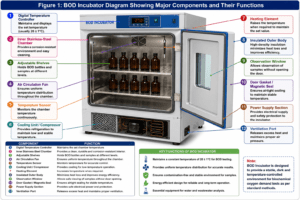
When looking at the diagram, don’t focus only on the sample chamber. Notice how the sensing, heating, and cooling sections are arranged around it. When a test is not giving the expected result, the first step is usually to look at the main operating sections of the chamber. On a few occasions, everything appeared normal from the outside, yet the air was not moving properly inside, which affected temperature uniformity.
Shelf arrangement is another detail that often gets ignored. If too many samples are placed close together, airflow can become restricted.
The BOD incubator diagram shown above helps identify the major components responsible for temperature control and sample incubation.
Note: Component locations may vary between models, but most BOD incubators contain similar temperature control, air circulation, heating, and cooling systems.
| Part | Function |
|---|---|
| Inner Chamber | Holds samples |
| Compressor | Cooling |
| Heater | Heating |
| Fan | Air circulation |
| PID Controller | Temperature control |
| Sensor | Temperature monitoring |
Construction of BOD Incubator
Most people only see the chamber and the control panel from the outside, but there is quite a bit more inside the cabinet than it appears. During maintenance work, you can notice that the sample compartment is separated from the outer body by an insulated section. This helps the chamber stay less affected by changes in room temperature.
The storage area used for bottles and samples is generally designed to handle frequent cleaning, which is important in laboratory environments where spills and moisture are not uncommon. Shelves can usually be repositioned depending on the type of work being carried out.
A number of operating systems are fitted around the chamber walls. Some are responsible for cooling, while others help raise the temperature when needed. Air movement inside the cabinet is equally important because uneven circulation can sometimes create differences between one shelf and another.
Most of the control process happens automatically. Once the required temperature is selected, the equipment continuously adjusts itself to keep conditions as steady as possible throughout the testing period.
A BOD incubator diagram is useful for understanding the arrangement of the refrigeration system, heating unit, and air circulation components.
BOD Incubator Construction Diagram Explanation
A typical BOD incubator consists of a double-walled cabinet with high-density insulation between the walls. The inner chamber is generally manufactured from stainless steel, while the outer body is made from powder-coated mild steel or stainless steel. The refrigeration unit and heating system work together to maintain precise temperatures. An air circulation fan distributes conditioned air evenly throughout the chamber, while a PID controller continuously monitors and regulates temperature. This construction helps maintain stable environmental conditions required for BOD testing, microbiological studies, and environmental research applications.
Parts of BOD Incubator and Their Functions
People often focus on the chamber and temperature display because those are the most visible parts of the equipment. In practice, several other sections are working at the same time to keep the selected conditions stable. During maintenance or inspection, technicians usually pay attention to airflow, cooling performance, temperature sensing, and the overall condition of the chamber. The table below gives a quick overview of the main parts commonly found in a laboratory BOD incubator and the role each one performs during operation.
The labeled BOD incubator diagram makes it easier to identify the function of each component.
|
Component |
Function |
|
Inner Chamber |
Stores samples, culture media, and BOD bottles during testing. |
|
Outer Cabinet |
Provides structural strength and protects internal components. |
|
Removable Shelves |
Allow flexible arrangement of samples inside the chamber. |
|
Refrigeration System |
Maintains temperatures below ambient conditions required for BOD testing. |
|
Heating Element |
Supplies controlled heat to achieve the desired temperature setting. |
|
Air Circulation Fan |
Distributes air evenly throughout the chamber for uniform temperature. |
|
Temperature Sensor |
Continuously monitors internal temperature and sends feedback to the controller. |
|
PID Controller |
Regulates heating and cooling functions to maintain precise temperature conditions. |
|
Toughened Glass Window |
Allows observation of samples without disturbing chamber conditions. |
|
Safety Thermostat |
Protects samples and equipment from excessive temperature rise. |
|
Door Lock and Handle |
Secures the chamber during testing and prevents accidental opening. |
|
Power Supply System |
Provides electrical power for all operating components. |
BOD Incubator Uses in Laboratory
BOD incubators are widely used across industries for controlled testing and microbial growth applications. Below are the key uses:
– Water and wastewater testing (BOD analysis)
– Microbiological culture growth
– Pharmaceutical stability testing
– Food and dairy product testing
– Environmental research and pollution analysis
Bionics Scientific Technologies manufactures BOD incubators in standard models ranging from 68 litres to 425 litres in capacity. Each system features a temperature range of 2°C to 60°C with a uniformity of ±0.5°C @ 20°C. Connect for more queries at info@bionicsscientific.com or Connect at +91 9111161955 | 9376651333
Scientists measure dissolved oxygen levels before and after incubation to determine the amount of oxygen consumed by microorganisms. This helps laboratories evaluate organic pollution levels in water and wastewater samples.
- BOD Incubator Diagram: Working Principle, Parts, Construction and Uses
- What Is a BOD Incubator?
- BOD Incubator Diagram with Labels
- Construction of BOD Incubator
- BOD Incubator Construction Diagram Explanation
- Parts of BOD Incubator and Their Functions
- BOD Incubator Uses in Laboratory
- Working Principle of BOD Incubator
- BOD Testing Procedure:
- Importance of BOD Testing:
- Applications of BOD Incubator
- What is the difference between a BOD incubator and a normal incubator?
- Types of Incubators
- Temperature Range and Specifications
- Why is a BOD Incubator Important?
- What Does a Laboratory Incubator Do?
- General Usage of of Laboratory Incubators
- BOD Incubator Price in India
- Looking for the Best BOD Incubator for Your Laboratory?
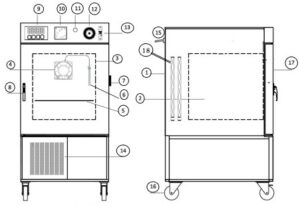
BOD Incubator Diagram with Label
- Exterior
- Inner chamber
- Toughened glass window
- Air circulation fan
- Removable tray
- Temperature sensor
- Door hinges
- Door handle with lock & key
- PID temperature controller
- Analog ampere meter
- Pilot lamp
- Safety thermostat
- On/Off MCB
- Refrigeration system
- Power cord
- Caster wheels
- Solid door
- Heater
Working Principle of BOD Incubator
The principle of biological oxygen demand (BOD) is based on the fact that microorganisms present in water bodies require oxygen to break down waste materials through vital processes such as respiration. The principle of BOD incubators is based on maintaining a stable and controlled low-temperature environment, typically at 20°C, which is essential for biochemical oxygen demand (BOD) testing. In laboratory settings, BOD incubators are used to simulate natural environmental conditions for testing the oxygen demand of biological samples, such as wastewater, over a specific incubation period (usually 5 days). This controlled environment ensures accurate BOD results by preventing external temperature fluctuations that may affect microbial activity.
BOD Testing Procedure:
BOD tests measure the amount of oxygen that microbes use over five days at 20°C. Scientists record the oxygen level at the start of the test and again after five days. They calculate the difference to find out how much oxygen the microorganisms used. This shows the level of contamination in the water at the beginning of the test.
Importance of BOD Testing:
BOD testing helps scientists assess the level of organic pollution in water. It shows how much oxygen microorganisms need to break down organic matter. Higher BOD levels mean more pollution and less oxygen available for aquatic life. By measuring BOD, industries and environmental agencies can monitor water quality, control waste discharge, and protect ecosystems.
| Industry | Application |
|---|---|
| Water Treatment | BOD testing |
| Pharmaceutical | Stability testing |
| Food Industry | Bacterial growth |
| Research Labs | Microbial studies |
Applications of BOD Incubator
- Pharmaceutical Laboratories – Used for stability testing, microbial analysis and controlled temperature studies in pharmaceutical research and quality control laboratories.
- Microbiology Testing Laboratories – Suitable for bacterial culture growth, microbial incubation and laboratory testing applications requiring stable environmental conditions.
- Water Treatment Plants – Widely used for biochemical oxygen demand testing in water and wastewater treatment analysis.
- Wastewater Analysis – Helps laboratories evaluate organic pollution levels and monitor oxygen consumption in wastewater samples.
- Food and Dairy Testing – Used for microbial testing and quality assessment in food processing and dairy laboratories.
- Environmental Research Laboratories – Supports environmental monitoring, pollution studies and aquatic research applications.
- Bacterial Culture Growth Studies – Maintains controlled low-temperature conditions for bacterial growth and microbiological experiments.
What is the difference between a BOD incubator and a normal incubator?
The main differences between a BOD incubator and a normal incubator lie in their design and purpose:
| Aspect | Normal Incubator | BOD Incubator |
|---|---|---|
| Objective | Used in experiments like cell culture, microbiology, and biochemical studies. | Designed for atmospheric and water purification studies using BOD tests. |
| Temperature Range | Adjustable based on experiment needs (e.g., 25°C for fungi, 37°C for bacteria). | Maintains a constant temperature around 20°C for optimal BOD testing. |
| Application | Supports growth of cells, bacteria, fungi, and biochemical processes. | Measures oxygen consumption by microbes in water samples. |
| Air & Agitation | May or may not include air circulation or agitation. | Often includes controlled air circulation and agitation for accurate BOD results. |
| Environment Simulation | Provides thermal control for general lab use. | Simulates aquatic conditions to monitor microbial oxygen demand. |
| Measurement Scope | Broad use across multiple types of biological and chemical studies. | Focused on oxygen demand in water-based microbial activity. |
Types of Incubators
- BOD Incubators: These incubators maintain low temperatures, usually around 20°C, to support Biochemical Oxygen Demand (BOD) testing in water and wastewater analysis.
- CO₂ Incubators: These CO₂ incubators maintain controlled CO₂ levels and humidity to support the growth of cell cultures, especially in medical and biological research.
- Shaking Incubators: The shaking incubators combine incubation and shaking motion to promote cell growth in liquid cultures, often used in molecular biology and fermentation studies.
- Refrigerated Incubators: These allow temperature settings below ambient levels, which are useful for enzyme storage, low-temp microbial cultures, and seed germination studies.
How BOD Incubators Work
A BOD incubator works by combining precise temperature control, uniform air circulation, and thermal insulation to create ideal conditions for BOD testing. Here’s how it functions:
- Sample Placement: Water or sewage samples, often placed in BOD bottles, are loaded into the BOD incubator.
- Temperature Control System: The incubator uses a compressor-based refrigeration system along with heating elements to maintain a constant temperature (usually 20°C).
- Air Circulation: Internal fans circulate air uniformly to ensure consistent temperature across all shelves—critical for uniform BOD readings.
- Digital Controller: A microprocessor-based digital controller regulates the internal temperature and often includes alarms for deviations.
- Incubation Period: Over 5 days, the incubator allows microorganisms to consume oxygen while breaking down organic matter. The decrease in oxygen level indicates the biochemical oxygen demand (BOD) of the sample.
Temperature Range and Specifications
One of the main reasons laboratories use a BOD incubator is its ability to hold a selected temperature for extended periods without significant fluctuation. In routine testing, even small temperature variations can influence results, which is why these chambers are designed with both cooling and heating systems working together. Depending on the model and chamber size, specifications may differ slightly, but most units are built to provide consistent operating conditions for applications that require long incubation periods. The values shown below represent specifications commonly found in laboratory BOD incubators.
|
Specification |
Typical Value |
|
Temperature Range |
5°C to 60°C |
|
Temperature Accuracy |
±0.5°C |
|
Temperature Uniformity |
±0.5°C @ 20°C |
|
Controller Type |
PID Digital Controller |
|
Chamber Material |
SS 304 Stainless Steel |
|
Insulation |
PUF Insulation |
|
Cooling System |
Compressor-Based Refrigeration |
|
Air Circulation |
Forced Air Circulation |
|
Capacity Range |
68 Litres to 425 Litres |
Why is a BOD Incubator Important?
Not every laboratory test can be finished in a single day. Some samples need to remain under controlled conditions for much longer. If the temperature changes during that period, the observations may not represent the actual test conditions. Because of that, many laboratories use a separate chamber designed to maintain the selected temperature throughout the testing process.
Typical uses include:
- Water and wastewater quality assessment
- Microbiological testing and culture growth
- Pharmaceutical and quality control studies
- Environmental research and monitoring
What Does a Laboratory Incubator Do?
Walk into most laboratories and you’ll usually find an incubator running in the background. Samples are often placed inside for several hours or longer, depending on the work being performed. The purpose is simply to keep conditions steady while the testing process continues. Different laboratories use incubators for different types of studies, including microbiological and research-related work.
General Usage of of Laboratory Incubators
1. Mammalian Cell Culture and Escherichia coli Growth
One of the most common applications of incubators is for the cultivation of mammalian cells and Escherichia coli bacteria.
- Mammalian cells typically require a temperature of 37°C, with 5–10% CO₂ and slightly humid conditions to thrive and divide.
- Escherichia coli bacteria generally grow within a temperature range of 25°C to 37°C, with less stringent CO₂ requirements. However, incubators sometimes maintain up to 10% CO₂ and moderate humidity to support optimal bacterial growth.
2. Microbiological Incubators
Microbiological incubators are used for culturing various microbial species, each of which may require distinct environmental conditions. These incubators operate over a broader temperature range of 20°C to 80°C, accommodating thermophilic and mesophilic microbes.
3. BOD (Biological Oxygen Demand) Incubators
BOD incubators are specifically designed to measure the biological oxygen demand in samples — an important parameter in water and wastewater testing. These incubators function at a temperature range of 20°C to 45°C, simulating conditions under which microorganisms consume oxygen while decomposing organic matter
BOD Incubator Price in India
| Capacity | Temperature Range | Approx Price |
|---|---|---|
| 100 Litres | 5°C to 60°C | ₹45,000 – ₹65,000 |
| 200 Litres | 5°C to 60°C | ₹70,000 – ₹1,10,000 |
| 300 Litres | 5°C to 60°C | ₹1,20,000 – ₹1,80,000 |
Related Products
Laboratory Incubator – Used for microbial culture growth and laboratory testing applications.
Hot Air Oven – Suitable for dry heat sterilization and laboratory drying processes.
Stability Chamber – Designed for temperature and humidity stability testing in pharmaceutical laboratories.
Deep Freezer – Ideal for low-temperature sample and chemical storage applications.
Autoclave – Used for steam sterilization of laboratory instruments and media.
Q1: What is a BOD incubator used for?
Q2: What temperature range do BOD incubators operate within?
Q3: How accurate is the temperature control in your BOD incubators?
Q4: What sizes of BOD incubators does Bionics Scientific Technologies offer?
Q5: What materials are used in your BOD incubators?
Q6: How do Bionics BOD incubators maintain temperature uniformity?
Q7: What safety features are standard in Bionics BOD Incubators?
Q8: Can your BOD incubators cool below room temperature?
Q9: How should customers maintain their BOD incubators for optimal performance?
Q10: What should customers consider when choosing a BOD incubator from Bionics Scientific Technologies?
Q12: What are the main parts of a BOD incubator?
A chamber, cooling arrangement, airflow system, and temperature controls are commonly found in most units.
Q13: What is a BOD incubator diagram?
It shows the internal layout and helps users identify different sections of the equipment.
Looking for the Best BOD Incubator for Your Laboratory?
Contact Bionics Scientific Technologies for pricing, specifications, custom sizes and fast delivery support across India.
Get Best Quote
Chat with our technical team on WhatsApp for instant pricing and specifications. call: +91 9111161955 | 9376651333