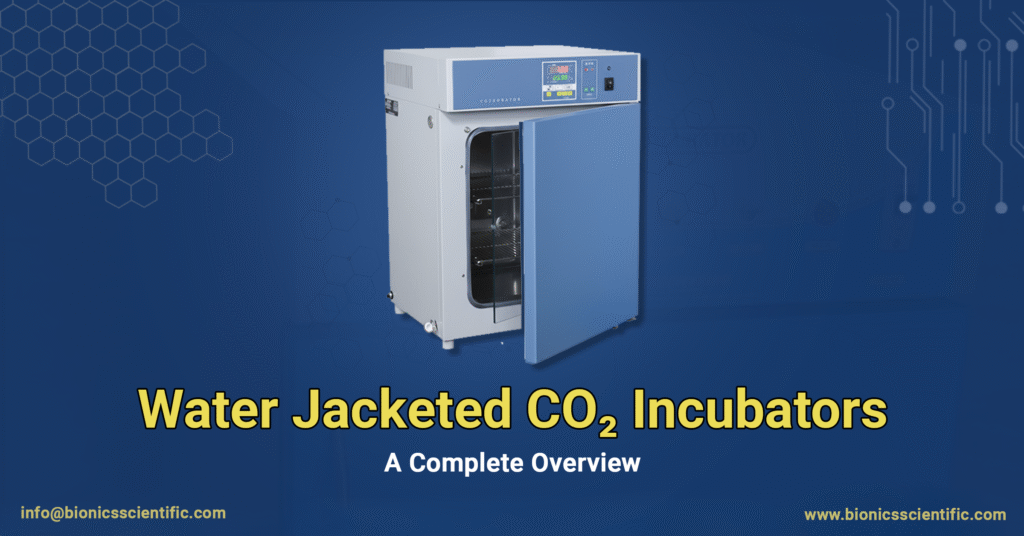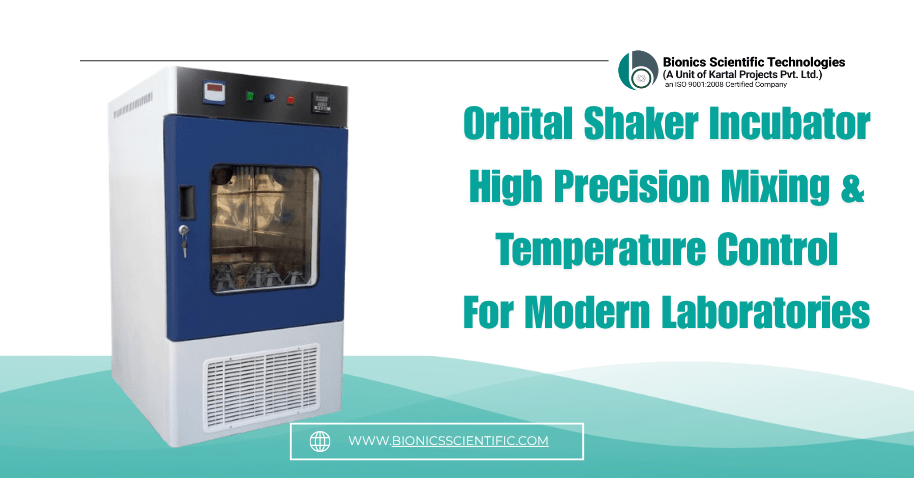
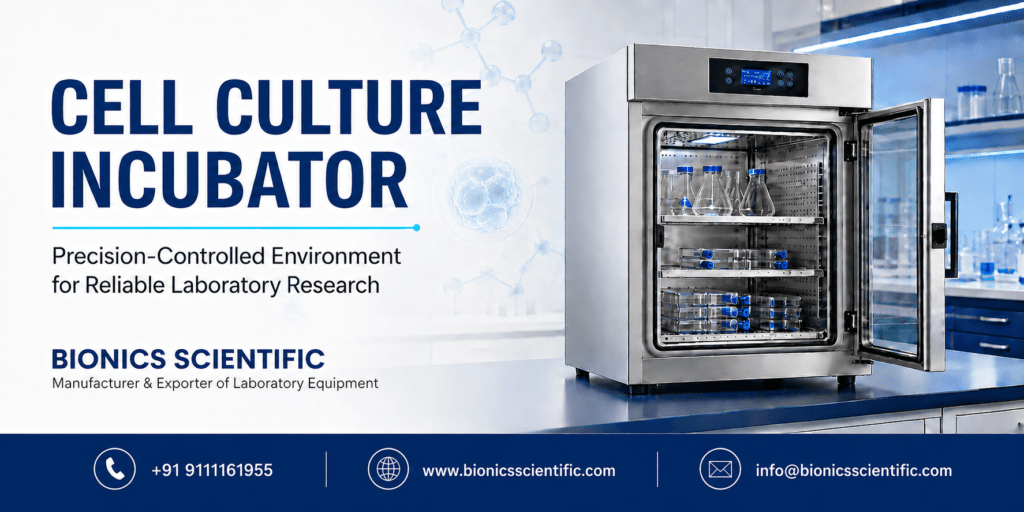
A cell culture incubator is a laboratory instrument designed to maintain controlled environmental conditions for growing and maintaining cell cultures. Depending on the model and application, it can regulate parameters such as temperature and, in specialized systems, CO₂ and humidity. Laboratories in the UAE, Saudi Arabia, Qatar, Oman, Kuwait, and Bahrain are increasingly sourcing this equipment from India, where manufacturing capacity for lab instruments has grown steadily and suppliers are used to handling the documentation and logistics that cross-border orders require.
Table of Contents
- What Is a Cell Culture Incubator?
- How Does a Cell Culture Incubator Work?
- Important Features
- Key Specifications
- Temperature Control
- Applications
- Cell Culture vs CO₂ Incubator
- How to Choose a Cell Culture Incubator
- Considerations for Middle Eastern Laboratories
- Quotation Requirements
- FAQs
- Contact Bionics Scientific
Quick Answer
Cell culture incubators provide stable conditions that help cells grow and remain viable during laboratory research. The required conditions depend on the cell line, culture protocol and incubator type.
What Is a Cell Culture Incubator?
A cell culture incubator is a laboratory instrument built to hold a controlled, stable internal environment for growing and maintaining cell cultures, tissue samples, or microbial cultures. It isn’t a general storage cabinet—it’s engineered specifically to keep temperature (and, on some models, other conditions) steady enough for repeatable results. Construction and capability vary by manufacturer.
How Does a Cell Culture Incubator Work?
The basic mechanism is straightforward. A heating element, tied to a controller and internal sensors, keeps chamber temperature near the target value—sensors read conditions, and the controller adjusts output accordingly.
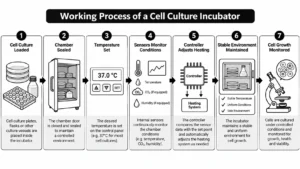
Where fitted, air circulation spreads that heat evenly so one shelf doesn’t run warmer than another. Insulated walls slow heat loss and help the chamber recover quickly after a door opens and closes. Many units also carry a display or alarm that flags anything drifting out of range. None of this is universal, though — features differ from model to model, so it’s worth confirming what a given unit actually includes.
Cell Culture Incubator vs CO₂ Incubator
| Feature | Standard Cell Culture Incubator | CO₂ Incubator |
| Temperature control | Yes | Yes |
| CO₂ control | Not necessarily | Yes |
| Humidity control | Model-dependent | Often available |
| Typical use | Applications requiring controlled temperature | Cell cultures requiring controlled CO₂ conditions |
| Selection | Based on protocol | Based on cell-line requirements |
Important Features to Consider
A few things tend to separate a good fit from a poor one:
- Temperature range and how tightly it’s controlled
- Uniformity across the chamber, not just at the sensor
- Internal capacity relative to actual sample load
- What the inner chamber is made of
- Shelving — how many, and whether they adjust
- The type of controller and display fitted
- Alarms and safety cut-outs
- How easily the interior can be cleaned
- Data logging, if the model supports it
- Whether local voltage and frequency are compatible
No single model ticks every box here. A datasheet from the manufacturer settles most of these questions quickly.
Specification Parameters to Confirm
These figures shift between models, so treat any number below as something to verify, not assume.
| Parameter | What to Confirm |
| Chamber capacity | Volume against expected sample load |
| Temperature accuracy | Deviation from set point in operation |
| Controller type | Digital or microprocessor-based |
| Inner chamber material | Interior surface finish |
| Shelving | Count and adjustability |
| Safety features | Over-temperature and fault alarms |
| Power requirements | Voltage, frequency, consumption |
| Dimensions and weight | External and internal measurements |
Temperature Range and Control
Temperature performance is one of the most important specifications to evaluate because stable conditions are essential for many cell-culture protocols. Ask the manufacturer to walk through the following for the exact model being considered.
| Temperature Parameter | Why It Matters |
| Operating range (min/max) | Whether the unit suits the culture protocol |
| Set-point accuracy | How closely it holds the target reading |
| Uniformity across the chamber | Consistency between shelves and zones |
| Recovery after a door opens | Practical impact during routine handling |
| Sensor type and placement | Reliability of the measurement itself |
| Behaviour in warmer ambient conditions | Relevant for installation in hotter climates |
Request these in writing. A brochure line rarely tells the full story.
Applications in Research and Industry
Biotechnology labs use temperature-controlled incubators for day-to-day cell maintenance. Pharmaceutical research relies on them during formulation and testing, microbiology labs run culture growth studies in them, and universities lean on the same equipment for teaching. Hospitals and clinical research units sometimes fold incubators into diagnostic work, and food or environmental testing labs use them for sample analysis. One model rarely fits every use equally well, so match the spec sheet to the actual protocol, not just the category.
Choosing a Cell Culture Incubator for Middle Eastern Laboratories
Gulf climates run hot, and that puts real strain on an incubator’s cooling and insulation system compared with cooler regions. It’s worth raising this directly with the manufacturer—ask how the unit performs once installed in a warmer ambient environment, not just under controlled test conditions.
Power compatibility comes next: voltage, frequency, and plug type should all match local standards before an order is placed. Capacity should reflect real sample volume, not a rough guess. And it pays to ask early about export packaging, how spare parts are handled, and who to contact for technical questions once the unit is running.
Why Buyers Consider Bionics Scientific
Bionics Scientific manufactures in India and works with laboratories, distributors, and procurement teams across Middle Eastern markets as a cell culture incubator supplier in Middle East territory. In practical terms, the company’s role is walking buyers through configuration choices, providing documentation, and coordinating the export side of an order.
For buyers weighing Bionics Scientific as a cell culture incubator exporter to Middle East destinations, the sensible next step is a datasheet request and a direct conversation about the specific model—not a decision made from a product photo alone.
Certifications & Quality Compliance
| Standard | Cert. No. | Scope | Valid Until |
| ISO 9001:2015 (QMS) | 184876 | Lab, scientific & cleanroom equipment mfg. | 30-03-2029 |
| CE (MDD 93/42/EEC) | 184877 | Products as per annexure | 30-03-2029 |
| GMP | 184878 | Includes fume hood and a biosafety cabinet. | 30-03-2029 |
| NSF/ANSI 61 | 183884 | Bio-safety cabinet, lab & scientific equipment | 08-03-2027 |
Information to Share When Requesting a Quotation
A quotation is only as useful as the information behind it:
- What the incubator will actually be used for
- Required chamber capacity
- Target operating temperature
- Accuracy or uniformity tolerances needed
- Roughly how many samples at once
- Preferred chamber material
- Destination country and city
- Local power supply details
- Any certificates or documents required
- Delivery timeline expectations
Frequently Asked Questions
What is a cell culture incubator?
It’s a laboratory instrument that holds a stable, controlled environment for growing cell, tissue, or microbial cultures. The chamber stays consistent enough for repeatable results, though exact capability depends on the model.
What is a cell culture incubator used for?
Mainly for maintaining and growing cell lines, tissue samples, and microbial cultures under steady conditions. It shows up across biotechnology, pharmaceutical research, microbiology, and academic settings, depending on the lab’s needs.
How do I select the correct chamber capacity?
Start with the current sample volume, then add room for growth. Shelving layout and bench space matter too — check both before locking in a model with the supplier.
Is a standard cell culture incubator the same as a CO₂ incubator?
Not automatically. A CO₂ incubator regulates carbon dioxide alongside temperature, which some protocols specifically require. According to the ATCC Animal Cell Culture Guide, the conditions for incubating should be based on the needs of that particular cell line.
What temperature-control specifications should I check?
Operating range, accuracy of the set-point, chamber uniformity, and recovery time after door opening. Get a proof of performance from the manufacturer instead of believing marketing materials.
How should the chamber be cleaned and maintained?
It depends on the material of the inner surface and the manufacturer’s recommendations, but cleaning the surfaces and shelves on a regular basis is common practice. Following the manufacturer’s cleaning and maintenance recommendations can help support reliable performance over time.
Does Bionics Scientific deliver products to Middle East buyers?
Yes. Bionics Scientific supplies cell culture incubators to buyers in the Middle East. Availability, configuration, documentation and delivery requirements can be discussed based on the destination and application.
What information is needed for an accurate quotation?
Application of the product, capacity, temperature range, sample volume, preferred material, destination details, power specifications, and documentation. This set of data allows choosing the optimal product configuration.
What should buyers in the UAE and Saudi Arabia check before purchasing?
Compatibility with voltage and frequency, installation conditions, chamber capacity, and documentation for customs clearance.
How can buyers contact Bionics Scientific?
Directly, buyers, labs, and distributors can request a technical datasheet, talk through configuration options, and get a commercial quotation.
Getting in Touch
Getting this right means matching real lab conditions to actual specifications and working with a supplier who answers clearly. Laboratories, hospitals, universities, biotechnology companies, and distributors across the UAE, Saudi Arabia, Qatar, Oman, Kuwait, and Bahrain are welcome to contact Bionics Scientific for model recommendations, specifications, configuration guidance, export information, and a quotation.