Quick Response
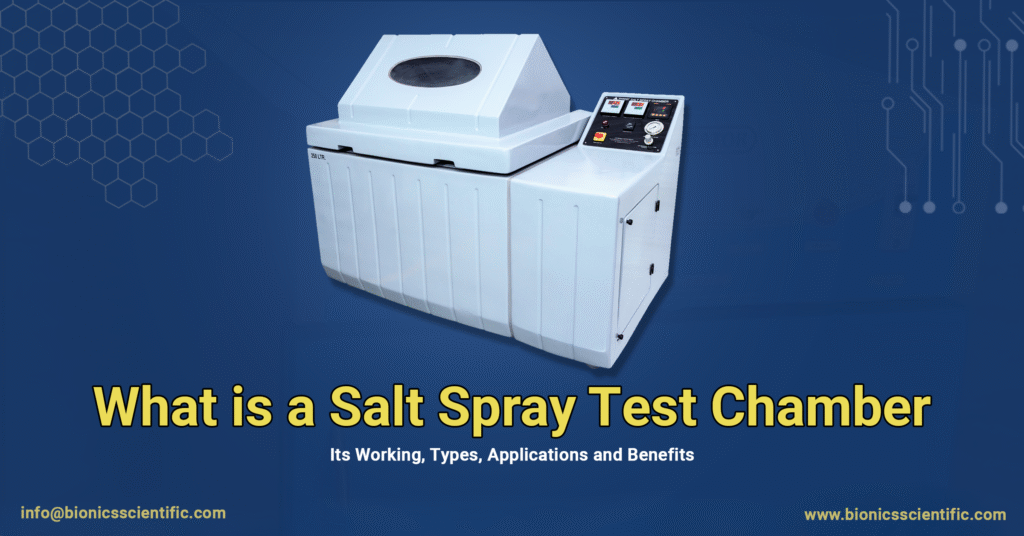
The salt spray testing chamber is an apparatus where the metallic products and coatings are exposed to a controlled environment of sodium chloride vapor. This testing chamber is used to quickly analyze the rusting properties of the metals rather than conducting the same process naturally. The industries of automobile manufacturing, coating, plating, and electronics utilize this testing equipment.
Introduction
On paper, the deal looks like a straightforward purchase. In practice, a salt spray test chamber is used for accelerated corrosion testing of metals, coatings, and plated components. This guide explains how it works, which test methods it supports, how to choose the right capacity, installation requirements, and what affects its price. Buyers who choose based on volume or cost without checking usable loading space or supported test modes often end up with equipment that can’t run their required procedure. Bionics Scientific works through this from the application outward, helping buyers make sense of specifications, plan installation, and put together a fitting quotation request.
Salt Spray Test Chamber at a Glance
- Used for accelerated corrosion testing of metals, platings, and coatings
- Common across automotive, coating, plating, fastener, and electronics manufacturing, and testing labs
- Three main methods: neutral salt spray (NSS), acetic acid salt spray (AASS), copper-accelerated CASS
- Capacity should follow specimen size and usable loading area, not cabinet volume
- Installation needs confirmed electrical supply, water, compressed air, drainage, and ventilation
- Price varies with capacity, build quality, supported modes, accessories, and service scope
What Is a Salt Spray Test Chamber?
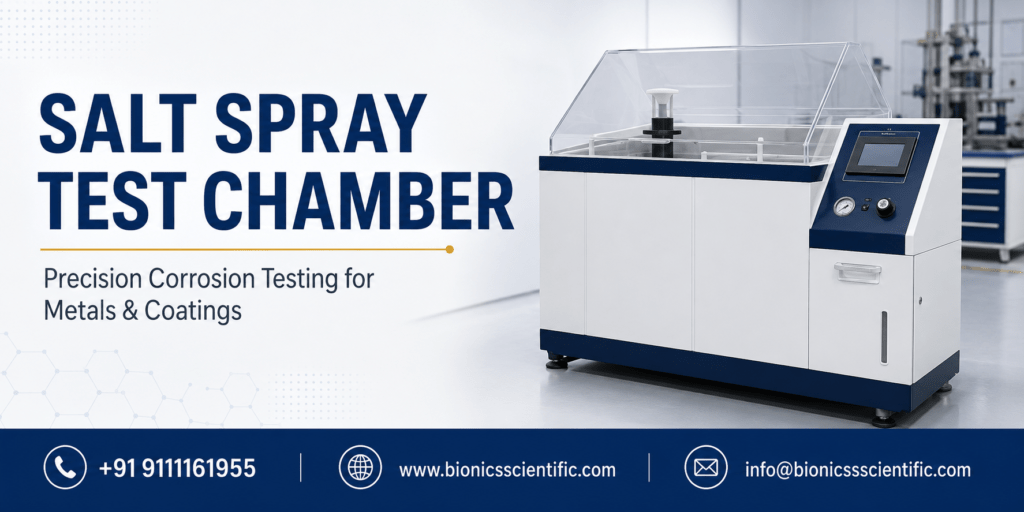
It’s a sealed, temperature-controlled cabinet that turns a sodium chloride solution into fog and circulates it around test specimens under standardized conditions. Salt spray testing is the procedure being carried out; the chamber is simply the equipment that makes it possible.
How Does It Work?
The solution is mixed at a certain concentration and pH and is aerosolized by using regulated compressed air. The chamber and saturator temperatures are maintained constant throughout the process while the samples are placed on holders tilted to ensure proper draining of fog. Collection funnels catch the fog as it falls, letting the operator measure the fallout rate and confirm conditions are within range. Repeatable results come directly from keeping fog distribution and temperature consistent from run to run.
Who Should Purchase One?
The list is longer than it might seem. Automotive manufacturers check plated and painted parts; coating and paint companies verify finish performance; electroplating and galvanizing operations confirm their process hasn’t drifted; fastener and metal-product manufacturers assess protective coatings; electronics manufacturers put enclosures and hardware through their paces; and research institutions and testing laboratories run standardized procedures for clients. What differs is the method required, so that’s worth confirming first.
What Types of Materials and Coatings Can Be Tested?
Painted panels, powder-coated specimens, electroplated specimens, galvanized specimens, anodized aluminum, fasteners, automobile parts, metal cabinets, electrical hardware, and conversion coatings can all be tested. The suitability will be determined by the product specification, specimen geometry, and test method.
What Standard Should the Buyer Require?
The vast majority of tests fall under ASTM B117 or ISO 9227:2022, depending on the customer requirement or the product specification. ASTM B117 provides specifications regarding the apparatus and methods of operation for salt spray or fog tests. ISO 9227:2022 provides the specifications of apparatus, chemicals, and procedures for NSS, AASS, and CASS—NSS is conducted in a neutral sodium chloride solution, AASS in an acidified salt solution, and CASS in an acidified solution with copper chloride solution. An apparatus meant for NSS does not necessarily accommodate AASS or CASS tests, nor should it be expected to include any cyclical, humidity, or drying stages.
NSS, AASS, and CASS Test Method Comparison
| Test Method | Test Solution | Common Application | Buyer Should Confirm |
| NSS | Neutral sodium chloride solution | Metals and protective coatings | Required NSS procedure |
| AASS | Acidified sodium chloride solution | Specified decorative and aluminium coatings | AASS compatibility |
| CASS | Acidified solution containing copper chloride | Specified decorative and aluminium coating systems | Verified CASS capability |
The required method depends on the applicable standard and product specification.
NSS, AASS, and CASS are different test procedures. A chamber configured for NSS may not automatically support AASS or CASS. Cyclic corrosion, humidity, and drying stages are separate capabilities and should be confirmed in the supplier’s written quotation.
How Should a Buyer Select Chamber Capacity?
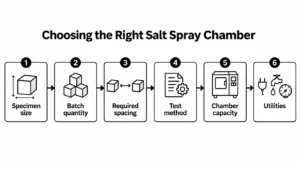
Start with the largest specimen dimensions, batch quantity, required spacing, specimen angle, holder arrangement, routine workload, and future demand. A chamber’s gross volume tells you almost nothing about how many specimens it can genuinely hold; the usable loading area is the number that matters.
Specifications to Compare
| Specification | Why It Matters | What to Confirm |
| Chamber capacity | Sets batch volume | Model-dependent |
| Working dimensions | Caps specimen size | Usable interior |
| Construction material | Resists salt exposure | Corrosion-resistant build |
| Temperature control | Affects repeatability | Accuracy vs. standard |
| Saturator control | Humidifies air | Independent control |
| Solution reservoir | Sets run length | Sizing vs. duration |
| Air-pressure regulation | Fog consistency | Regulation stability |
| Fog collection setup | Confirms fallout rate | Funnel position |
| Holder capacity/angle | Correct exposure | Adjustability |
| Supported modes (NSS/AASS/CASS) | Usable methods | Written confirmation |
| Controller/monitoring | Logged operation | Programmability |
| Water/air/electrical needs | Required for operation | Site-specific values |
| Safety protections | Protects operator | Included features |
| Accessories/documentation | Extends capability | Options available |
| Installation/training/warranty | Ownership cost | Scope in quotation |
Installation and Utility Requirements
Before the chamber arrives, check equipment dimensions, access route, floor or bench requirements, electrical supply, water, compressed-air quality, drainage, and ventilation, and settle who’s responsible for installation and operator training—against the specific model, not on assumption.
Mistakes Buyers Should Avoid
Common errors: picking a chamber on gross volume alone, comparing suppliers on price only, leaving NSS, AASS, or CASS unspecified, assuming cyclic testing is standard, overlooking holder arrangement, forgetting installation utilities, skipping documentation or warranty checks, and treating lab exposure hours as years outdoors. Each is avoidable with a little groundwork.
What Determines the Cost of a Salt Spray Test Chamber?
The cost of a salt spray test chamber depends on the size of the chamber, usable loading capacity, material, test methods supported, controls, safety features, accessories, documentation, installation, after-sales support, and freight charges.
In the case of buying salt spray test chamber manufacturers in India, the customer should consider test method compatibility, usable loading capacity, control capability, documentation, installation scope, and after-sales support and not just the price.
Confirmations Prior to Ordering
- Standard required, test method and specimen info
- Chamber capacity available and modes offered
- Control and fog collection system layout
- Utility provision and accessories supplied
- Documentation, calibration and training services
- Warranty, service and spare parts support
- Freight, installation, taxes and other exclusions
Information Needed for Quote
- Industry, application and specimen info (material, coating, size)
- Number per batch and test standard/method required
- Duration of exposure and capacity required, if known
- Electrical supply, water, air, drainage, ventilation available
- Installation city and any accessory/training requirements.
Frequently Asked Questions
What is the purpose of a salt spray test chamber?
This chamber is used for conducting accelerated corrosion tests on metals, metal plating, and metal coatings and helps in identifying coating defects and compliance with a requirement.
What is the difference between salt spray testing and a salt spray chamber?
Testing is the standardized procedure; the chamber is the equipment used to generate controlled fog and run that procedure.
Which materials and coatings can be evaluated?
Painted, powder-coated, electroplated, galvanized, and anodized components, plus fasteners, automotive parts, and electrical hardware, depending on the method used.
What is the difference between NSS, AASS, and CASS?
NSS runs on a neutral solution, AASS on an acidified salt solution, and CASS on an acidified solution with copper chloride, per ISO 9227:2022.
Does every chamber support all three methods?
Not automatically. A chamber built for NSS may not run AASS or CASS, so the mode you need must be confirmed beforehand.
How should a buyer choose the right chamber capacity?
Work from specimen size, batch quantity, spacing, and holder arrangement—gross volume alone won’t show how much usable space you’re getting.
What utilities are required for installation?
Typically electrical supply, water, compressed air, drainage, and ventilation, though exact figures vary by model and should be confirmed beforehand.
How long does a salt spray test run?
That’s set by the applicable requirement and can range from a few hours to several hundred or even thousand hours.
Can salt spray testing predict outdoor service life?
No — exposure hours don’t convert directly into years outdoors. Results are better used for defect detection and conformity checks.
What are the requirements for obtaining a salt spray test chamber quotation?
Please provide your application details, test specimen material and dimensions, coating details, number of batches, standard and test procedure to be performed, exposure time, installation location city, utility facilities, and any accessories or documentation needs.
Request a Salt Spray Test Chamber Quotation
Please contact Bionics Scientific for any queries related to the application, specimen material & dimension, coating type, number of pieces, standard required and the testing methodology, exposure period, installation site, utilities available, and accessory requirements. The company can help you select the proper chamber along with the verified specifications, types of testing supported, installation requirements, accessories, and salt spray test chamber price.