
Quick Answer: Incubation Meaning in Microbiology
Microbiology Incubation is the growth of the organism under certain environmental conditions to grow and study the organism. In this case, temperature takes precedence, but other factors such as humidity, oxygen level, and incubation time may be considered depending on the type of microorganism and experiment.
Table of Contents
- What Is Incubation in Microbiology?
- Why Is Incubation Important?
- Incubation vs Incubator
- Incubation Process
- Conditions Required for Incubation
- How Does an Incubator Work?
- Types of Incubators
- Incubator Diagram
- Factors to Consider Before Buying
- FAQs
Introduction to Microbiological Incubation
Reliable lab results start with stable conditions. Whether a lab is confirming sterility, checking water quality, or identifying a pathogen, the underlying microbial growth has to happen under carefully regulated conditions. That’s why incubation sits at the heart of laboratory workflow—and why how well an incubator functions has a direct bearing on data accuracy and regulatory compliance.
Key Elements of Microbiological Incubation
| Element | Purpose |
| Temperature | Controls the rate of microbial growth |
| Time | Determines the duration of incubation |
| Culture medium | Provides nutrients for microorganisms |
| Oxygen | Determines suitability for aerobic/anaerobic growth |
| Humidity | Helps maintain suitable environmental conditions |
| Monitoring | Confirms that required conditions remain stable |
What Is Incubation Meaning in Microbiology?
At its core, incubation is the practice of holding temperature—and often humidity and gas levels—steady enough to let microbes grow on a culture medium. Given the right conditions, bacteria, fungi, and other microorganisms multiply until they reach levels that are visible or can be analyzed biochemically.
Incubation in microbiology is the controlled growth of microorganisms under defined conditions. Temperature is usually the primary parameter, while incubation time, oxygen availability, humidity and the culture medium may also influence the process.
Examples of Incubation in Microbiology
- Bacterial culture growth
- Fungal culture
- Sterility testing
- Food microbiology testing
- Water microbiology testing
- Pharmaceutical microbiology
- Clinical sample analysis
- Research and biotechnology applications
Why Are Controlled Incubation Conditions Important?
This is because the speed of microbial growth and colony morphology directly depend on the temperature. Any variation of even a few degrees may affect the growth rate or even give false results. To be sure that the result is due to biological properties of the organism and not to your machine’s settings, you have to maintain conditions stable.
| Incubation | Incubator |
| A laboratory process | A laboratory device |
| Provides conditions for microbial growth | Creates and maintains those conditions |
| Involves time, temperature and other parameters | Uses heaters, sensors, controllers and airflow |
| Applied to cultures/samples | Used to perform controlled incubation |
Incubation Process: Key Laboratory Stages
Here is how the process of incubation is performed in the laboratory:
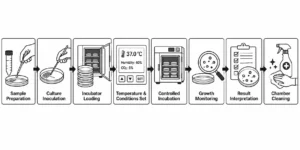
1. Culture preparation
The specimen is inoculated onto the appropriate validated culture medium.
2. Sample loading
Petri dishes, tubes or flasks are placed inside the incubator with sufficient spacing for airflow.
3. Parameter setting
The required temperature and other environmental conditions are established according to the applicable SOP.
4. Monitoring
Sensors and the digital controller continuously monitor the chamber conditions.
5. Growth evaluation
Samples are examined after the specified incubation period.
6. Result interpretation
Colony growth, morphology or other relevant observations are compared with acceptance criteria.
7. Cleaning and disinfection
The chamber is cleaned and disinfected according to laboratory procedures.
This is essentially the backbone of incubation across pharmaceutical and food-testing labs.
How Does a Microbiological Incubator Work?
- Heating system
Maintains the required chamber temperature. - Temperature sensors
Continuously measure the internal temperature. - Controller
Compares actual temperature with the set value and adjusts heating. - Insulation
Reduces heat transfer between the chamber and surrounding environment. - Air circulation
Helps maintain temperature uniformity throughout the chamber.
Incubator Function: How Controlled Microbial Growth Is Achieved
Getting a stable internal environment comes down to a handful of core components working together:
- Heating – Heating elements increase the temperature of the air in the chamber to above ambient. Sensing – RTD and thermocouple sensors provide continuous temperature data feedback to the controller.
- Control – The controller, which is a computer processor, compares the actual temperature with the desired one and controls the heaters.
- Insulation – A thick insulation barrier exists between the inner and outer walls, preventing heat loss.
- Airflow—The warmed air can be distributed evenly among all the shelves either by convection currents or forced airflow.
All these characteristics affect the ability of the incubator to maintain the desired temperature.
Incubator Diagram: Key Parts to Know
A labeled incubator diagram typically points out the outer cabinet and inner chamber walls, the insulation layer, heating elements, a temperature sensor, a digital controller and display, adjustable shelves, a circulation fan (in forced-air units), a door with a viewing window and gasket seal, and a ventilation port. Bacteriological incubator diagrams generally follow this same basic layout.
Types of Incubators You’ll Find in Microbiology Labs
- Bacteriological incubators handle standard aerobic culture work, using either natural or forced convection.
- “Bioincubator” is a broader label covering units used for bacteriological work, cell culture, or other biological applications—often built with tighter uniformity requirements.
- Anaerobic incubators maintain an oxygen-free or low-oxygen atmosphere, which is essential for anaerobes that won’t grow — or won’t even survive — in normal air.
- Incubation rooms are walk-in spaces with controlled temperature, used when sample volumes outgrow what a standard chamber can hold, relying on roomwide heating and monitoring instead.
Bacteriological, Bio and Anaerobic Incubator Comparison
| Type | Atmosphere | Typical Use | Best For |
| Bacteriological incubator | Ambient air | Routine culture | Clinical, food labs |
| Bio incubator | Ambient/regulated | Bacteriological, biological samples | Multi-application labs |
| Anaerobic incubator | Oxygen-free/reduced | Anaerobe culturing | Clinical, research |
| Incubation room | Room-controlled | Bulk incubation | High-throughput sites |
The Bottom Line on Incubation
Put simply, incubation means deliberately creating and holding the exact conditions microbes need to grow. The organism, the medium, and the method dictate what those parameters should be — and the incubator’s heating, sensing, control, and airflow systems keep them steady, generating growth data that labs can stand behind during an audit.
What to Consider Before Buying an Incubator
Choosing the right incubator isn’t a simple decision—it pays to work through a checklist before requesting quotes.
Microbiology Incubator Buying Checklist
| Parameter | What to Confirm |
| Application | Microbiology, sterility, or BOD testing |
| Temperature range | Matches the organisms and methods you’ll use |
| Uniformity/stability | Sufficient for reproducible results |
| Chamber capacity | Fits current load and room to grow |
| Airflow type | Natural or forced convection |
| Recovery after door opening | How fast it returns to set point |
| Internal construction | Corrosion-resistant, easy to clean |
| Shelf capacity | Number of shelves and their load rating |
| Controller/display | Accuracy and data-logging capability |
| Safety alarms | Over-temperature, sensor failure, door alarms |
| Calibration | Traceable certificates and a defined schedule |
| Temperature mapping | Documented uniformity studies |
| IQ/OQ documentation | Needed for regulated environments |
| Installation conditions | Space, ventilation, ambient temperature |
| Power backup | Keeps long cycles running through outages |
| Cleaning requirements | How easy it is to decontaminate |
| After-sales support | Availability of service and spares in India |
Why Incubation Temperature and Duration Aren’t Fixed
There’s no universal “correct” incubation setting. Temperature and duration depend on the organism being cultured, the medium in use, the approved SOP, and the validated test method. Rather than relying on a generic setting, buyers and lab staff should always default to their specific protocol, since these parameters shift from one testing application to the next.
FAQ
What is incubation in microbiology?
It is a process of controlling temperature and other conditions to allow microorganisms to grow on a culture media for analysis. The primary
What’s the use of an incubator?
An incubator maintains a controlled and relatively uniform temperature using heating elements, sensors, a controller and insulation.
What is an incubator diagram?
An incubator diagram is a labeled illustration showing the main components of an incubator and how they are arranged. It commonly identifies the chamber, insulation, heating element, temperature sensor, controller, shelves, door and airflow system. The exact components vary according to the incubator design.
What is the function of a bacteriological incubator?
It is used for culturing bacteria under aerobic conditions in clinical laboratories, food industry and research organizations.
What is an anaerobic incubator?
An incubator that offers an oxygen-free or low-oxygen atmosphere.
What is an incubation chamber?
A walk-in temperature-controlled space for sample volumes that are too large for a conventional incubator chamber.
The importance of uniform temperature?
Because different temperatures will cause different growth of samples placed at different levels.
Is there one single incubation temperature that is used for all tests?
No—it depends on the organism, medium, SOP, and validated method.
Need Help Selecting a Microbiology Incubator?
The Bionics Scientific Company provides incubators that match the buyer’s requirement across India. When it comes to choosing an incubator for your microbiology work, please provide us with details of your application, temperature range needed, and documentation that you need. We will be able to offer you a suitable solution and quote accordingly.